Ch. 22 - Pathogenic Fungi
Bauman - Microbiology with Diseases by Taxonomy 6th Edition
Bauman6th EditionMicrobiology with Diseases by TaxonomyISBN: 9780134832302Not the one you use?Change textbook
Chapter 22, Problem 9

Indicate whether each statement is true or false. If the statement is false, change the underlined word or phrase to make the statement true.


_____ Relapse of fungal diseases is common in AIDS patients.

Verified step by step guidance
1
Understand the context: AIDS patients have compromised immune systems, which makes them more susceptible to infections, including fungal diseases.
Recall that fungal infections can be difficult to completely eradicate in immunocompromised individuals, leading to a higher chance of relapse or recurrence.
Evaluate the statement: 'Relapse of fungal diseases is common in AIDS patients.' Given their weakened immunity, this statement is generally true.
If the statement were false, you would need to identify the incorrect term and replace it with a correct one, but in this case, the statement is accurate as is.
Conclude that the statement is true because the immunosuppression in AIDS patients predisposes them to recurrent fungal infections.

Verified video answer for a similar problem:

This video solution was recommended by our tutors as helpful for the problem above.
Video duration:
3m
Was this helpful?

Key Concepts

Here are the essential concepts you must grasp in order to answer the question correctly.

Fungal Infections in Immunocompromised Patients

Fungal infections are more frequent and severe in immunocompromised individuals, such as AIDS patients, due to their weakened immune systems. These infections can be opportunistic, taking advantage of reduced immune defenses to cause disease.
Recommended video:
Guided course
03:52
Map of Lesson on Bacteriophage Infections

Relapse of Fungal Diseases

Relapse refers to the return of an infection after a period of improvement or apparent cure. In fungal diseases, relapse can occur if the infection is not fully eradicated or if the immune system remains compromised, making management challenging.
Recommended video:
Guided course
04:57
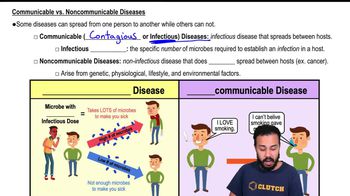
Communicable vs. Noncommunicable Diseases

Impact of AIDS on Immune Function

AIDS, caused by HIV, leads to a progressive decline in CD4+ T cells, impairing the body's ability to fight infections. This immunodeficiency increases susceptibility to opportunistic infections, including fungal diseases, and contributes to higher relapse rates.
Recommended video:
Guided course
06:04
Functional Groups