Ch. 22 - Pathogenic Fungi
Bauman - Microbiology with Diseases by Taxonomy 6th Edition
Bauman6th EditionMicrobiology with Diseases by TaxonomyISBN: 9780134832302Not the one you use?Change textbook
Chapter 22, Problem 8

Indicate whether each statement is true or false. If the statement is false, change the underlined word or phrase to make the statement true.


_____ Candida albicans generally causes localized opportunistic infections but can become systemic, particularly in the immunocompetent.

Verified step by step guidance
1
Step 1: Understand the organism mentioned, Candida albicans, which is a type of yeast commonly found as part of the normal flora in humans but can cause infections under certain conditions.
Step 2: Recognize the term 'opportunistic infections,' which means infections that occur more frequently or are more severe in individuals with weakened immune systems.
Step 3: Analyze the statement that Candida albicans causes localized opportunistic infections but can become systemic, particularly in the immunocompetent. Recall that systemic infections usually occur in immunocompromised, not immunocompetent, individuals.
Step 4: Determine that the phrase 'immunocompetent' is incorrect in this context and should be replaced with 'immunocompromised' to make the statement true.
Step 5: Conclude that the corrected statement should read: 'Candida albicans generally causes localized opportunistic infections but can become systemic, particularly in the immunocompromised.'

Verified video answer for a similar problem:

This video solution was recommended by our tutors as helpful for the problem above.
Video duration:
3m
Was this helpful?

Key Concepts

Here are the essential concepts you must grasp in order to answer the question correctly.

Candida albicans as an Opportunistic Pathogen

Candida albicans is a fungal organism commonly found as part of the normal human microbiota. It usually causes localized infections, such as oral thrush or vaginal candidiasis, especially when the host's immune defenses are weakened or disrupted.
Recommended video:
Guided course
03:40
Introduction to Pathogenic Toxins

Systemic Candidiasis and Host Immune Status

Systemic infections by Candida albicans occur when the fungus enters the bloodstream and spreads throughout the body. These severe infections primarily affect immunocompromised individuals, such as those with HIV/AIDS, cancer, or undergoing immunosuppressive therapy, rather than immunocompetent hosts.
Recommended video:
Guided course
03:21
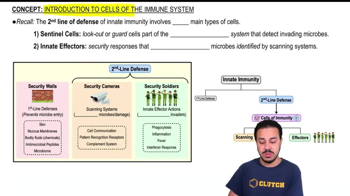
Introduction to Cells of the Immune System

Definition of Immunocompetent vs. Immunocompromised

An immunocompetent individual has a fully functioning immune system capable of fighting infections effectively. In contrast, immunocompromised individuals have weakened immune defenses, making them more susceptible to opportunistic infections like systemic candidiasis.
Recommended video:
Guided course
05:56
Needham vs. Spallanzani