Skip to main content
Macroeconomics
My Course
Learn
Exam Prep
AI Tutor
Study Guides
Flashcards
Explore
Try the app
My Course
Learn
Exam Prep
AI Tutor
Study Guides
Flashcards
Explore
Try the app
Back
Total Revenue Along a Linear Demand Curve quiz
You can tap to flip the card.
What is the main difference between slope and elasticity on a demand curve?
You can tap to flip the card.
👆
What is the main difference between slope and elasticity on a demand curve?
Slope is the ratio of unit changes between two variables, while elasticity is the ratio of percentage changes.
Track progress
Control buttons has been changed to "navigation" mode.
1/15
Related flashcards
Related practice
Recommended videos
Total Revenue Along a Linear Demand Curve definitions
Total Revenue Along a Linear Demand Curve
13 Terms
Total Revenue Along a Linear Demand Curve
4. Elasticity
10 problems
Topic
Income Elasticity of Demand
4. Elasticity
9 problems
Topic
4. Elasticity - Part 1 of 2
10 topics
15 problems
Chapter
4. Elasticity - Part 2 of 2
1 topic
3 problems
Chapter
Guided course
07:13
Total Revenue Along a Linear Demand Curve
9
views
Terms in this set (15)
Hide definitions
What is the main difference between slope and elasticity on a demand curve?
Slope is the ratio of unit changes between two variables, while elasticity is the ratio of percentage changes.
How does the percentage change in price differ when increasing from \$1 to \$2 versus \$2 to \$3?
From \$1 to \$2, the percentage change is 100%, but from \$2 to \$3, it is only 50%.
On a linear demand curve, where is the unit elastic point typically found?
The unit elastic point is found at the midpoint of the demand curve.
What happens to total revenue as price decreases along the elastic section of a linear demand curve?
Total revenue increases as price decreases in the elastic section.
What happens to total revenue as price decreases past the unit elastic point?
Total revenue begins to decrease as price decreases past the unit elastic point.
How do unit changes and percentage changes behave along a linear demand curve?
Unit changes remain constant, but percentage changes decrease as you move along the curve.
Which section of a linear demand curve is considered elastic?
The section to the left of the midpoint is elastic.
Which section of a linear demand curve is considered inelastic?
The section to the right of the midpoint is inelastic.
At what point on a linear demand curve is total revenue maximized?
Total revenue is maximized at the unit elastic point, which is the midpoint.
How do you calculate total revenue from a demand schedule?
Total revenue is calculated by multiplying price by quantity demanded.
Why does total revenue increase in the elastic section of the demand curve?
Because the percentage increase in quantity demanded is greater than the percentage decrease in price.
Why does total revenue decrease in the inelastic section of the demand curve?
Because the percentage decrease in price is greater than the percentage increase in quantity demanded.
What is the value of elasticity at the midpoint of a linear demand curve?
Elasticity is exactly one (unit elastic) at the midpoint.
If the price falls and total revenue rises, what can you say about the elasticity of demand?
Demand is elastic in that range.
If the price falls and total revenue falls, what can you say about the elasticity of demand?
Demand is inelastic in that range.
 BackBack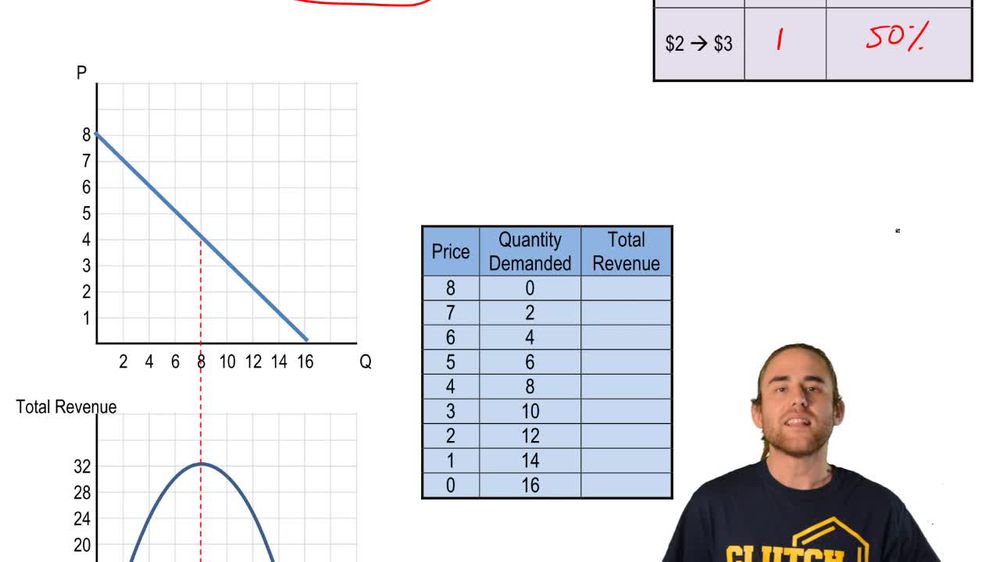
 07:13
07:13