Skip to main content
Macroeconomics
My Course
Learn
Exam Prep
AI Tutor
Study Guides
Flashcards
Explore
Try the app
My Course
Learn
Exam Prep
AI Tutor
Study Guides
Flashcards
Explore
Try the app
Back
Time Value of Money Calculations quiz
You can tap to flip the card.
Why is money considered more valuable today than in the future?
You can tap to flip the card.
👆
Why is money considered more valuable today than in the future?
Because you can invest money today and earn interest, making it worth more in the future.
Track progress
Control buttons has been changed to "navigation" mode.
1/15
Related flashcards
Related practice
Recommended videos
Time Value of Money Calculations definitions
Time Value of Money Calculations
13 Terms
Time Value of Money Calculations
13. The Financial System
9 problems
Topic
Calculating Bond and Stock Prices
13. The Financial System
5 problems
Topic
14. The Financial System - Part 1 of 2
8 topics
15 problems
Chapter
13. The Financial System - Part 2 of 2
1 topic
3 problems
Chapter
Guided course
06:28
Time Value of Money Calculations
3
views
Terms in this set (15)
Hide definitions
Why is money considered more valuable today than in the future?
Because you can invest money today and earn interest, making it worth more in the future.
What are the two main concepts related to the time value of money?
The two main concepts are compounding and discounting.
What does compounding mean in the context of the time value of money?
Compounding means earning interest on both the initial principal and the accumulated interest over time.
What is discounting in time value of money calculations?
Discounting is determining the present value of money to be received in the future by removing interest.
What is the fundamental equation for the time value of money?
The equation is FV = PV * (1 + r)^n.
In the equation FV = PV * (1 + r)^n, what does FV stand for?
FV stands for future value, which is the amount of money at a future date.
What does PV represent in the time value of money equation?
PV represents present value, or the amount of money today.
How is the interest rate represented in the time value of money formula?
The interest rate is represented by 'r' and is expressed as a decimal.
What does 'n' represent in the formula FV = PV * (1 + r)^n?
'n' is the number of periods, usually years, over which the money is invested or discounted.
If you invest \$100 at 10% interest for 3 years, which concept are you applying?
You are applying compounding, as you are calculating the future value of present money.
What tool is helpful for visualizing cash flows in time value of money problems?
A timeline is helpful for visualizing cash flows over different periods.
When using the time value of money equation, what must be provided in the problem?
The interest rate (r) and the number of periods (n) must be given.
How do you express a 10% interest rate in the time value of money formula?
You express it as 0.10 in the formula.
Which process involves finding out what a present amount of money will be worth in the future?
This process is called compounding.
If you want to know the value today of \$1,000 to be received in 5 years, which process do you use?
You use discounting to find its present value.
 BackBack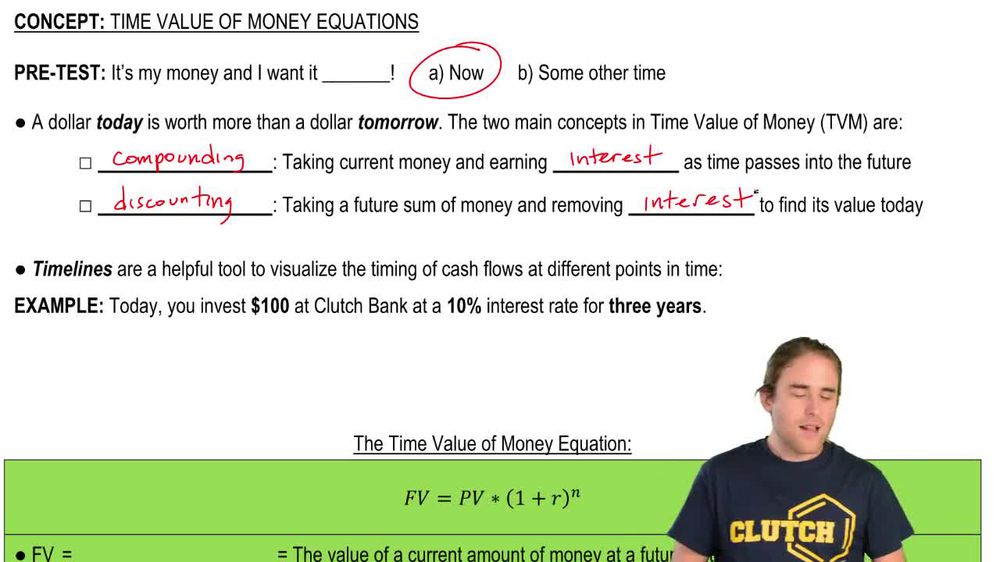
 06:28
06:28