Skip to main content
Macroeconomics
My Course
Learn
Exam Prep
AI Tutor
Study Guides
Flashcards
Explore
Try the app
My Course
Learn
Exam Prep
AI Tutor
Study Guides
Flashcards
Explore
Try the app
Back
Time Value of Money Calculations definitions
You can tap to flip the card.
Time Value of Money
You can tap to flip the card.
👆
Time Value of Money
A principle stating that a sum is more valuable today than the same sum in the future due to its earning potential.
Track progress
Control buttons has been changed to "navigation" mode.
1/13
Related flashcards
Related practice
Recommended videos
Time Value of Money Calculations quiz
Time Value of Money Calculations
15 Terms
Time Value of Money Calculations
13. The Financial System
9 problems
Topic
Calculating Bond and Stock Prices
13. The Financial System
5 problems
Topic
14. The Financial System - Part 1 of 2
8 topics
15 problems
Chapter
13. The Financial System - Part 2 of 2
1 topic
3 problems
Chapter
Guided course
06:28
Time Value of Money Calculations
3
views
Terms in this set (13)
Hide definitions
Time Value of Money
A principle stating that a sum is more valuable today than the same sum in the future due to its earning potential.
Compounding
A process where interest is earned on both the initial amount and previously accumulated interest over time.
Discounting
A method for determining the current worth of a sum to be received in the future by removing interest.
Interest
An amount earned or paid for the use of money, typically expressed as a percentage of the principal.
Future Value
An amount that a present sum will grow to after earning interest over a specified period.
Present Value
The current worth of a future sum, calculated by removing interest that would be earned over time.
Interest Rate
A percentage used to calculate how much interest is earned or paid over a period, often expressed as a decimal.
Timeline
A visual tool used to map out cash flows and periods, aiding in understanding money's movement over time.
Cash Flow
An amount of money invested or received at specific points in time, shown on a timeline.
Number of Periods
A count of time intervals, such as years or months, over which money is invested or discounted.
Compound Interest
Interest calculated on both the original principal and accumulated interest from previous periods.
Market Interest Rate
A rate available in the financial market, used to determine how much interest can be earned or paid.
Fundamental Equation
A formula, FV = PV × (1 + r)^n, used to calculate how much a present sum will be worth in the future.
 BackBack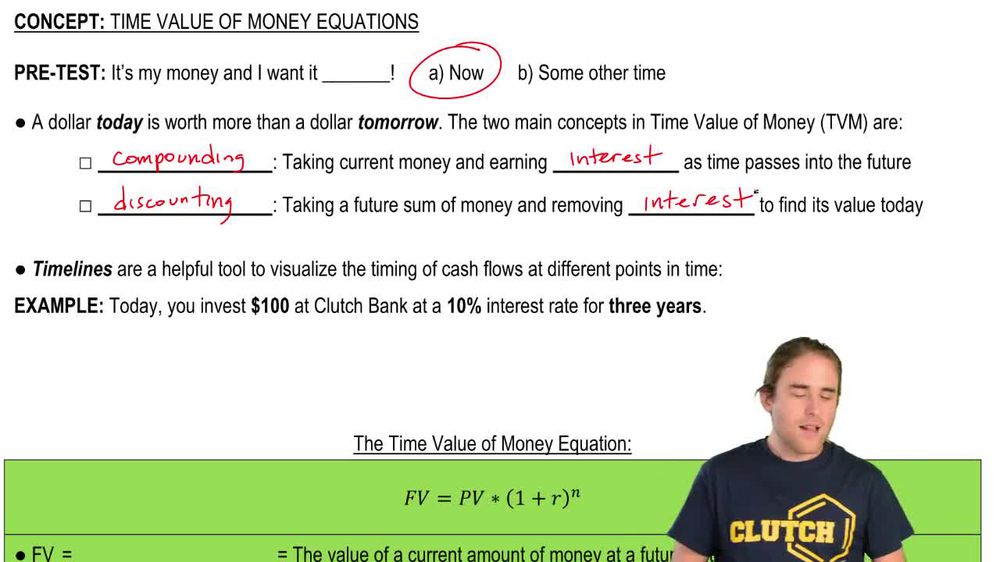
 06:28
06:28