Skip to main content
Macroeconomics
My Course
Learn
Exam Prep
AI Tutor
Study Guides
Flashcards
Explore
Try the app
My Course
Learn
Exam Prep
AI Tutor
Study Guides
Flashcards
Explore
Try the app
Back
The Money Supply on the Graph quiz
You can tap to flip the card.
What does the vertical money supply curve on the graph indicate?
You can tap to flip the card.
👆
What does the vertical money supply curve on the graph indicate?
It indicates that the money supply is fixed by the Federal Reserve and does not change with the interest rate.
Track progress
Control buttons has been changed to "navigation" mode.
1/15
Related flashcards
Related practice
Recommended videos
The Money Supply on the Graph definitions
The Money Supply on the Graph
14 Terms
The Money Supply on the Graph
18. Monetary Policy
10 problems
Topic
Monetary Policy and Aggregate Demand
18. Monetary Policy
10 problems
Topic
19. Monetary Policy
8 topics
14 problems
Chapter
Guided course
11:53
Money Supply and Equilibrium in Money Market
6
views
Terms in this set (15)
Hide definitions
What does the vertical money supply curve on the graph indicate?
It indicates that the money supply is fixed by the Federal Reserve and does not change with the interest rate.
Who controls the supply of money in the economy?
The Federal Reserve (Fed) controls the supply of money in the economy.
What components make up M1 in the money supply?
M1 includes currency in circulation and checking account deposits.
How does the Fed increase the money supply using open market operations?
The Fed increases the money supply by purchasing Treasury securities (T-bills), which puts more money into the hands of the public.
What happens to the money supply when the Fed sells T-bills?
When the Fed sells T-bills, money is taken from the public and the money supply decreases.
What does a rightward shift of the money supply curve represent?
A rightward shift represents an increase in the money supply, usually due to the Fed purchasing T-bills.
What does a leftward shift of the money supply curve represent?
A leftward shift represents a decrease in the money supply, usually due to the Fed selling T-bills.
What determines the equilibrium interest rate in the money market?
The intersection of the money supply and money demand curves determines the equilibrium interest rate.
Why is the money supply curve vertical instead of upward sloping?
It is vertical because the Fed sets the money supply at a fixed level, regardless of the interest rate.
What is the 'price' of money in the money market model?
The 'price' of money is the interest rate.
How does an increase in the money supply affect the equilibrium interest rate?
An increase in the money supply shifts the supply curve right, leading to a lower equilibrium interest rate.
Why might the Fed want to lower the interest rate during a recession?
Lowering the interest rate makes loans cheaper, encouraging investment and stimulating economic activity.
What is meant by 'open market operations'?
Open market operations refer to the Fed's buying and selling of Treasury securities to adjust the money supply.
Who is considered 'the public' in the context of the money supply?
'The public' includes banks and individuals who hold money in circulation or in checking accounts.
What happens to the quantity of money available to the public when the Fed purchases T-bills?
The quantity of money available to the public increases when the Fed purchases T-bills.
 BackBack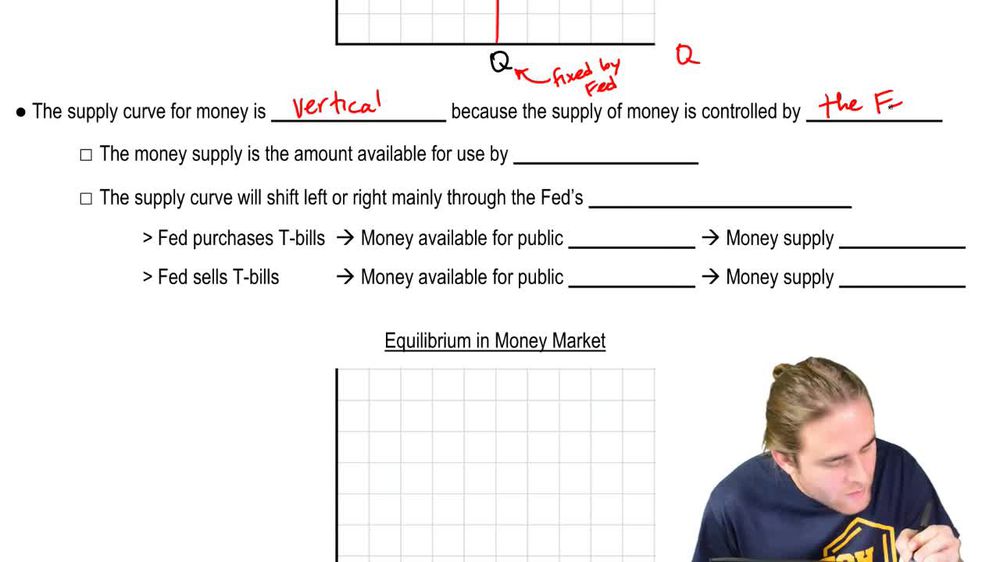
 11:53
11:53