Skip to main content
Macroeconomics
My Course
Learn
Exam Prep
AI Tutor
Study Guides
Flashcards
Explore
Try the app
My Course
Learn
Exam Prep
AI Tutor
Study Guides
Flashcards
Explore
Try the app
Back
The Money Supply on the Graph definitions
You can tap to flip the card.
Money Supply Curve
You can tap to flip the card.
👆
Money Supply Curve
A vertical line on the money market graph representing a fixed quantity of money set by the central bank, regardless of interest rate.
Track progress
Control buttons has been changed to "navigation" mode.
1/14
Related flashcards
Related practice
Recommended videos
The Money Supply on the Graph quiz
The Money Supply on the Graph
15 Terms
The Money Supply on the Graph
18. Monetary Policy
10 problems
Topic
Monetary Policy and Aggregate Demand
18. Monetary Policy
10 problems
Topic
19. Monetary Policy
8 topics
14 problems
Chapter
Guided course
11:53
Money Supply and Equilibrium in Money Market
6
views
Terms in this set (14)
Hide definitions
Money Supply Curve
A vertical line on the money market graph representing a fixed quantity of money set by the central bank, regardless of interest rate.
Federal Reserve
The central authority responsible for determining the total amount of money available to the public through policy actions.
M1
A measure including currency in circulation and checking account deposits, representing the most liquid forms of money.
Currency in Circulation
Physical cash held by the public, not including reserves held by the central bank or in vaults.
Checking Account Deposits
Funds in bank accounts that can be accessed on demand and are included in the most liquid money measures.
Open Market Operations
Central bank activities involving the buying or selling of government securities to adjust the amount of money in the economy.
Treasury Securities
Government-issued debt instruments, such as T-bills, used in monetary policy to influence the money supply.
T-bills
Short-term government securities traded by the central bank to manage liquidity and interest rates.
Equilibrium Interest Rate
The rate at which the quantity of money demanded equals the quantity supplied in the money market.
Money Demand Curve
A downward-sloping line showing the relationship between the interest rate and the quantity of money people want to hold.
Quantity of Money
The total amount of funds available for use by the public, determined by central bank policy.
Interest Rate
The cost of borrowing money, serving as the 'price' in the money market and influenced by monetary policy.
Liquidity Preference
A theory explaining how the supply and demand for money interact to determine the equilibrium interest rate.
Monetary Policy
Central bank strategies, mainly involving open market operations, aimed at influencing economic activity through money supply adjustments.
 BackBack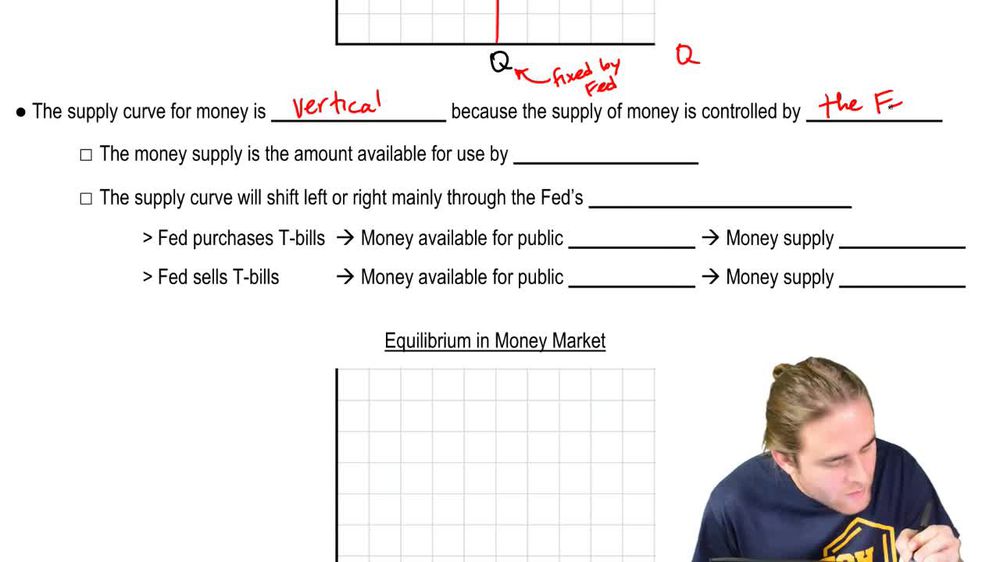
 11:53
11:53