Skip to main content
Macroeconomics
My Course
Learn
Exam Prep
AI Tutor
Study Guides
Flashcards
Explore
Try the app
My Course
Learn
Exam Prep
AI Tutor
Study Guides
Flashcards
Explore
Try the app
Back
The Free Rider Problem and the Tragedy of the Commons quiz
You can tap to flip the card.
What are the two main characteristics of public goods?
You can tap to flip the card.
👆
What are the two main characteristics of public goods?
Public goods are non-rival and non-excludable.
Track progress
Control buttons has been changed to "navigation" mode.
1/15
Related flashcards
Related practice
Recommended videos
The Free Rider Problem and the Tragedy of the Commons definitions
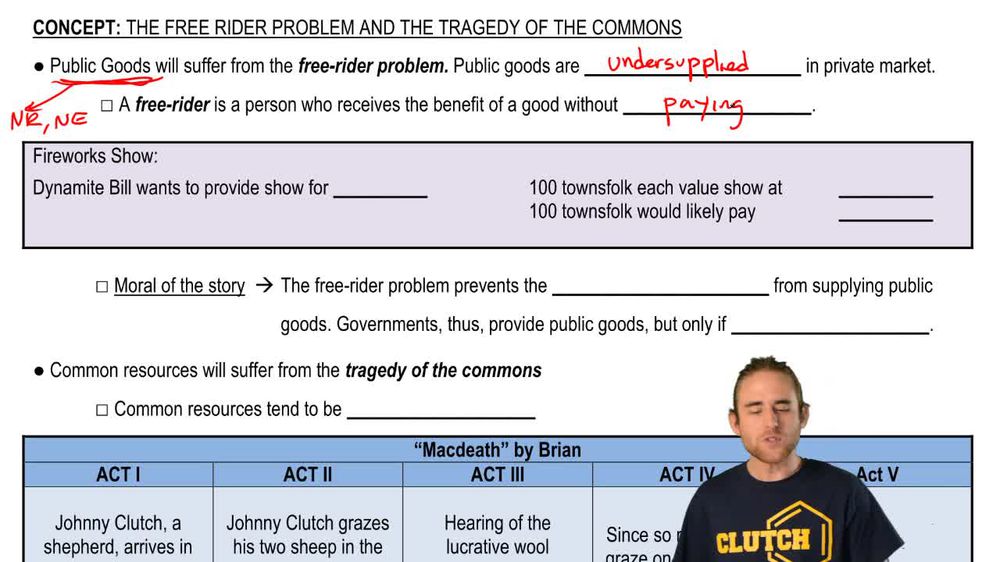
The Free Rider Problem and the Tragedy of the Commons
15 Terms
The Free Rider Problem and the Tragedy of the Commons
8. The Types of Goods
10 problems
Topic
Public Goods: Demand Curve and Optimal Quantity
8. The Types of Goods
10 problems
Topic
8. The Types of Goods
3 topics
15 problems
Chapter
Guided course
07:34
Tragedy of the Commons
6
views
Guided course
06:11
Free Rider Problem
9
views
Terms in this set (15)
Hide definitions
What are the two main characteristics of public goods?
Public goods are non-rival and non-excludable.
What is the free rider problem?
The free rider problem occurs when individuals benefit from a good without paying for it.
Why are public goods typically under-supplied in a private market?
They are under-supplied because people can benefit without paying, so private suppliers cannot cover their costs.
Give an example of a public good discussed in the lesson.
A fireworks show is an example of a public good.
How can the government solve the free rider problem for public goods?
The government can tax residents and use the funds to provide the public good.
What condition must be met for the government to provide a public good?
The marginal benefit of the good must be greater than or equal to its marginal cost.
What are common resources, and how do they differ from public goods?
Common resources are rival and non-excludable, while public goods are non-rival and non-excludable.
What is the tragedy of the commons?
The tragedy of the commons is the overuse and depletion of a common resource because individuals act in their own self-interest.
What example was used to illustrate the tragedy of the commons?
The example of grazing land being overused by too many sheep was used.
Why do common resources tend to be overused?
They are overused because no one can be excluded from using them, and each person has an incentive to use as much as possible.
How can clearly defined property rights help prevent the tragedy of the commons?
Clearly defined property rights align individual incentives with societal costs, encouraging sustainable use.
What is an externality in the context of common resources?
An externality is a cost imposed on society by individual actions that is not reflected in private decision-making.
How does the market equilibrium for common resources differ from the efficient equilibrium?
The market equilibrium results in overuse, while the efficient equilibrium would have less use if all social costs were considered.
What happens to the supply curve when external costs are considered for common resources?
The marginal social cost curve shifts to the left of the private cost curve, indicating higher total costs.
What is the main takeaway about government involvement with public goods and common resources?
Governments often provide public goods and regulate common resources to correct market failures caused by free riders and overuse.
 BackBack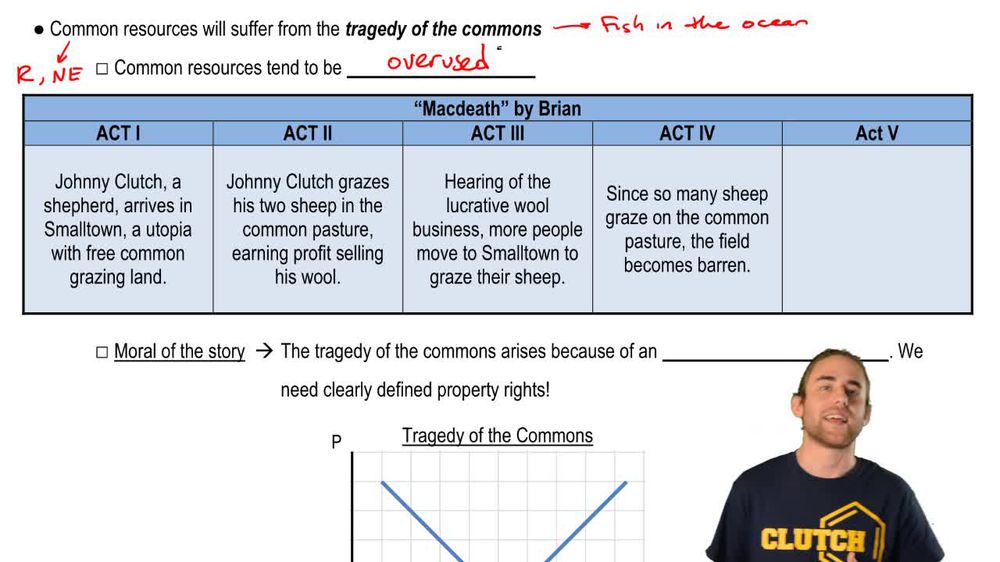
 07:34
07:34