Skip to main content
Macroeconomics
My Course
Learn
Exam Prep
AI Tutor
Study Guides
Flashcards
Explore
Try the app
My Course
Learn
Exam Prep
AI Tutor
Study Guides
Flashcards
Explore
Try the app
Back
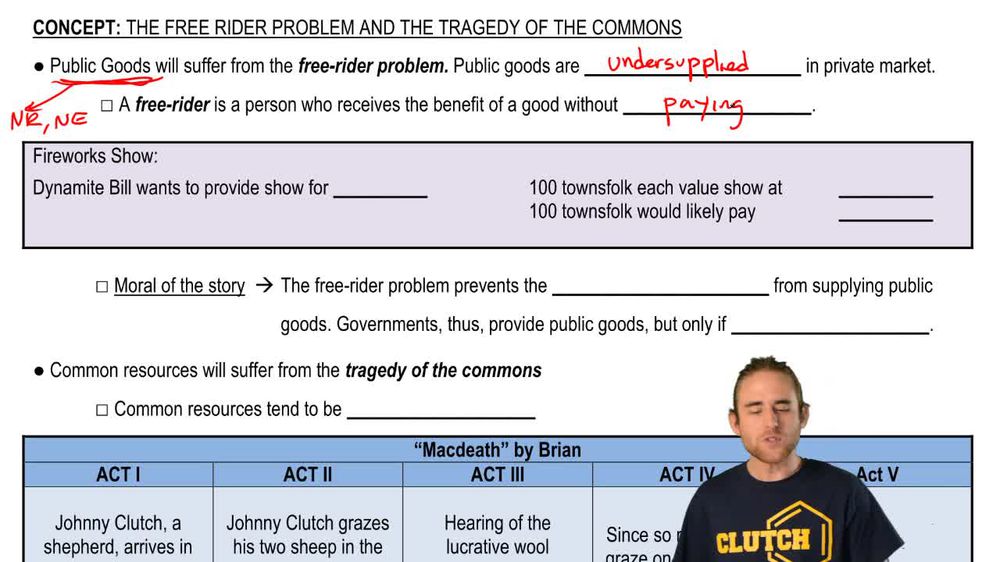
The Free Rider Problem and the Tragedy of the Commons definitions
You can tap to flip the card.
Public Good
You can tap to flip the card.
👆
Public Good
A resource that is both non-rival and non-excludable, making it difficult for private markets to supply efficiently.
Track progress
Control buttons has been changed to "navigation" mode.
1/15
Related flashcards
Related practice
Recommended videos
The Free Rider Problem and the Tragedy of the Commons quiz
The Free Rider Problem and the Tragedy of the Commons
15 Terms
The Free Rider Problem and the Tragedy of the Commons
8. The Types of Goods
10 problems
Topic
Public Goods: Demand Curve and Optimal Quantity
8. The Types of Goods
10 problems
Topic
8. The Types of Goods
3 topics
15 problems
Chapter
Guided course
07:34
Tragedy of the Commons
6
views
Guided course
06:11
Free Rider Problem
9
views
Terms in this set (15)
Hide definitions
Public Good
A resource that is both non-rival and non-excludable, making it difficult for private markets to supply efficiently.
Non-Rivalry
A situation where one person's consumption does not reduce the amount available for others.
Non-Excludability
A characteristic where it is difficult or impossible to prevent individuals from accessing a resource.
Free Rider Problem
A challenge where individuals benefit from a good without contributing to its cost, leading to under-provision.
Marginal Benefit
The additional satisfaction or value gained by society from consuming one more unit of a good.
Marginal Cost
The extra expense incurred to provide one additional unit of a good or service.
Common Resource
A resource that is rival but non-excludable, often leading to overuse and depletion.
Tragedy of the Commons
A scenario where shared resources are overused and degraded due to individual incentives outweighing collective well-being.
Externality
A side effect of an individual's actions that imposes costs or benefits on others not reflected in market prices.
Property Rights
Legal or social arrangements that determine how resources are owned and used, influencing incentives for conservation.
Negative Externality
A cost imposed on society by individual actions, such as resource depletion, not accounted for in private decisions.
Efficient Quantity
The level of resource use where total societal benefits are maximized, considering all costs, including externalities.
Private Cost
The expense directly borne by an individual or firm when making economic decisions, excluding external effects.
Social Cost
The total cost to society, including both private expenses and externalities, from producing or consuming a good.
Government Intervention
Actions by authorities, such as taxation or regulation, to correct market failures and ensure efficient resource allocation.
 BackBack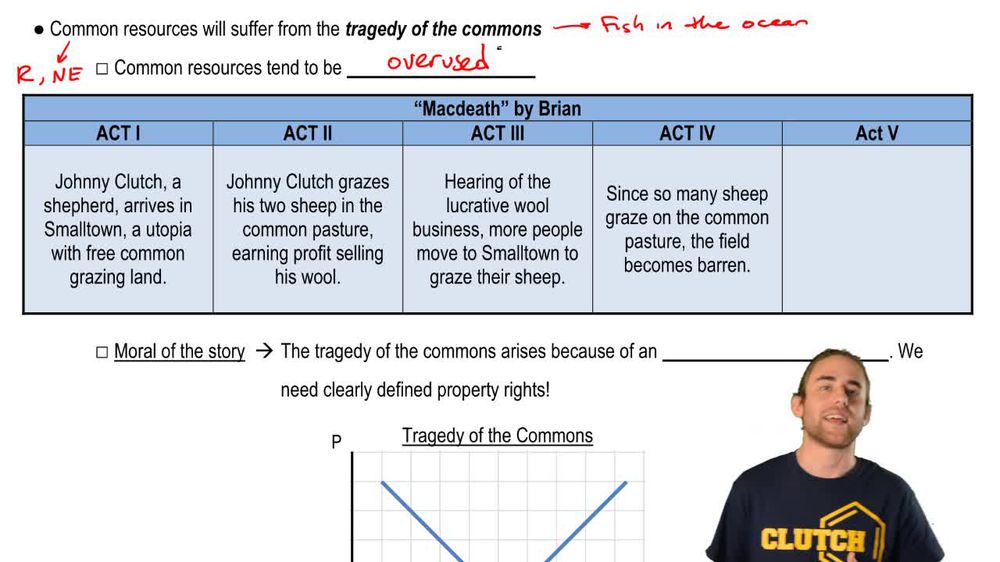
 07:34
07:34