Skip to main content
Macroeconomics
My Course
Learn
Exam Prep
AI Tutor
Study Guides
Flashcards
Explore
Try the app
My Course
Learn
Exam Prep
AI Tutor
Study Guides
Flashcards
Explore
Try the app
Back
Supply of Labor in Perfect Competition definitions
You can tap to flip the card.
Supply of Labor
You can tap to flip the card.
👆
Supply of Labor
Total hours individuals are willing to work at various wage rates, reflecting the trade-off between work and leisure.
Track progress
Control buttons has been changed to "navigation" mode.
1/13
Related flashcards
Recommended videos
Supply of Labor in Perfect Competition quiz
Supply of Labor in Perfect Competition
15 Terms
Guided course
03:17
Supply of Labor in Perfect Competition
Guided course
04:34
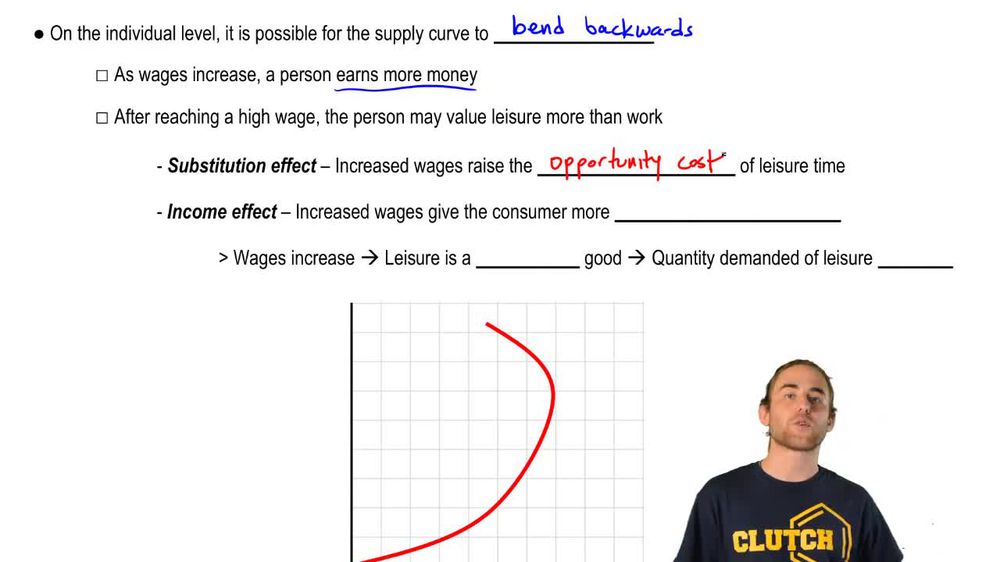
Individual Supply Curve of Labor (Backward-Bending Supply Curve)
Terms in this set (13)
Hide definitions
Supply of Labor
Total hours individuals are willing to work at various wage rates, reflecting the trade-off between work and leisure.
Leisure
All non-work activities, including relaxation, family time, and hobbies, valued as an alternative to working.
Reservation Wage
Minimum pay required for someone to choose work over leisure, representing the lowest acceptable compensation.
Market Supply
Aggregate quantity of labor offered by all individuals in the economy at different wage levels.
Individual Supply Curve
Graph showing how one person's willingness to work changes as wages rise, possibly bending backward at high wages.
Substitution Effect
Tendency to work more as wages increase, since the opportunity cost of leisure rises with higher earnings.
Income Effect
Tendency to desire more leisure and work less as higher wages boost overall purchasing power.
Opportunity Cost
Value of leisure time forgone when choosing to work, which increases as wages rise.
Backward-Bending Supply Curve
Situation where higher wages eventually lead to less labor supplied, as leisure becomes more attractive.
Purchasing Power
Ability to buy goods and services, which grows as wages increase, influencing the desire for leisure.
Normal Good
Item for which demand rises as income increases; in this context, leisure is treated as one.
Labor Market Equilibrium
Point where labor supplied equals labor demanded, determined by wage adjustments and individual choices.
Quantity Supplied
Total hours of labor offered at a specific wage, rising with higher pay until the income effect dominates.
 BackBack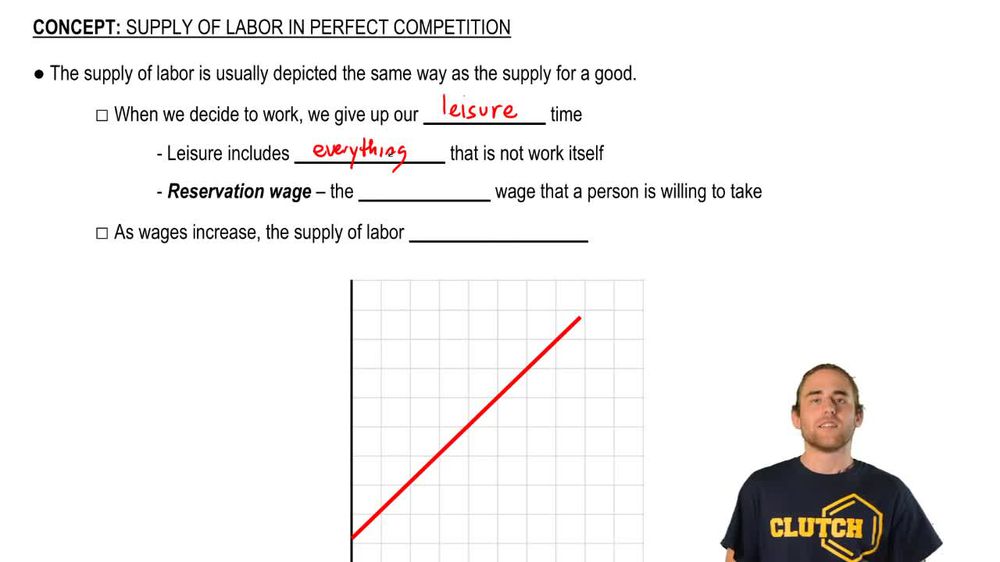
 03:17
03:17