Skip to main content
Macroeconomics
My Course
Learn
Exam Prep
AI Tutor
Study Guides
Flashcards
Explore
Try the app
My Course
Learn
Exam Prep
AI Tutor
Study Guides
Flashcards
Explore
Try the app
Back
Shifts in Labor Supply definitions
You can tap to flip the card.
Labor Supply
You can tap to flip the card.
👆
Labor Supply
Total number of individuals willing and able to work at various wage levels in a given market.
Track progress
Control buttons has been changed to "navigation" mode.
1/15
Related flashcards
Recommended videos
Shifts in Labor Supply quiz
Shifts in Labor Supply
15 Terms
Guided course
03:47
Shifts in Labor Supply
Terms in this set (15)
Hide definitions
Labor Supply
Total number of individuals willing and able to work at various wage levels in a given market.
Population Size
Overall number of people in a country, directly influencing the potential workforce available.
Demographics
Statistical characteristics such as age and gender that shape the composition of the workforce.
Working Age
Age range, typically 18 to 65, during which individuals are most likely to participate in employment.
Baby Boomer Generation
Large cohort born post-World War II whose entry into the workforce significantly expanded labor supply.
Labor Force Participation
Proportion of the population either employed or actively seeking employment.
Alternative Opportunities
Other available jobs or markets that can attract workers away from their current employment.
Substitute Labor Markets
Different job sectors requiring similar skills, allowing workers to switch based on wage differences.
Substitution Effect
Movement of workers between markets in response to changes in relative wages.
Employment Ratio
Share of the working-age population that is currently employed.
Economic Equilibrium
State in the labor market where supply matches demand, resulting in stable wages and employment.
Immigration
Movement of people into a country, increasing the available workforce and shifting labor supply.
Wage Differential
Variation in pay between different jobs or markets, influencing worker movement.
Aggregate Supply of Labor
Total labor available for work across all markets within an economy.
Labor Market
Arena where employers seek workers and individuals offer their labor in exchange for wages.
 BackBack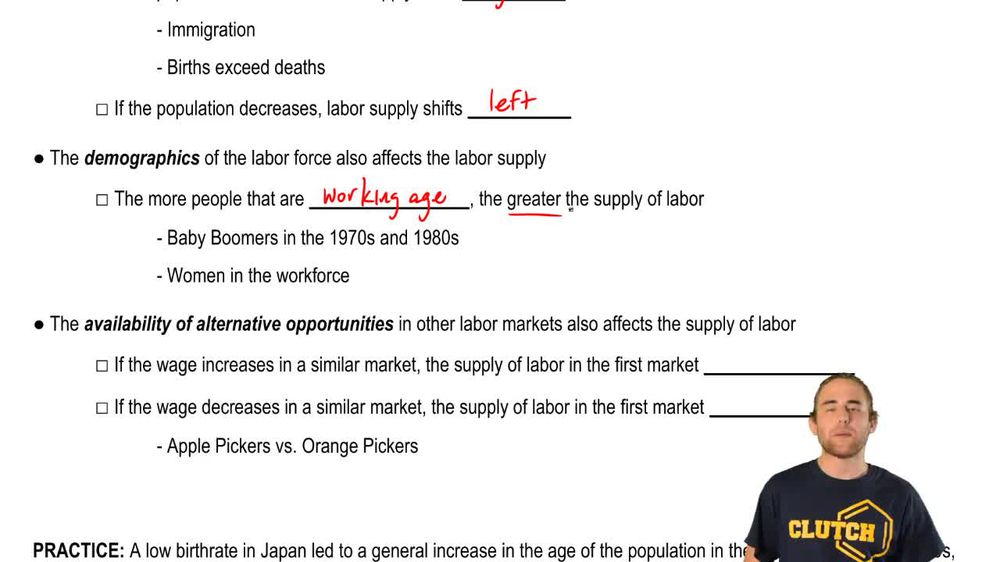
 03:47
03:47