Skip to main content
Macroeconomics
My Course
Learn
Exam Prep
AI Tutor
Study Guides
Flashcards
Explore
Try the app
My Course
Learn
Exam Prep
AI Tutor
Study Guides
Flashcards
Explore
Try the app
Back
Shifts in Labor Demand quiz
You can tap to flip the card.
What is the formula for marginal revenue product (MRP) in the context of labor demand?
You can tap to flip the card.
👆
What is the formula for marginal revenue product (MRP) in the context of labor demand?
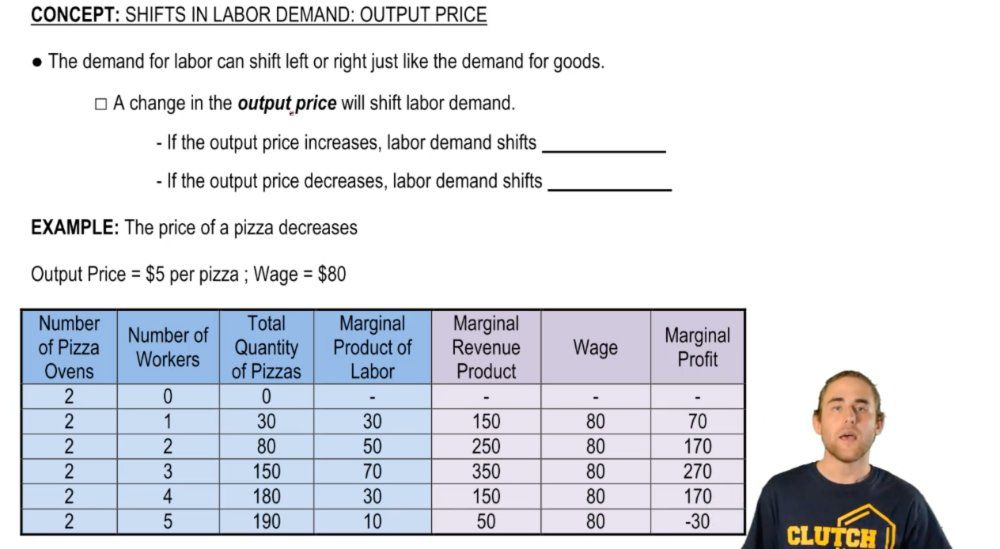
MRP is calculated as the output price multiplied by the marginal product of labor (MRP = Price × MPL).
Track progress
Control buttons has been changed to "navigation" mode.
1/15
Related flashcards
Recommended videos
Shifts in Labor Demand definitions
Shifts in Labor Demand
15 Terms
Guided course
03:09
Shifts in Labor Demand:Technological Change (II)
Guided course
06:57
Shifts in Labor Demand:Output Price
Guided course
03:01
Shifts in Labor Demand:Technological Change (I)
Terms in this set (15)
Hide definitions
What is the formula for marginal revenue product (MRP) in the context of labor demand?
MRP is calculated as the output price multiplied by the marginal product of labor (MRP = Price × MPL).
How does an increase in output price affect the demand for labor?
An increase in output price raises the marginal revenue product, shifting labor demand to the right and increasing the number of workers hired.
What happens to labor demand when the output price decreases?
A decrease in output price lowers the marginal revenue product, shifting labor demand to the left and reducing the number of workers hired.
Does a change in output price affect the marginal product of labor (MPL)?
No, the marginal product of labor depends on the number of workers and not on the output price.
How do you determine the profit-maximizing number of workers to hire?
You hire workers up to the point where the marginal revenue product equals the wage.
What is a labor-saving (substitute) technology, and how does it affect labor demand?
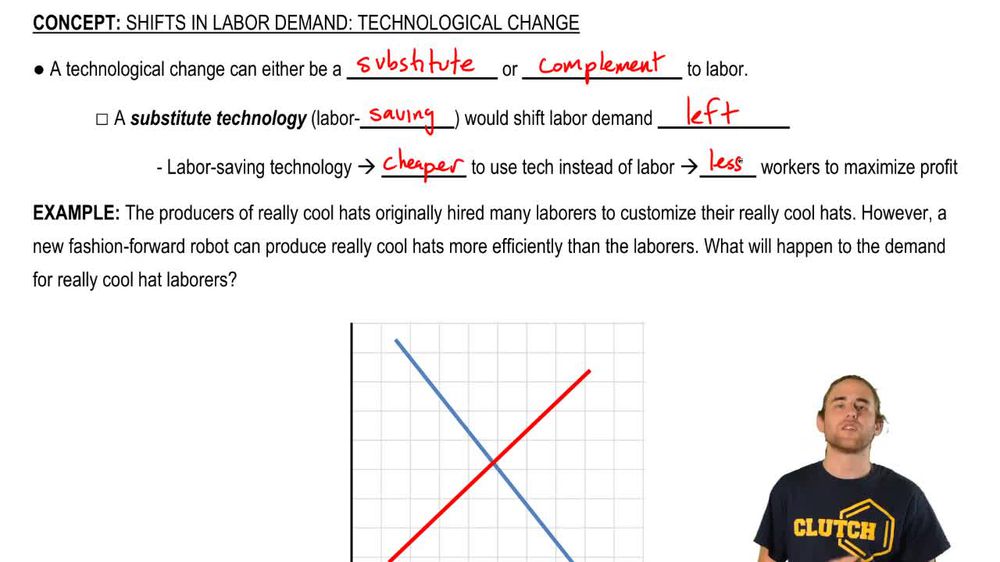
A labor-saving technology replaces workers, shifting the demand for labor to the left and decreasing both equilibrium wage and employment.
What is a labor-augmenting (complementary) technology, and how does it affect labor demand?
A labor-augmenting technology increases worker productivity, shifting labor demand to the right and raising both equilibrium wage and employment.
In the example of the pizza shop, what happened to the number of workers hired when the output price dropped from \$5 to \$2?
The number of workers hired decreased because the marginal revenue product fell, making it less profitable to hire as many workers.
What happens to equilibrium wage and employment when labor demand shifts left due to substitute technology?
Both equilibrium wage and employment decrease when labor demand shifts left.
What happens to equilibrium wage and employment when labor demand shifts right due to complementary technology?
Both equilibrium wage and employment increase when labor demand shifts right.
Why does a labor-augmenting technology increase the marginal product of labor?
It makes each worker more productive, so the marginal product of labor rises.
How does the introduction of a new tool that makes workers twice as fast affect labor demand?
It increases the marginal product of labor, shifting labor demand to the right and increasing both wages and employment.
Why might a firm hire fewer workers when the output price falls, even if wages stay the same?
Because the marginal revenue product decreases, making it less profitable to hire additional workers.
What is the relationship between marginal revenue product and wage in determining hiring decisions?
Firms hire workers as long as the marginal revenue product is greater than or equal to the wage.
How do shifts in labor demand relate to shifts in product market demand curves?
Shifts in labor demand work similarly to product market demand curves, moving left or right in response to changes in output price or technology.
 BackBack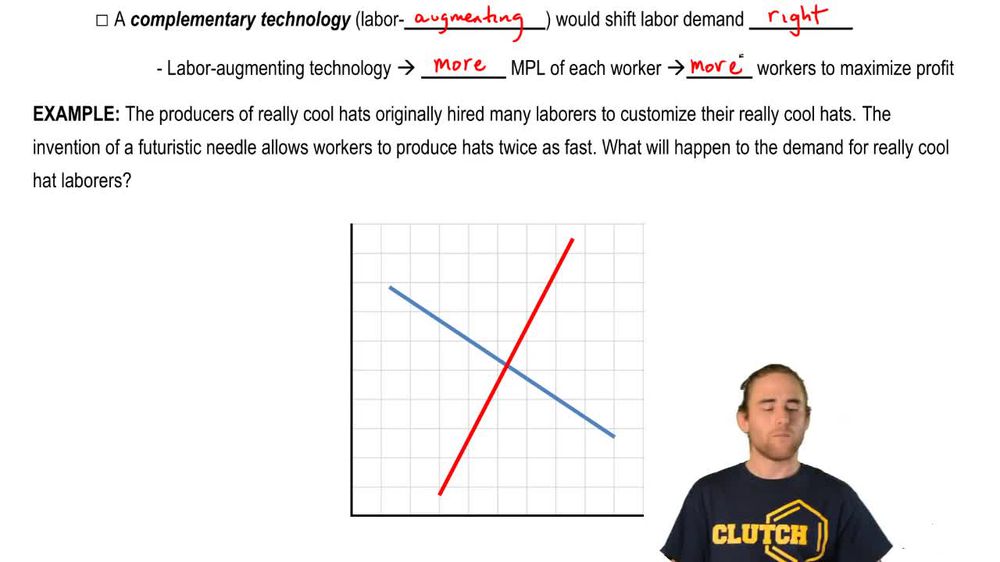
 03:09
03:09