Skip to main content
Macroeconomics
My Course
Learn
Exam Prep
AI Tutor
Study Guides
Flashcards
Explore
Try the app
My Course
Learn
Exam Prep
AI Tutor
Study Guides
Flashcards
Explore
Try the app
Back
Revenue in Perfect Competition quiz
You can tap to flip the card.
What is the formula for total revenue (TR) in perfect competition?
You can tap to flip the card.
👆
What is the formula for total revenue (TR) in perfect competition?
Total revenue equals price times quantity (TR = P × Q).
Track progress
Control buttons has been changed to "navigation" mode.
1/15
Related flashcards
Recommended videos
Revenue in Perfect Competition definitions
Revenue in Perfect Competition
12 Terms
Guided course
06:20
Revenue in Perfect Competition
1
views
Guided course
08:15
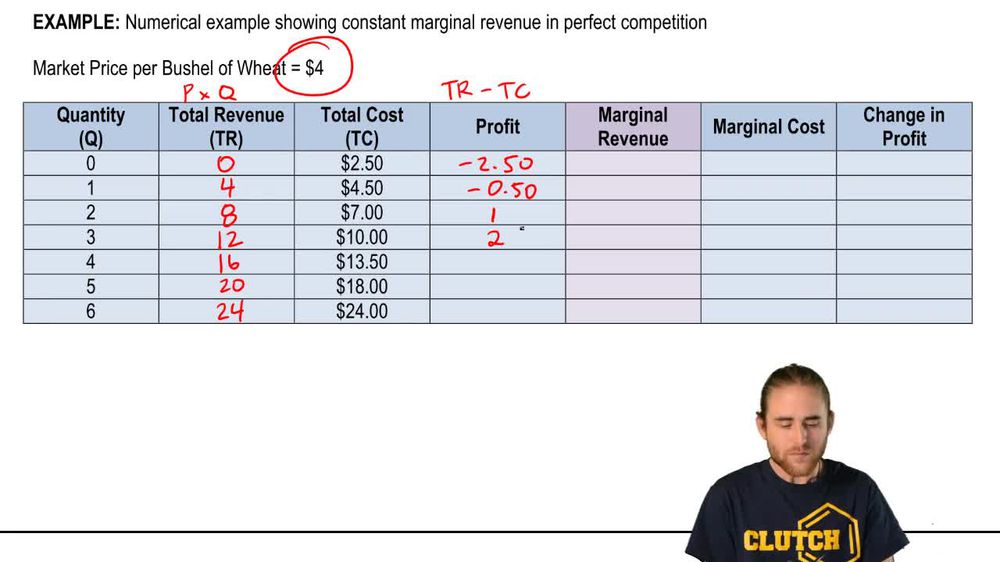
Calculating Profit from a Table
1
views
Terms in this set (15)
Hide definitions
What is the formula for total revenue (TR) in perfect competition?
Total revenue equals price times quantity (TR = P × Q).
How do you calculate average revenue (AR) in any market structure?
Average revenue is total revenue divided by quantity (AR = TR/Q), which simplifies to price (P).
What does marginal revenue (MR) represent for a firm?
Marginal revenue is the additional revenue a firm earns by selling one more unit of output.
What is the formula for marginal revenue (MR)?
Marginal revenue equals the change in total revenue divided by the change in quantity (MR = ΔTR/ΔQ).
In perfect competition, what is the relationship between price and marginal revenue?
In perfect competition, marginal revenue equals price (MR = P).
Why does a perfectly competitive firm face a perfectly elastic demand curve?
Because the firm is a price taker and can sell any quantity at the market price without affecting the price.
What happens to the price when a perfectly competitive firm increases its output by one unit?
The price remains unchanged because the firm's output is too small to affect the market price.
How does the average revenue curve relate to the demand curve in perfect competition?
The average revenue curve is the same as the demand curve for the firm.
Is the equality AR = MR = P unique to perfect competition?
Yes, this equality is a special feature of perfect competition and does not hold in other market structures.
Why can a perfectly competitive firm sell as much as it wants at the market price?
Because there are many sellers and the firm's output is insignificant relative to the total market, so it cannot influence the price.
What is the marginal benefit to a firm in terms of revenue?
The marginal benefit is the additional revenue gained from selling one more unit, which is the marginal revenue.
What happens to total revenue when a perfectly competitive firm sells one more unit?
Total revenue increases by exactly the market price of the good.
How does the calculation of average revenue demonstrate its equality to price?
Since AR = TR/Q and TR = P × Q, dividing gives AR = P.
In perfect competition, what does the firm's demand curve look like?
It is a horizontal line at the market price, indicating perfectly elastic demand.
Why is the marginal revenue curve flat in perfect competition?
Because each additional unit sold brings in the same revenue as the previous one, equal to the market price.
 BackBack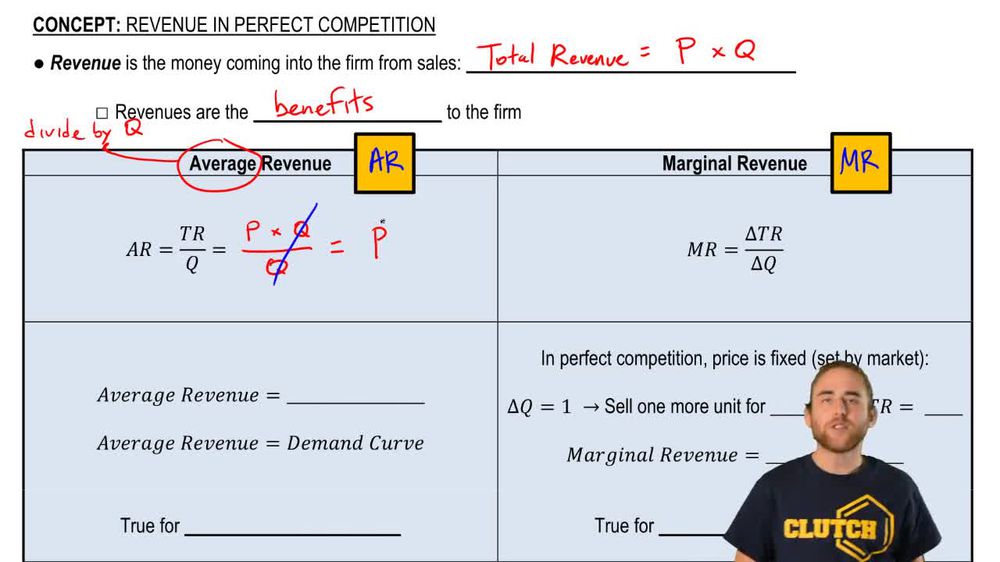
 06:20
06:20