What does the Real Business Cycle (RBC) model focus on as the main driver of economic fluctuations?
The RBC model focuses on changes in aggregate supply as the main driver of economic fluctuations.
According to the RBC model, what are the primary causes of inflation and recession?
Inflation and recession are primarily caused by changes in technology and variations in resource availability.
How does the RBC model differ from the Keynesian and Monetarist models in explaining recessions?
The RBC model attributes recessions to supply-side factors, while Keynesian and Monetarist models focus on changes in aggregate demand and money supply, respectively.
What is a supply shock in the context of the RBC model?
A supply shock is a sudden change in resource availability or input prices that affects aggregate supply.
Give an example of a supply shock discussed in the RBC model.
An example is a significant increase in oil prices, which raises input costs and reduces resource availability.
What happens to the Long Run Aggregate Supply (LRAS) curve during a negative supply shock?
The LRAS curve shifts to the left, indicating reduced production capacity.
How does a leftward shift in the LRAS curve affect production and employment?
It leads to lower production and lower employment in the economy.
What happens to aggregate demand (AD) following a reduction in production and employment in the RBC model?
Aggregate demand also shifts to the left due to decreased demand and lower income levels.
In the RBC model, what typically happens to the price level after both LRAS and AD shift left?
The price level may remain constant at the new equilibrium, even though GDP falls.
What is the main idea behind the Real Business Cycle model?
The main idea is that economic fluctuations are driven by changes in aggregate supply, not aggregate demand.
How does the RBC model explain a decrease in real GDP?
A decrease in real GDP is explained by a reduction in resource availability or a negative supply shock.
What is the sequence of events in the RBC model after a supply shock?
A supply shock reduces LRAS, which lowers production and employment, leading to a leftward shift in AD.
Why does aggregate demand decrease after a negative supply shock in the RBC model?
Aggregate demand decreases because lower production and employment reduce overall income and spending.
What does the RBC model suggest about the role of aggregate demand in economic fluctuations?
The RBC model suggests that aggregate demand changes are a result, not a cause, of supply-side fluctuations.
What should you remember as the key focus of the Real Business Cycle Model?
You should remember that the RBC model focuses on aggregate supply changes as the main cause of economic fluctuations.
 Back
Back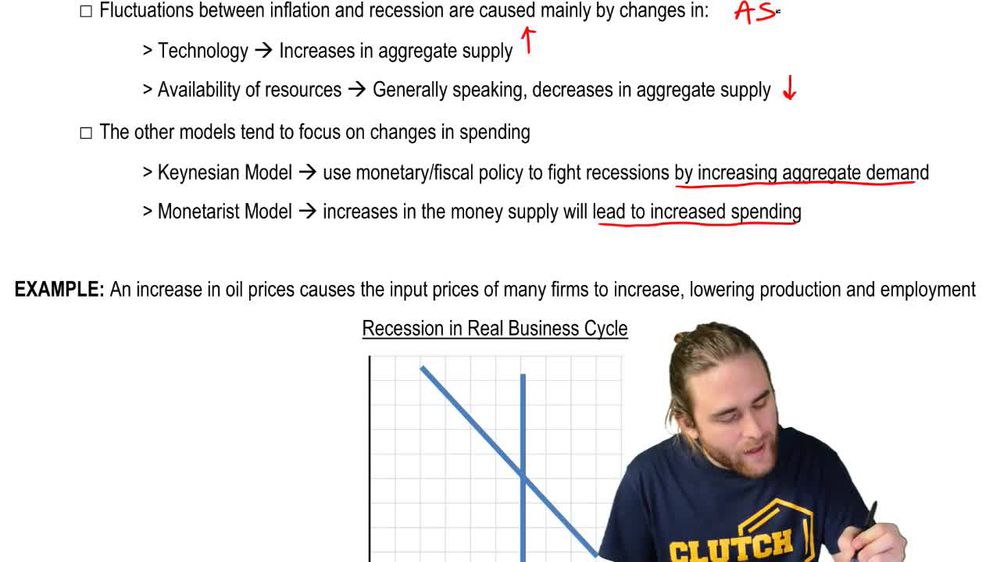
 03:54
03:54