Skip to main content
Macroeconomics
My Course
Learn
Exam Prep
AI Tutor
Study Guides
Flashcards
Explore
Try the app
My Course
Learn
Exam Prep
AI Tutor
Study Guides
Flashcards
Explore
Try the app
Back
Real Business Cycle Model definitions
You can tap to flip the card.
Real Business Cycle Model
You can tap to flip the card.
👆
Real Business Cycle Model
A framework emphasizing economic fluctuations driven by shifts in aggregate supply, especially from technology or resource changes.
Track progress
Control buttons has been changed to "navigation" mode.
1/15
Related flashcards
Related practice
Recommended videos
Real Business Cycle Model quiz
Real Business Cycle Model
15 Terms
Real Business Cycle Model
22. Macroeconomic Schools of Thought
10 problems
Topic
Austrian Model
22. Macroeconomic Schools of Thought
10 problems
Topic
24. Macroeconomic Schools of Thought
7 topics
15 problems
Chapter
Guided course
03:54
Real Business Cycle Model
4
views
Terms in this set (15)
Hide definitions
Real Business Cycle Model
A framework emphasizing economic fluctuations driven by shifts in aggregate supply, especially from technology or resource changes.
Aggregate Supply
The total output producers are willing and able to supply at various price levels, central to explaining economic cycles in this model.
Aggregate Demand
The total spending on goods and services in an economy, which shifts in response to changes in production and income.
Supply Shock
A sudden event, like a spike in input costs or resource scarcity, that disrupts production and shifts aggregate supply.
Long Run Aggregate Supply
A curve representing the economy's maximum sustainable output, which can shift due to resource or technology changes.
Equilibrium
A state where aggregate supply and aggregate demand intersect, determining the economy's output and price level.
Price Level
An index reflecting the average prices of goods and services, which may remain stable even as output changes in this model.
Recession
A period marked by reduced production and employment, often triggered by negative supply shocks in this framework.
Inflation
A general rise in prices, attributed here mainly to supply-side factors like resource costs or technological shifts.
Resource Availability
The accessibility of inputs needed for production, whose changes can cause major shifts in economic output.
Production Capacity
The maximum output an economy can sustain, which declines when resources become scarce or technology regresses.
Input Prices
The costs of resources used by firms, where increases can reduce supply and trigger economic downturns.
Technological Change
Advancements or setbacks in methods of production, seen as a primary driver of supply-side economic fluctuations.
Employment
The level of labor utilization, which falls when production drops due to adverse supply conditions.
GDP
The total value of goods and services produced, which contracts following negative supply shocks in this model.
 BackBack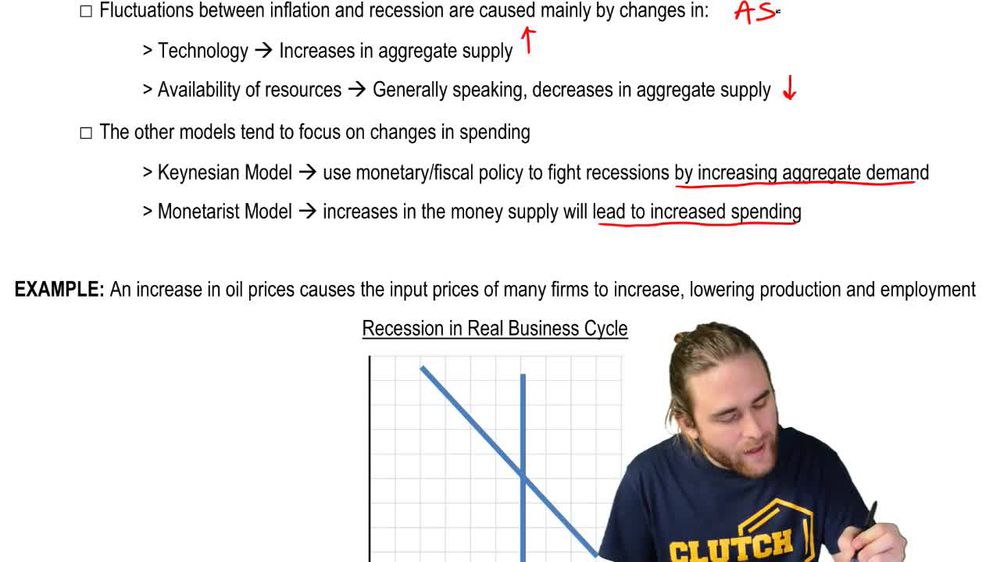
 03:54
03:54