What is the first step when calculating the effect of a tax on supply and demand using equations?
The first step is to adjust the supply or demand equation by replacing 'p' with 'p minus tax' (if suppliers are taxed) or 'p plus tax' (if buyers are taxed).
How does a \$1 per unit tax on suppliers affect the supply equation 'quantity supplied = 2p - 6'?
The supply equation becomes 'quantity supplied = 2(p - 1) - 6', which simplifies to '2p - 8'.
What is the new supply equation after a \$1 tax is imposed on suppliers?
The new supply equation is 'quantity supplied = 2p - 8'.
How do you find the new equilibrium price after a tax is imposed?
Set the new supply equation equal to the demand equation and solve for 'p'.
What is the demand equation used in the example?
The demand equation is 'quantity demanded = 10 - p'.
After imposing the tax and solving for equilibrium, what is the new equilibrium price?
The new equilibrium price is \$6.
How do you determine the equilibrium quantity after a tax is imposed?
Plug the new equilibrium price into the demand equation to solve for quantity.
What is the equilibrium quantity after the \$1 tax is imposed?
The equilibrium quantity is 4 units.
Who pays the equilibrium price after a tax is imposed on suppliers?
The buyers (non-taxed party) pay the equilibrium price.
How much do sellers receive per unit after a \$1 tax is imposed and the equilibrium price is \$6?
Sellers receive \$5 per unit, which is \$1 less than the price buyers pay.
Why do you replace 'p' with 'p - tax' in the supply equation when suppliers are taxed?
Because suppliers receive the market price minus the tax, reflecting their reduced revenue per unit.
Does it matter whether the tax is imposed on buyers or sellers when calculating the final prices?
No, the final prices for buyers and sellers will be the same regardless of which side is taxed.
What does the \$1 difference between the price buyers pay and the price sellers receive represent?
It represents the per-unit tax imposed by the government.
What is the general effect of a per-unit tax on the supply curve?
A per-unit tax shifts the supply curve vertically upward (or leftward) by the amount of the tax.
What are the three main steps to solve for prices and quantities after a tax is imposed?
1) Adjust the relevant equation for the tax, 2) solve for the new equilibrium price and quantity, 3) determine the prices paid by buyers and received by sellers.
 Back
Back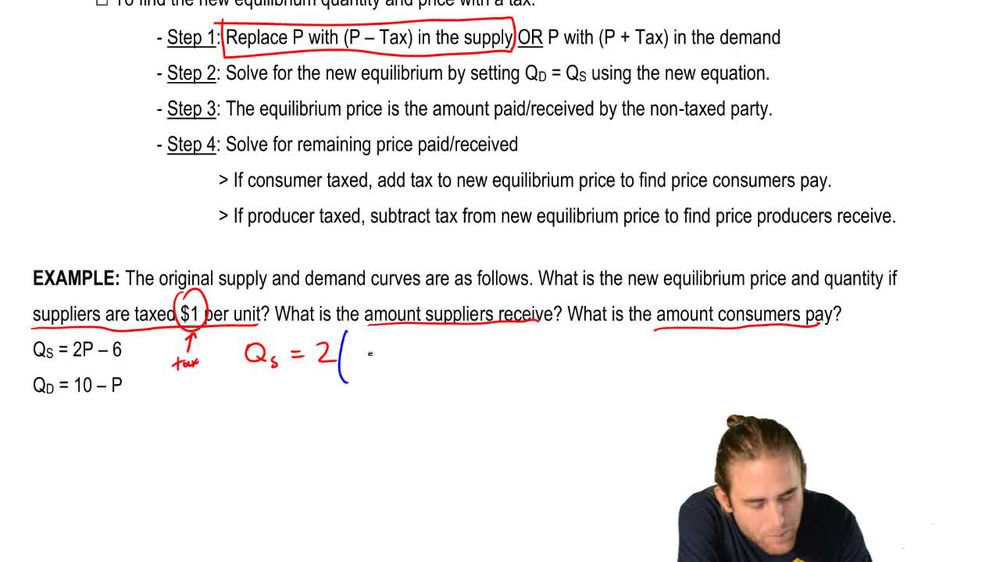
 08:01
08:01