Skip to main content
Macroeconomics
My Course
Learn
Exam Prep
AI Tutor
Study Guides
Flashcards
Explore
Try the app
My Course
Learn
Exam Prep
AI Tutor
Study Guides
Flashcards
Explore
Try the app
Back
Quantitative Analysis of Taxes definitions
You can tap to flip the card.
Equilibrium Price
You can tap to flip the card.
👆
Equilibrium Price
The value at which the quantity supplied equals the quantity demanded after accounting for any imposed tax.
Track progress
Control buttons has been changed to "navigation" mode.
1/15
Related flashcards
Related practice
Recommended videos
Quantitative Analysis of Taxes quiz
Quantitative Analysis of Taxes
15 Terms
Quantitative Analysis of Taxes
6. Introduction to Taxes
3 problems
Topic
The Laffer Curve
6. Introduction to Taxes
10 problems
Topic
6. Introduction to Taxes
6 topics
14 problems
Chapter
Guided course
08:01
Quantitative Analysis of Taxes
5
views
Terms in this set (15)
Hide definitions
Equilibrium Price
The value at which the quantity supplied equals the quantity demanded after accounting for any imposed tax.
Equilibrium Quantity
The amount exchanged in the market where the adjusted supply and demand equations intersect post-tax.
Supply Curve
A graphical or algebraic representation showing the relationship between price and quantity offered by sellers.
Demand Curve
A graphical or algebraic representation showing the relationship between price and quantity desired by buyers.
Tax Incidence
The division of a tax's economic burden between buyers and sellers, determined by market adjustments.
Shifted Supply Curve
A new supply relationship reflecting the reduction in seller receipts due to a per-unit tax.
Non-Taxed Party
The side of the market—buyer or seller—not directly responsible for remitting the tax to the government.
Taxed Party
The side of the market—buyer or seller—required to remit the tax, affecting their net proceeds.
Supply Equation
An algebraic expression relating quantity supplied to price, adjusted for taxes when applicable.
Demand Equation
An algebraic expression relating quantity demanded to price, used to solve for market outcomes.
Buyer Price
The amount paid by purchasers in the market, which may differ from the seller's receipt due to taxes.
Seller Price
The net amount received by suppliers after subtracting any per-unit tax from the market price.
Per-Unit Tax
A fixed amount levied on each unit sold, causing a vertical shift in the supply or demand curve.
Market Adjustment
The process by which new equilibrium values are found after a policy change, such as a tax.
Algebraic Solution
The method of using equations to determine new market prices and quantities after a tax is imposed.
 BackBack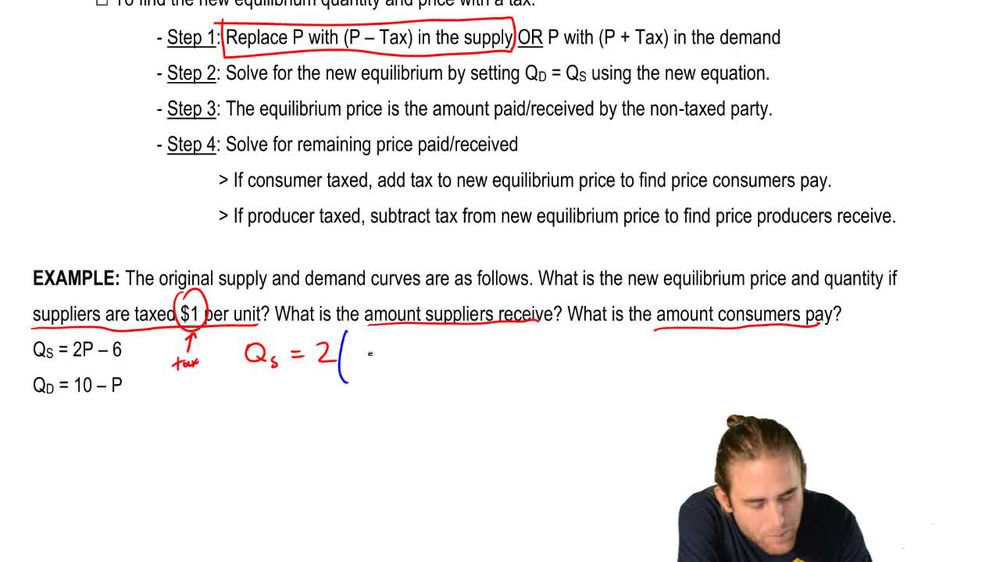
 08:01
08:01