Back

Quantitative Analysis of Price Ceilings and Floors: Finding Areas quiz

Control buttons has been changed to "navigation" mode.
1/15
  • When is a price floor considered effective in a market?

    A price floor is effective when it is set above the equilibrium price, preventing the market from reaching equilibrium.
  • Where is consumer surplus located on a supply and demand graph at equilibrium?

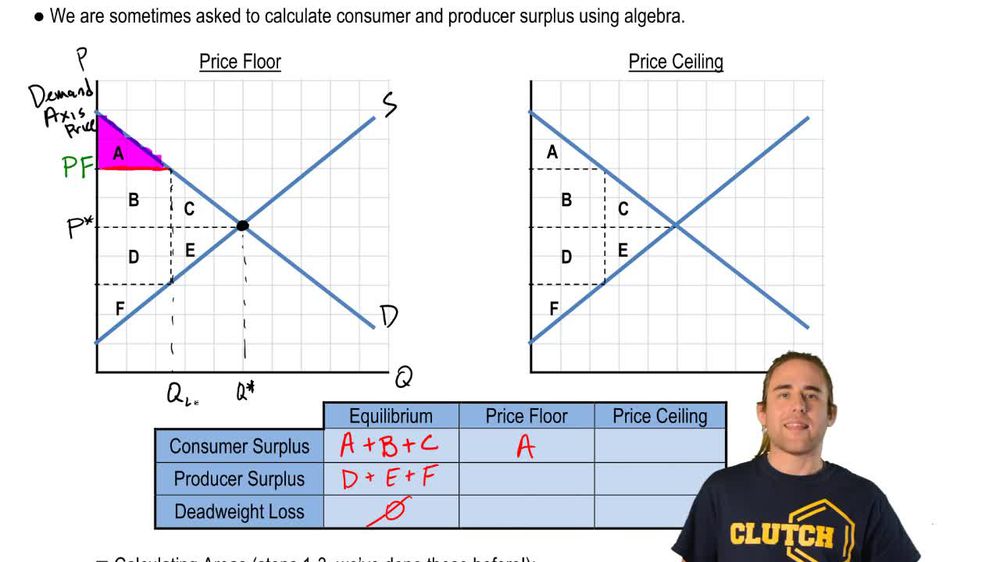
    Consumer surplus is the area above the equilibrium price and below the demand curve.
  • What happens to deadweight loss at market equilibrium?

    At equilibrium, there is no deadweight loss because all mutually beneficial trades occur.
  • How does a price floor affect consumer surplus?

    A price floor reduces consumer surplus to the area above the price floor and below the demand curve, typically just area A.
  • Which areas represent producer surplus under a price floor?

    Producer surplus under a price floor is the area below the price floor and above the supply curve, excluding areas where trades do not occur (C and E), typically B, D, and F.
  • What is deadweight loss in the context of a price floor?

    Deadweight loss is the total surplus lost due to trades that do not occur because of the price floor, represented by areas C and E.
  • What key values are needed to calculate areas under a price floor?

    You need the demand axis price, supply axis price, the price floor, equilibrium price, a 'missing price,' and the relevant quantities traded.
  • When is a price ceiling considered effective?

    A price ceiling is effective when it is set below the equilibrium price, restricting the market price from rising to equilibrium.
  • How does a price ceiling affect producer surplus?

    Producer surplus is reduced to the area below the price ceiling and above the supply curve, typically just area F.
  • Which areas represent consumer surplus under a price ceiling?

    Consumer surplus under a price ceiling includes the areas above the price ceiling and below the demand curve, typically A, B, and D.
  • What is deadweight loss in the summation of a price ceiling scenario?

    Deadweight loss is the surplus lost from trades that do not occur due to the price ceiling, represented by areas C and E.
  • Why is it important to identify the 'missing price' when calculating surplus areas?

    The 'missing price' helps define the boundaries of the geometric shapes needed to calculate surplus and deadweight loss areas accurately.
  • How do you calculate the area of consumer surplus under a price ceiling?

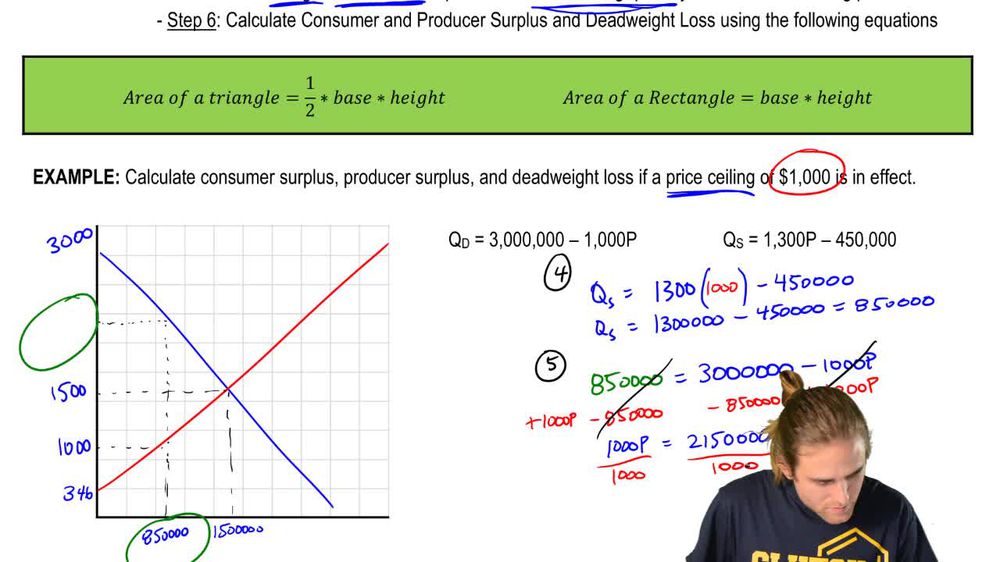
    You split the area into a rectangle and a triangle, using the demand axis price, the price ceiling, the missing price, and the relevant quantities.
  • What quantities are necessary to calculate deadweight loss under price controls?

    You need the equilibrium quantity, the lower quantity traded due to the price control, and the relevant prices to determine the area of deadweight loss.
  • What is the main new calculation step introduced when analyzing price ceilings and floors compared to equilibrium?

    The main new step is solving for the 'missing price' and the lower quantity, which are needed to calculate the altered surplus and deadweight loss areas.