Back

Quantitative Analysis of Price Ceilings and Floors: Finding Areas definitions

Control buttons has been changed to "navigation" mode.
1/15
  • Price Floor

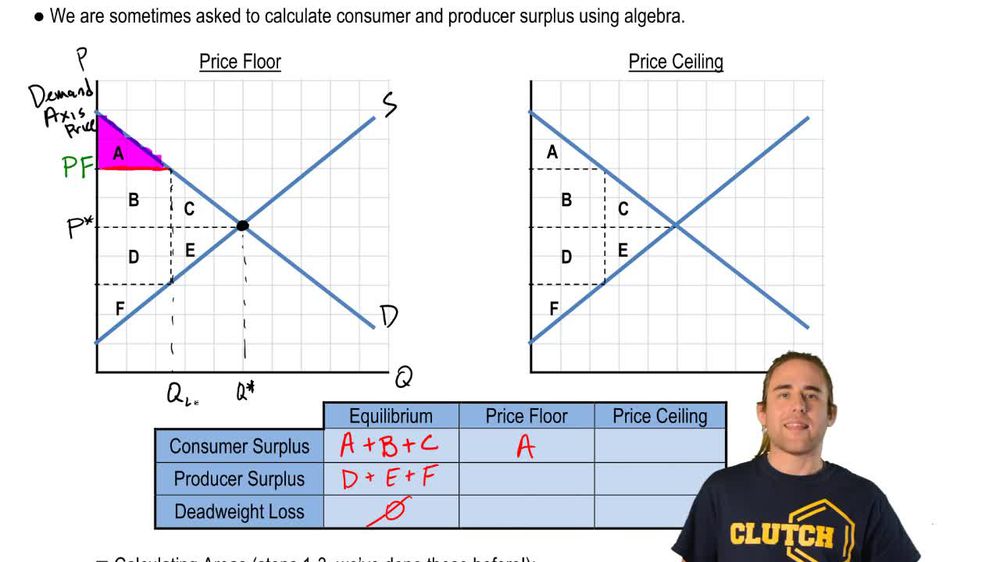
    A minimum allowable price set above equilibrium, causing reduced trades and potential surplus for producers but loss for consumers.
  • Price Ceiling

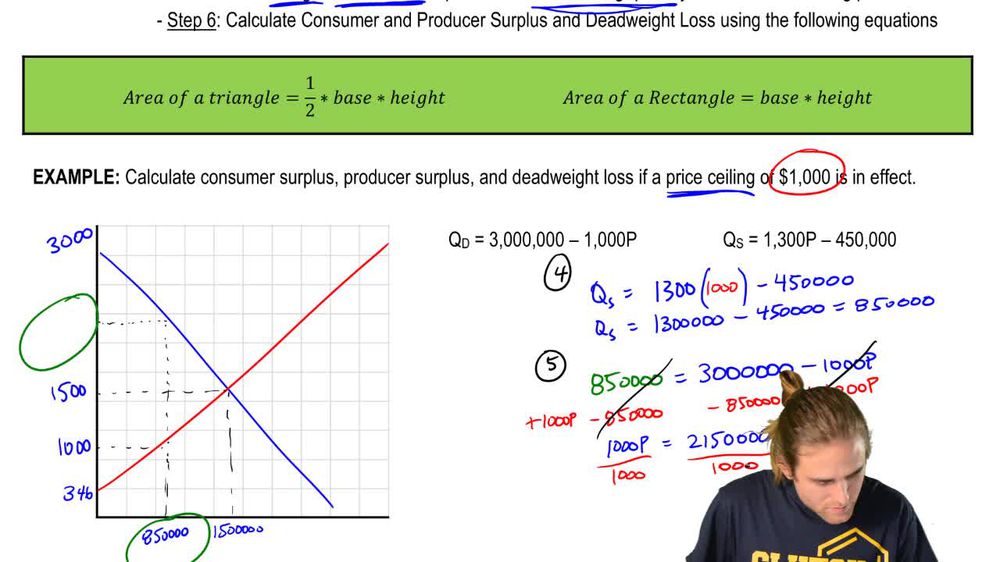
    A maximum allowable price set below equilibrium, increasing consumer benefit but reducing producer gains and total trades.
  • Equilibrium Price

    The market-clearing value where quantity demanded equals quantity supplied, maximizing total surplus with no inefficiency.
  • Consumer Surplus

    The net benefit buyers receive, measured as the area above market price and below the demand curve up to the traded quantity.
  • Producer Surplus

    The net benefit sellers receive, shown as the area below market price and above the supply curve up to the traded quantity.
  • Deadweight Loss

    The value of mutually beneficial trades lost due to market interventions, represented by areas where trades no longer occur.
  • Demand Curve

    A graphical representation showing the relationship between price and quantity buyers are willing to purchase.
  • Supply Curve

    A graphical representation showing the relationship between price and quantity sellers are willing to offer.
  • Demand Axis Price

    The intercept where the demand curve meets the price axis, indicating the highest price buyers would pay for the first unit.
  • Supply Axis Price

    The intercept where the supply curve meets the price axis, indicating the lowest price at which sellers would offer the first unit.
  • Equilibrium Quantity

    The amount exchanged in the market when supply equals demand, maximizing total gains from trade.
  • Lower Quantity

    The reduced amount traded under a price floor or ceiling, reflecting inefficiency and lost transactions.
  • Missing Price

    An additional value needed to calculate surplus areas, often found between the controlled price and axis intercepts.
  • Graphical Representation

    A visual tool using curves and shaded areas to illustrate market outcomes and the effects of price controls.
  • Algebraic Calculation

    A method using equations and geometric area formulas to determine surplus and loss values under market interventions.