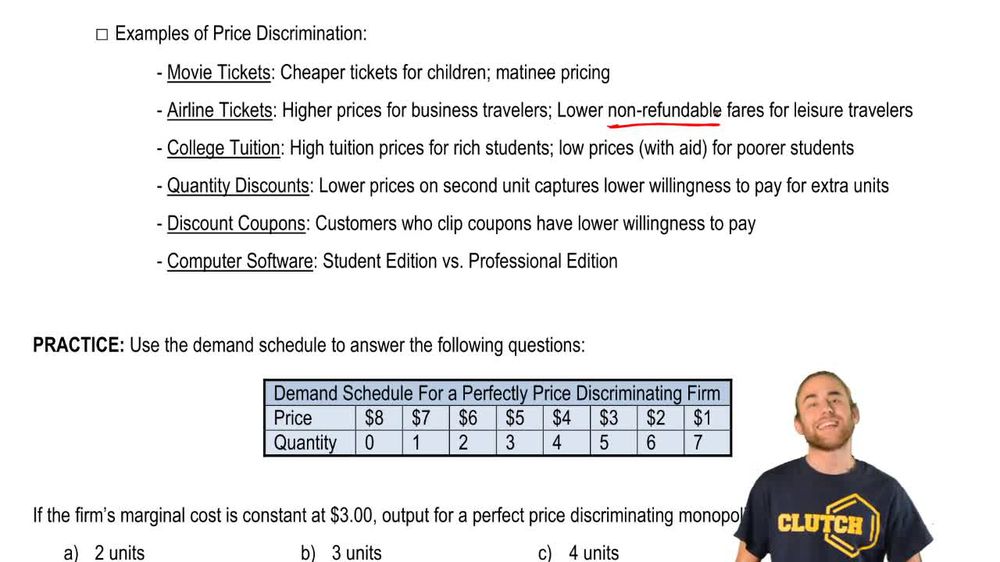
What is price discrimination in the context of monopolies?
Price discrimination is when a firm sells the same good to different customers at different prices based on their willingness to pay.
What are the three conditions necessary for a firm to practice price discrimination?
The firm must have market power, be able to segregate the market into distinct groups, and prevent resale between customers.
How does a single-price monopolist differ from a price-discriminating monopolist?
A single-price monopolist charges all customers the same price, while a price-discriminating monopolist charges different prices to different groups or individuals.
Why must resale be prevented for price discrimination to work?
If customers can resell the product, those who buy at a lower price could sell to those who would otherwise pay more, undermining the firm's ability to price discriminate.
How does a firm determine which customers to charge higher or lower prices in price discrimination?
The firm segments customers based on their willingness to pay, charging higher prices to those with more inelastic demand and lower prices to those with more elastic demand.
In the Microsoft example, why are students charged a lower price than small businesses?
Students have a more elastic demand and are more price sensitive, so charging them a lower price increases sales and profit, while small businesses have inelastic demand and can be charged more.
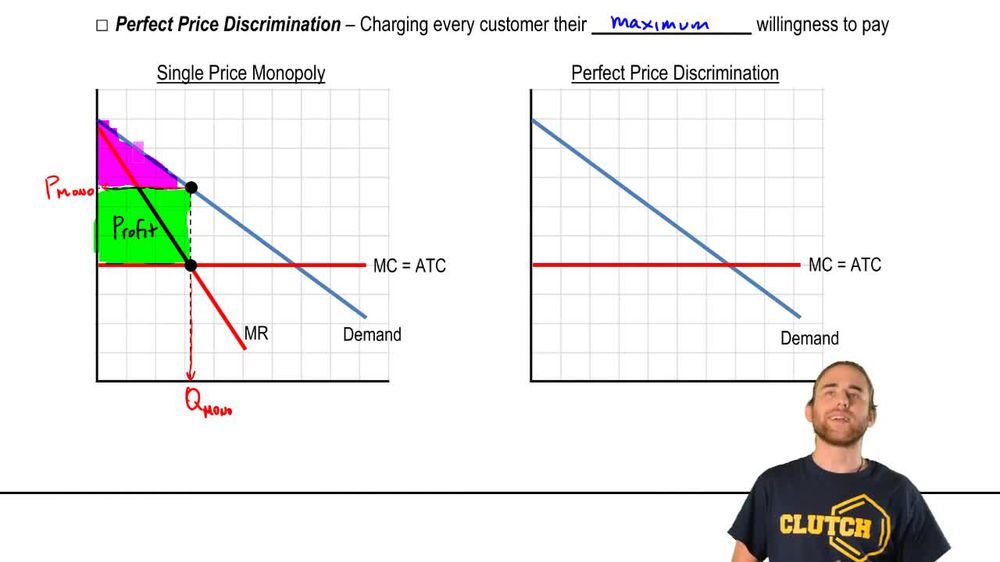
What is perfect price discrimination?
Perfect price discrimination occurs when a firm charges each customer their maximum willingness to pay for each unit of the good.
What happens to consumer surplus under perfect price discrimination?
Consumer surplus is eliminated because the firm captures all of it as profit by charging each customer their maximum willingness to pay.
How does perfect price discrimination affect deadweight loss?
Perfect price discrimination eliminates deadweight loss by producing the socially optimal quantity, achieving allocative efficiency.
Why is perfect price discrimination rare in the real world?
It is difficult for firms to know each customer's exact willingness to pay and to prevent resale completely.
What is an example of perfect price discrimination in the real world?
Google AdWords auctions are an example, where advertisers bid up to their maximum willingness to pay for keywords.
How does price discrimination increase a monopolist’s profit compared to single pricing?
By charging higher prices to those willing to pay more and lower prices to others, the monopolist can sell more units and capture more profit than with a single price.
What is the impact of price discrimination on output compared to a single-price monopoly?
Price discrimination generally increases output compared to a single-price monopoly, as more customers are served at different prices.
What ethical concern is associated with perfect price discrimination?
Perfect price discrimination raises ethical concerns because it eliminates consumer surplus, leaving all gains with the producer.
How does the Google AdWords auction system achieve efficiency?
It allocates ad space to the highest bidder, ensuring that those who value it most (and are willing to pay the most) receive it, which is an efficient outcome.
 Back
Back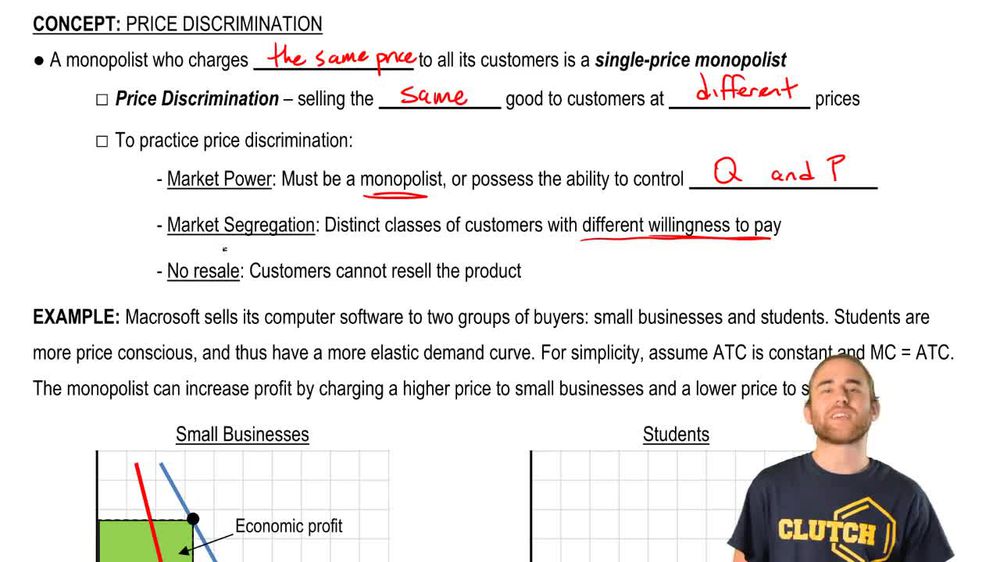
 07:45
07:45