Skip to main content
Macroeconomics
My Course
Learn
Exam Prep
AI Tutor
Study Guides
Flashcards
Explore
Try the app
My Course
Learn
Exam Prep
AI Tutor
Study Guides
Flashcards
Explore
Try the app
Back
Price Discrimination definitions
You can tap to flip the card.
Price Discrimination
You can tap to flip the card.
👆
Price Discrimination
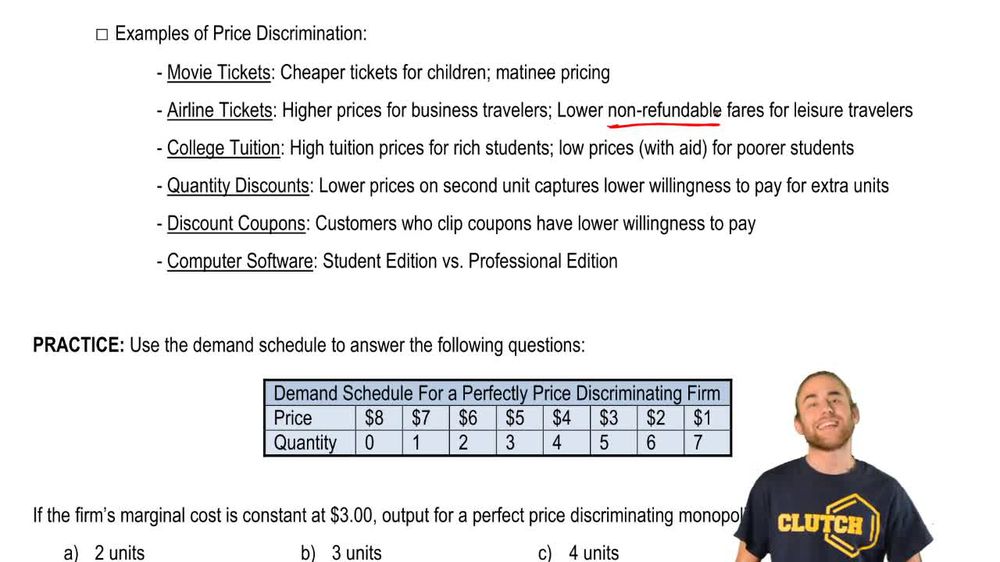
Selling identical goods to different buyers at varying prices based on their willingness to pay, aiming to boost profits by segmenting markets.
Track progress
Control buttons has been changed to "navigation" mode.
1/15
Related flashcards
Recommended videos
Price Discrimination quiz
Price Discrimination
15 Terms
Guided course
07:45
Price Discrimination
1
views
Guided course
04:05
Price Discrimination
1
views
Guided course
06:11
Perfect Price Discrimination
1
views
Terms in this set (15)
Hide definitions
Price Discrimination
Selling identical goods to different buyers at varying prices based on their willingness to pay, aiming to boost profits by segmenting markets.
Market Power
Ability of a firm to influence price and output in a market, often necessary for charging different prices to different groups.
Single-Price Monopoly
A market structure where one seller charges all customers the same price, typically resulting in restricted output and deadweight loss.
Perfect Price Discrimination
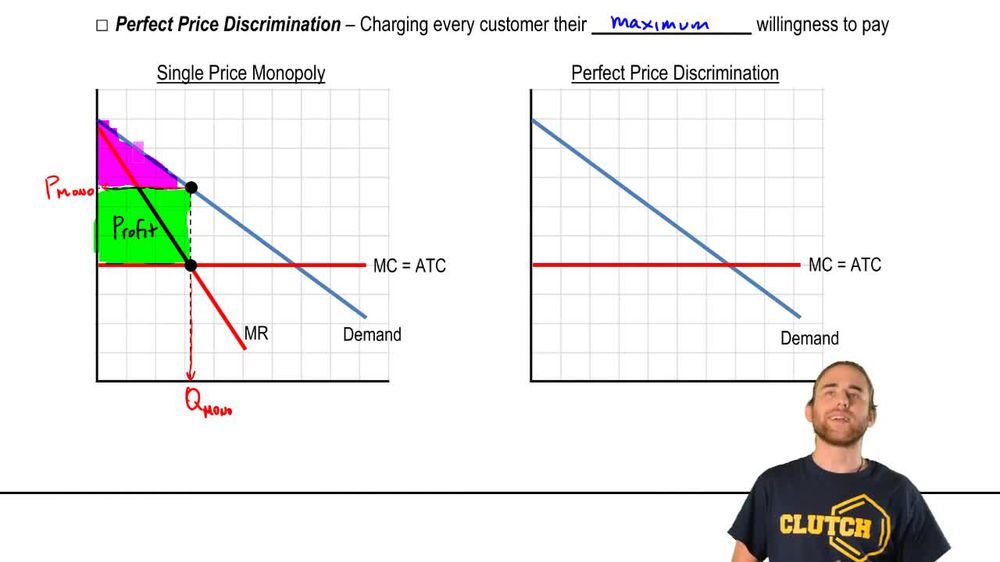
Charging each buyer their maximum willingness to pay, capturing all potential profit and eliminating deadweight loss.
Consumer Surplus
The difference between what buyers are willing to pay and what they actually pay, often reduced or eliminated under price discrimination.
Deadweight Loss
Lost economic efficiency when potential trades do not occur, often present in monopolies but eliminated with perfect price discrimination.
Allocative Efficiency
A state where resources are distributed optimally, achieved when output matches the level where price equals marginal cost.
Marginal Revenue
The additional income from selling one more unit, crucial for determining optimal output and pricing in monopoly settings.
Marginal Cost
The cost of producing one additional unit, used to find profit-maximizing output in both single-price and price discriminating monopolies.
Elastic Demand
A situation where buyers are sensitive to price changes, often leading firms to charge lower prices to these groups.
Inelastic Demand
A scenario where buyers are less responsive to price changes, allowing firms to charge higher prices to these groups.
Market Segmentation
Dividing buyers into distinct groups based on characteristics like willingness to pay, enabling targeted pricing strategies.
Resale Prevention
Measures taken to stop buyers from reselling goods, ensuring that price discrimination strategies remain effective.
Economic Profit
The surplus remaining after all costs are covered, often increased through effective price discrimination.
Willingness to Pay
The highest price a buyer is prepared to pay for a good, forming the basis for differentiated pricing in monopolistic markets.
 BackBack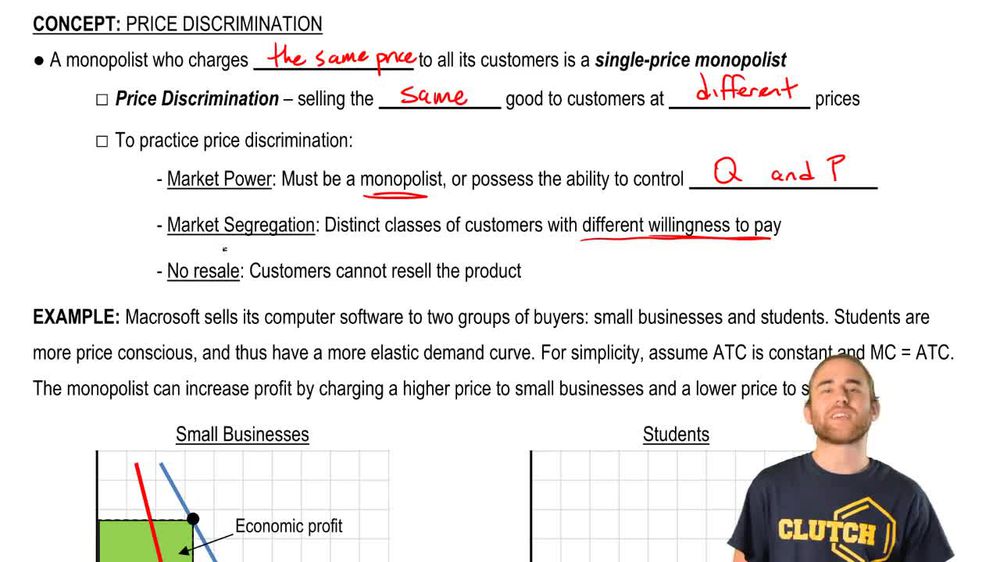
 07:45
07:45