Skip to main content
Macroeconomics
My Course
Learn
Exam Prep
AI Tutor
Study Guides
Flashcards
Explore
Try the app
My Course
Learn
Exam Prep
AI Tutor
Study Guides
Flashcards
Explore
Try the app
Back
PPF - Increasing Marginal Opportunity Costs and Allocative Efficiency definitions
You can tap to flip the card.
Production Possibility Frontier
You can tap to flip the card.
👆
Production Possibility Frontier
A curve showing all possible combinations of two goods an economy can produce using all resources efficiently.
Track progress
Control buttons has been changed to "navigation" mode.
1/15
Related flashcards
Related practice
Recommended videos
PPF - Increasing Marginal Opportunity Costs and Allocative Efficiency quiz
PPF - Increasing Marginal Opportunity Costs and Allocative Efficiency
15 Terms
PPF - Increasing Marginal Opportunity Costs and Allocative Efficiency
2. Introductory Economic Models
10 problems
Topic
PPF - Outward Shifts
2. Introductory Economic Models
10 problems
Topic
2. Introductory Economic Models
6 topics
15 problems
Chapter
03:33
PPF - Graphing Increasing Marginal Opportunity Costs
17
views
1
rank
05:04
PPF - The Law of Increasing Opportunity Costs
3
views
Terms in this set (15)
Hide definitions
Production Possibility Frontier
A curve showing all possible combinations of two goods an economy can produce using all resources efficiently.
Marginal Opportunity Cost
The additional amount of one good forgone to produce one more unit of another good, increasing as production shifts.
Law of Increasing Opportunity Cost
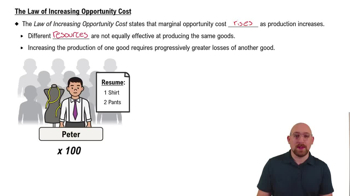
As more of a good is produced, the opportunity cost of producing each additional unit rises due to resource specialization.
Allocative Efficiency
The optimal production mix where consumer preferences are met and marginal benefit equals marginal cost.
Productive Efficiency
A situation where goods are produced using all resources without waste, represented by points on the PPF curve.
Marginal Benefit
The extra value consumers place on one more unit of a good, typically decreasing as quantity increases.
Marginal Cost
The additional cost, in terms of forgone goods, of producing one more unit, often rising with increased output.
Arc Method
A technique for calculating the average slope between two points on a curve, used to plot marginal cost on a PPF.
Resource Specialization
The tendency for certain resources to be better suited for producing specific goods, leading to increasing opportunity costs.
Trade-off
A decision involving the sacrifice of one good to gain more of another, inherent in resource allocation.
Bowed-Outward Curve
A PPF shape reflecting increasing marginal opportunity costs as production shifts between goods.
Consumer Preferences
The subjective values and desires that determine the optimal mix of goods for allocative efficiency.
Willingness to Pay
The maximum amount a consumer values an additional unit of a good, used to measure marginal benefit.
Efficient Quantity
The specific output level where marginal benefit equals marginal cost, maximizing overall satisfaction.
Resource Allocation
The distribution of inputs among different production activities to achieve efficiency and meet preferences.
 BackBack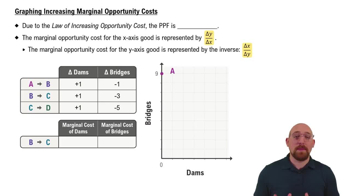
 03:33
03:33