Skip to main content
Macroeconomics
My Course
Learn
Exam Prep
AI Tutor
Study Guides
Flashcards
Explore
Try the app
My Course
Learn
Exam Prep
AI Tutor
Study Guides
Flashcards
Explore
Try the app
Back
Monopsony quiz
You can tap to flip the card.
What is a monopsony?
You can tap to flip the card.
👆
What is a monopsony?
A monopsony is a market with a single buyer, often seen in labor markets where one firm hires all workers.
Track progress
Control buttons has been changed to "navigation" mode.
1/15
Related flashcards
Recommended videos
Monopsony definitions
Monopsony
14 Terms
Guided course
03:52
Monopsony and Minimum Wage
1
views
Guided course
07:18
Monopsony
1
views
Terms in this set (15)
Hide definitions
What is a monopsony?
A monopsony is a market with a single buyer, often seen in labor markets where one firm hires all workers.
How does a monopsony differ from a monopoly?
A monopoly is a single seller in a market, while a monopsony is a single buyer.
In what type of market is a monopsony most commonly found?
Monopsonies are most commonly found in labor markets where one firm is the main employer.
How does a monopsony determine the number of workers to hire?
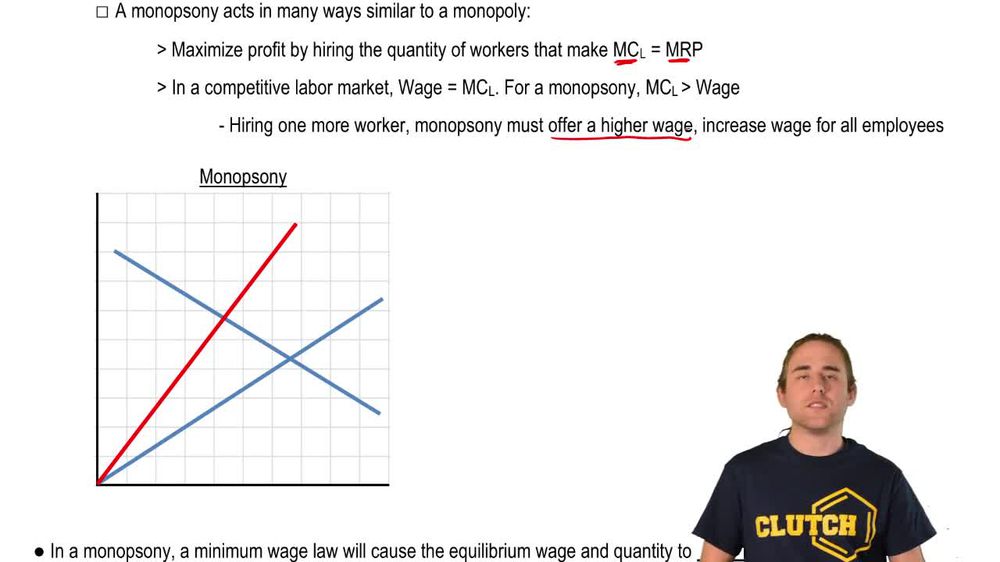
A monopsony hires workers where the marginal cost of labor equals the marginal revenue product of labor.
Why is the marginal cost of labor higher than the wage in a monopsony?
Because hiring an additional worker requires raising the wage for all employees, not just the new hire.
What happens to wages and employment in a monopsony compared to a competitive market?
Wages and employment are lower in a monopsony than in a competitive market.
How does the supply curve of labor relate to the wage paid in a monopsony?
The wage paid is where the supply curve touches the hiring point, which is lower than the competitive equilibrium wage.
What effect does a monopsony have on the quantity of labor hired?
A monopsony hires fewer workers than would be hired in a competitive market.
How does a minimum wage law affect a monopsony labor market?
A minimum wage law increases both the wage and the quantity of labor hired, moving the market toward competitive equilibrium.
What happens to the marginal cost of labor when a minimum wage is implemented in a monopsony?
The marginal cost of labor becomes equal to the minimum wage up to the equilibrium quantity.
Why does a minimum wage law help workers in a monopsony?
It prevents the monopsony from paying below-equilibrium wages and increases employment to competitive levels.
What is the derived demand for labor in a monopsony?
The firm's demand for labor is based on the marginal revenue product, or what workers can produce for the firm.
How does the marginal cost curve in a monopsony compare to the supply curve?
The marginal cost curve is steeper than the supply curve because hiring more workers raises wages for all employees.
What is the main similarity between a monopoly and a monopsony?
Both maximize profits by equating marginal cost and marginal revenue, but from opposite sides of the market.
What is the outcome if a minimum wage is set at the competitive equilibrium wage in a monopsony?
The labor market returns to competitive equilibrium, with higher wages and more workers hired.
 BackBack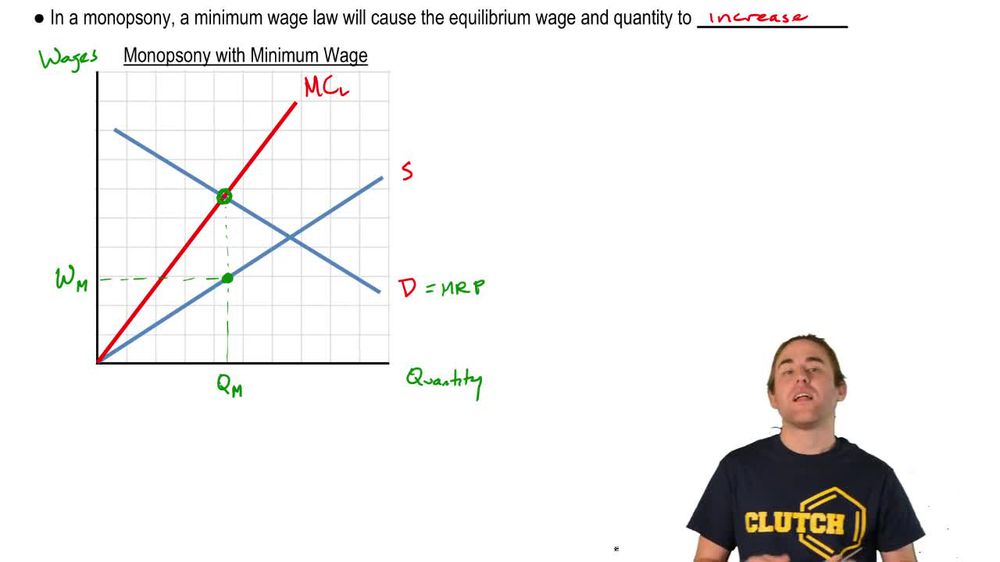
 03:52
03:52