Skip to main content
Macroeconomics
My Course
Learn
Exam Prep
AI Tutor
Study Guides
Flashcards
Explore
Try the app
My Course
Learn
Exam Prep
AI Tutor
Study Guides
Flashcards
Explore
Try the app
Back
Monopsony definitions
You can tap to flip the card.
Monopsony
You can tap to flip the card.
👆
Monopsony
A market structure with a single buyer, often resulting in lower wages and employment compared to competitive markets.
Track progress
Control buttons has been changed to "navigation" mode.
1/14
Related flashcards
Recommended videos
Monopsony quiz
Monopsony
15 Terms
Guided course
03:52
Monopsony and Minimum Wage
1
views
Guided course
07:18
Monopsony
1
views
Terms in this set (14)
Hide definitions
Monopsony
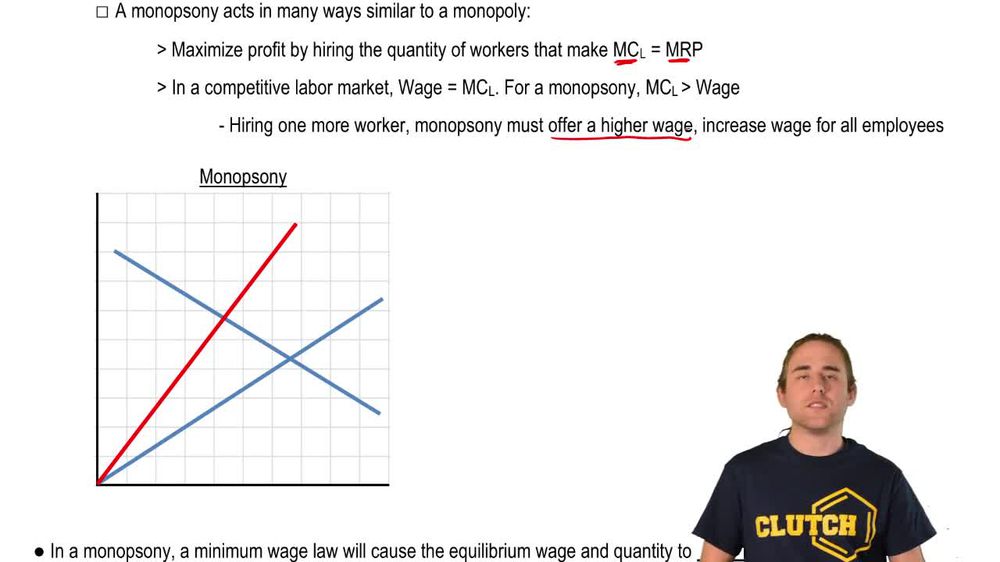
A market structure with a single buyer, often resulting in lower wages and employment compared to competitive markets.
Labor Market
A setting where firms hire workers and wages are determined by the interaction of labor supply and demand.
Marginal Cost of Labor
The additional expense incurred by hiring one more worker, including wage increases for all current employees.
Marginal Revenue Product
The extra output value generated by employing one more worker, guiding firms' hiring decisions.
Supply Curve of Labor
A graphical representation showing the relationship between wage levels and the quantity of labor supplied.
Demand Curve for Labor
A graphical line reflecting how many workers firms want to hire at various wage rates, based on productivity.
Equilibrium Wage
The pay rate where labor supply equals labor demand, typically higher in competitive markets than in monopsonies.
Equilibrium Quantity
The number of workers employed where labor supply and demand intersect, often reduced in monopsony situations.
Minimum Wage
A legally set wage floor that can raise both pay and employment in markets dominated by a single employer.
Wage Floor
A government-imposed lower limit on wages, preventing employers from paying below a certain amount.
Profit Maximization
The process by which firms determine the optimal number of workers to hire by equating marginal cost and marginal revenue product.
Derived Demand
The need for labor that arises from the demand for the goods and services produced by workers.
Market Power
The ability of a firm to influence wages and employment levels due to its dominant position as the sole buyer.
Competitive Market
A market with many buyers and sellers, leading to wage and employment levels set by supply and demand without single-firm influence.
 BackBack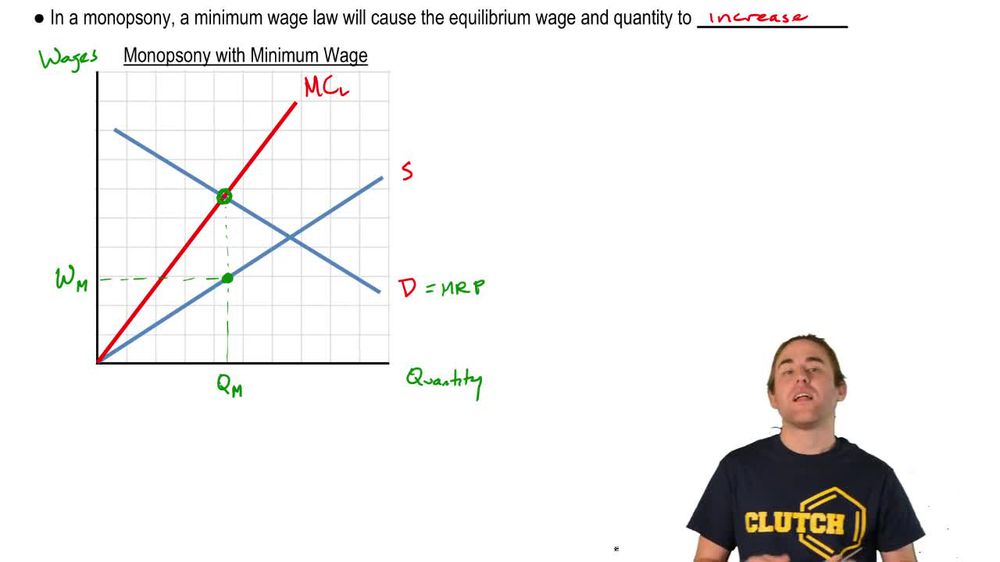
 03:52
03:52