Skip to main content
Macroeconomics
My Course
Learn
Exam Prep
AI Tutor
Study Guides
Flashcards
Explore
Try the app
My Course
Learn
Exam Prep
AI Tutor
Study Guides
Flashcards
Explore
Try the app
Back
Monopoly Revenue quiz
You can tap to flip the card.
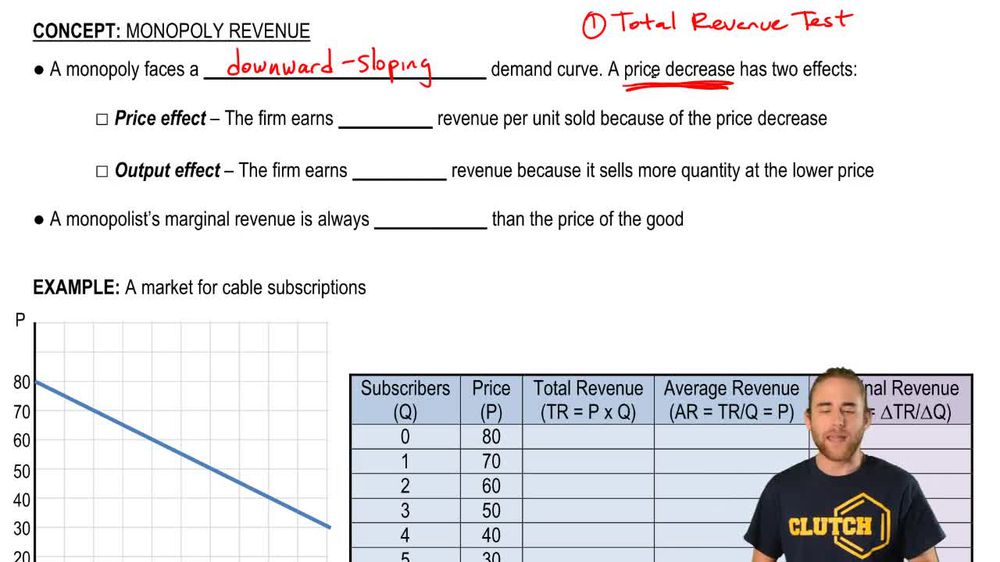
What type of demand curve does a monopoly face?
You can tap to flip the card.
👆
What type of demand curve does a monopoly face?
A monopoly faces a downward sloping demand curve.
Track progress
Control buttons has been changed to "navigation" mode.
1/15
Related flashcards
Recommended videos
Monopoly Revenue definitions
Monopoly Revenue
13 Terms
Guided course
06:43
Monopoly and Marginal Revenue
Guided course
03:37
Monopoly Revenue
Terms in this set (15)
Hide definitions
What type of demand curve does a monopoly face?
A monopoly faces a downward sloping demand curve.
How does the demand curve faced by a monopoly differ from that in perfect competition?
In perfect competition, the firm faces a flat (horizontal) demand curve, while a monopoly faces a downward sloping demand curve.
What are the two main effects on revenue when a monopoly changes its price?
The two main effects are the price effect and the output effect.
What is the price effect when a monopoly lowers its price?
The price effect means the firm earns less revenue per unit sold because each unit is sold at a lower price.
What is the output effect when a monopoly lowers its price?
The output effect means the firm sells more units, increasing total revenue from the higher quantity sold.
How do the price effect and output effect interact when a monopoly changes its price?
They work in opposite directions: the price effect reduces revenue per unit, while the output effect increases revenue by selling more units.
What happens to marginal revenue when a monopoly lowers its price?
Marginal revenue is always less than the price because of the combined price and output effects.
Why is marginal revenue less than price for a monopoly?
Because lowering the price to sell more units reduces the revenue earned on all units, not just the additional ones sold.
How does raising the price affect the price and output effects for a monopoly?
Raising the price increases revenue per unit (price effect) but decreases the number of units sold (output effect).
In perfect competition, how does price relate to marginal revenue?
In perfect competition, price equals marginal revenue.
What is the key difference in revenue analysis between monopoly and perfect competition?
In monopoly, marginal revenue is less than price, while in perfect competition, marginal revenue equals price.
How does the concept of monopoly revenue relate to monopolistic competition?
The analysis of monopoly revenue is exactly the same as for monopolistic competition.
What happens to total revenue if the output effect outweighs the price effect when a monopoly lowers its price?
Total revenue increases if the output effect is stronger than the price effect.
What happens to total revenue if the price effect outweighs the output effect when a monopoly lowers its price?
Total revenue decreases if the price effect is stronger than the output effect.
Why is understanding the price and output effects important for monopolies?
It helps monopolies manage pricing strategies to maximize revenue despite demand elasticity and diminishing marginal productivity.
 BackBack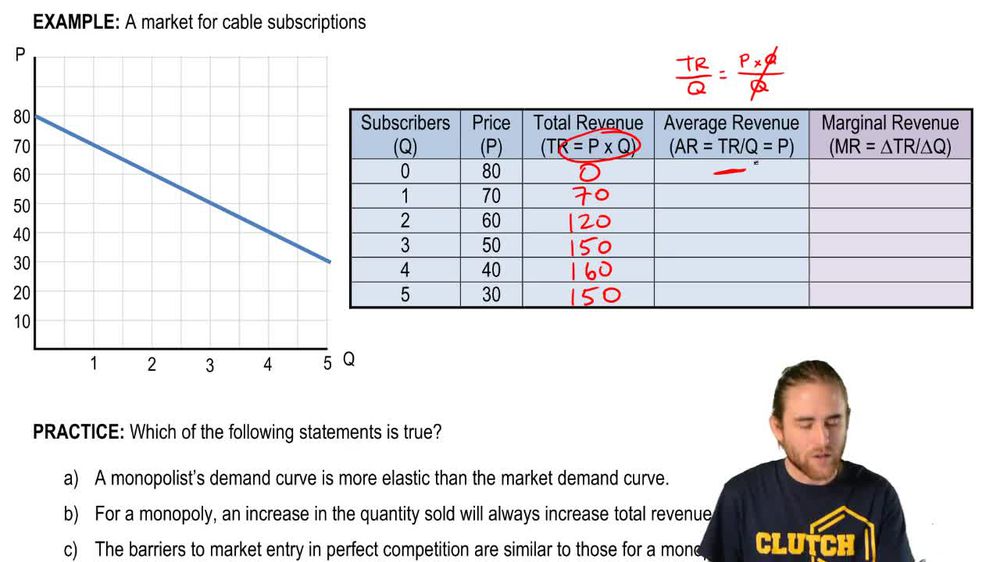
 06:43
06:43