Skip to main content
Macroeconomics
My Course
Learn
Exam Prep
AI Tutor
Study Guides
Flashcards
Explore
Try the app
My Course
Learn
Exam Prep
AI Tutor
Study Guides
Flashcards
Explore
Try the app
Back
Monopoly Revenue definitions
You can tap to flip the card.
Monopoly
You can tap to flip the card.
👆
Monopoly
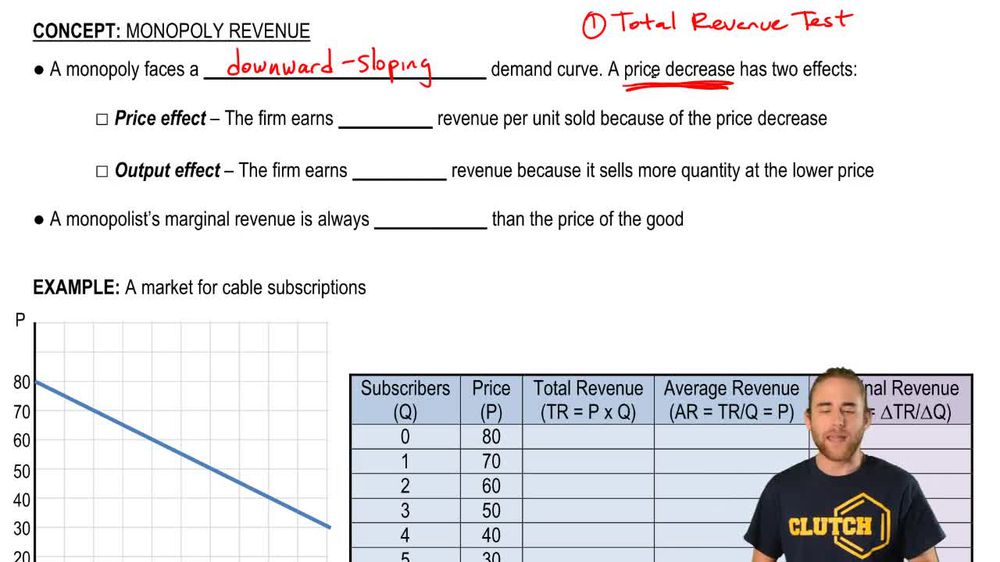
A single seller dominates the market, facing a downward sloping demand curve and controlling price and output.
Track progress
Control buttons has been changed to "navigation" mode.
1/13
Related flashcards
Recommended videos
Monopoly Revenue quiz
Monopoly Revenue
15 Terms
Guided course
06:43
Monopoly and Marginal Revenue
Guided course
03:37
Monopoly Revenue
Terms in this set (13)
Hide definitions
Monopoly
A single seller dominates the market, facing a downward sloping demand curve and controlling price and output.
Demand Curve
A graphical representation showing the relationship between price and quantity demanded, sloping downward for monopolies.
Marginal Revenue
The additional income from selling one more unit, always less than price for a monopolist due to price and output effects.
Average Revenue
Total revenue divided by quantity sold, equal to the price in both monopoly and perfect competition.
Price Effect
The change in revenue resulting from selling each unit at a different price when price changes.
Output Effect
The change in revenue caused by selling more or fewer units as a result of a price change.
Perfect Competition
A market structure where many firms sell identical products and face a flat demand curve.
Monopolistic Competition
A market structure with many firms selling differentiated products, sharing revenue characteristics with monopoly.
Total Revenue
The overall income a firm receives from selling its product, calculated as price times quantity sold.
Elasticity
A measure of how much quantity demanded responds to a change in price, influencing monopoly pricing strategies.
Pricing Strategy
The approach a firm uses to set prices, balancing price and output effects to maximize revenue.
Market Structure
The organizational and competitive characteristics of a market, such as monopoly or perfect competition.
Revenue Maximization
The process of adjusting price and output to achieve the highest possible income for the firm.
 BackBack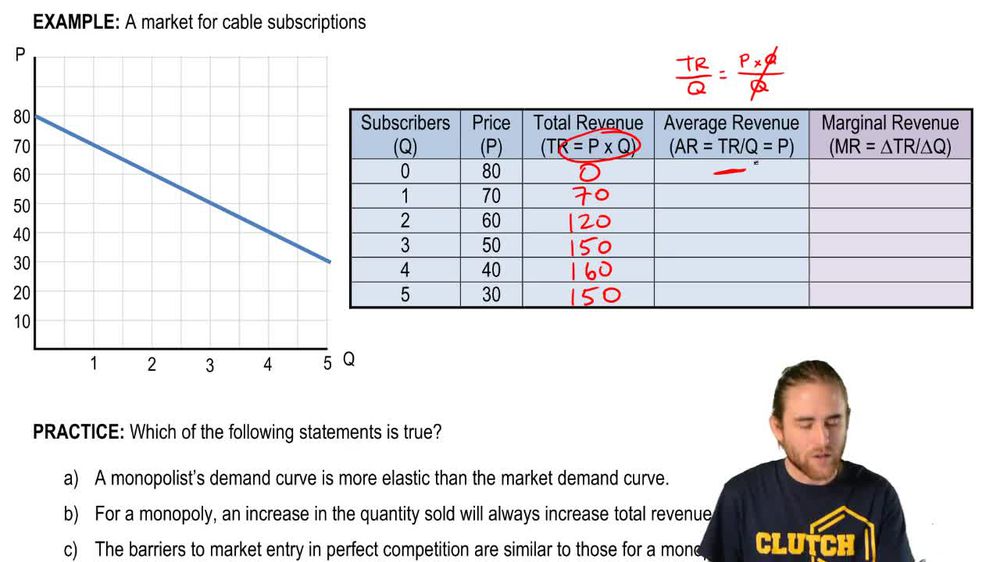
 06:43
06:43