What happens to economic profit in monopolistic competition in the long run?
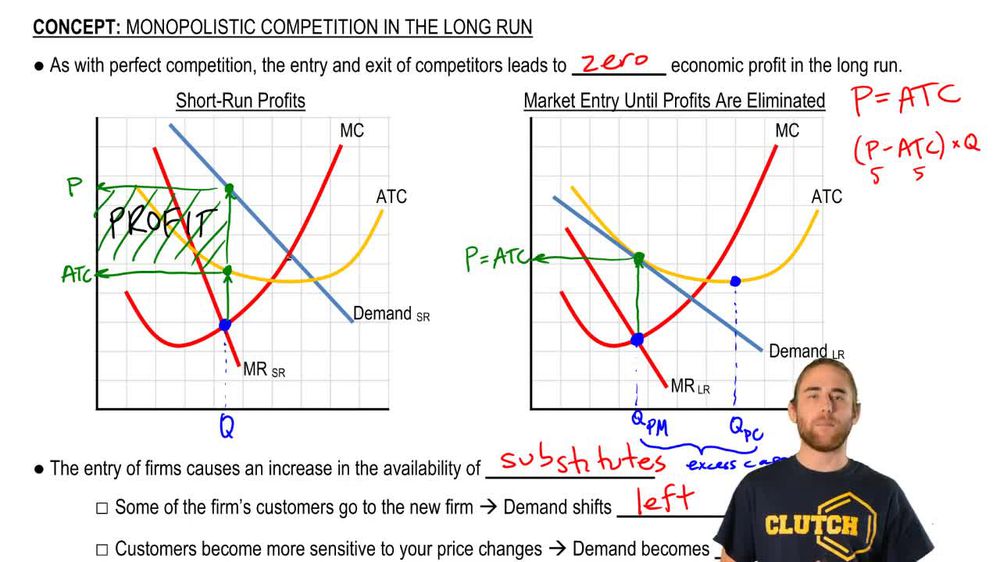
Economic profit is eliminated in the long run as price equals average total cost due to firm entry and exit.
How does the entry of new firms affect the demand curve for an existing firm in monopolistic competition?
The demand curve shifts to the left and becomes more elastic as customers have more substitutes.
At what point does a firm in monopolistic competition maximize profit?
A firm maximizes profit where marginal revenue equals marginal cost (MR = MC).
Why do firms in monopolistic competition not produce at minimum average total cost in the long run?
Because the downward-sloping demand curve only touches the ATC curve above its minimum, resulting in excess capacity.
What is excess capacity in monopolistic competition?
Excess capacity is when firms produce less than the quantity that would minimize average total cost.
How does product differentiation help firms in monopolistic competition stay profitable?
Product differentiation increases demand elasticity and prevents competitors from eroding profits.
What happens to the price and average total cost in the long-run equilibrium of monopolistic competition?
In long-run equilibrium, price equals average total cost, resulting in zero economic profit.
How does the demand curve in monopolistic competition differ from perfect competition in the long run?
In monopolistic competition, the demand curve is downward-sloping and only touches the ATC curve above its minimum, unlike the horizontal demand curve in perfect competition.
What causes the demand curve to become more elastic in monopolistic competition?
The entry of new firms and increased availability of substitutes make customers more sensitive to price changes.
Why can't firms in monopolistic competition achieve minimum average total cost?
Because the downward-sloping demand curve prevents the firm from producing at the minimum point of the ATC curve.
What is the main trade-off faced by firms in monopolistic competition?
Firms face a trade-off between cost efficiency and product differentiation.
What happens to short-run profits in monopolistic competition over time?
Short-run profits attract new entrants, which eventually eliminate profits in the long run.
How do firms respond to increased competition in monopolistic competition?
Firms differentiate their products to maintain profitability and attract customers.
What is the significance of the tangent condition in monopolistic competition graphs?
The tangent condition shows where the demand curve touches the ATC curve at one point, but not at its minimum.
Why do firms in monopolistic competition continue to innovate and differentiate their products?
Continuous innovation and differentiation are necessary to prevent competitors from eroding profits and to stay profitable.
 Back
Back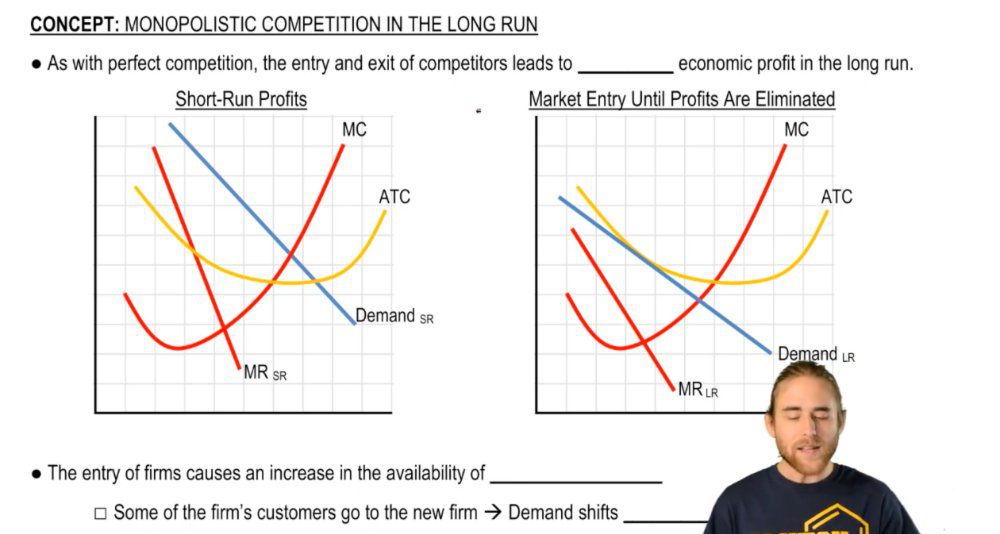
 09:47
09:47