Skip to main content
Macroeconomics
My Course
Learn
Exam Prep
AI Tutor
Study Guides
Flashcards
Explore
Try the app
My Course
Learn
Exam Prep
AI Tutor
Study Guides
Flashcards
Explore
Try the app
Back
Monopolistic Competition in the Long Run definitions
You can tap to flip the card.
Monopolistic Competition
You can tap to flip the card.
👆
Monopolistic Competition
A market structure with many firms offering differentiated products and free entry and exit.
Track progress
Control buttons has been changed to "navigation" mode.
1/15
Related flashcards
Recommended videos
Monopolistic Competition in the Long Run quiz
Monopolistic Competition in the Long Run
15 Terms
Guided course
09:47
Monopolistic Competition in the Long Run
1
views
Guided course
01:33
How Companies Stay Profitable
1
views
Terms in this set (15)
Hide definitions
Monopolistic Competition
A market structure with many firms offering differentiated products and free entry and exit.
Long-Run Equilibrium
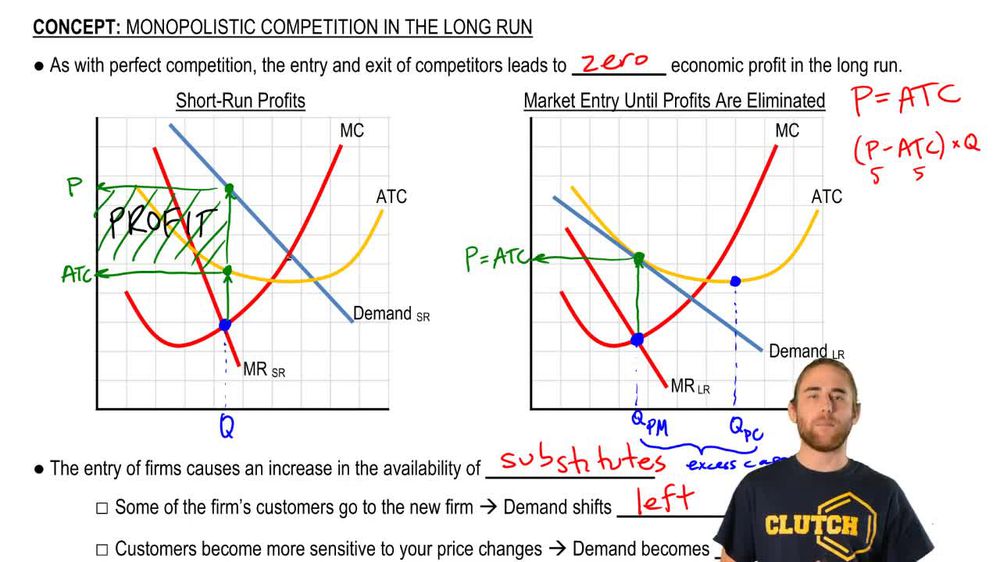
A state where price equals average total cost and economic profit is eliminated due to firm entry and exit.
Average Total Cost
The total cost per unit of output, including both fixed and variable costs, used to determine profit or loss.
Economic Profit
The surplus remaining after subtracting all costs, including opportunity costs, from total revenue.
Product Differentiation
The process of making a product distinct from competitors through features, branding, or quality.
Excess Capacity
The gap between the profit-maximizing output and the output at minimum average total cost, indicating inefficiency.
Demand Curve
A graphical representation showing the relationship between price and quantity demanded for a firm's product.
Elasticity
A measure of how sensitive quantity demanded is to changes in price, increasing with more substitutes.
Marginal Revenue
The additional income generated from selling one more unit of output.
Marginal Cost
The increase in total cost resulting from producing one additional unit of output.
Entry
The process by which new firms join a market, increasing competition and reducing profits.
Exit
The process by which firms leave a market, often due to sustained losses.
Substitute
A product that can replace another, increasing consumer choice and demand elasticity.
Profit-Maximizing Output
The quantity where marginal revenue equals marginal cost, yielding the highest possible profit.
Tangent Condition
A situation where the demand curve touches the average total cost curve at only one point, indicating zero profit.
 BackBack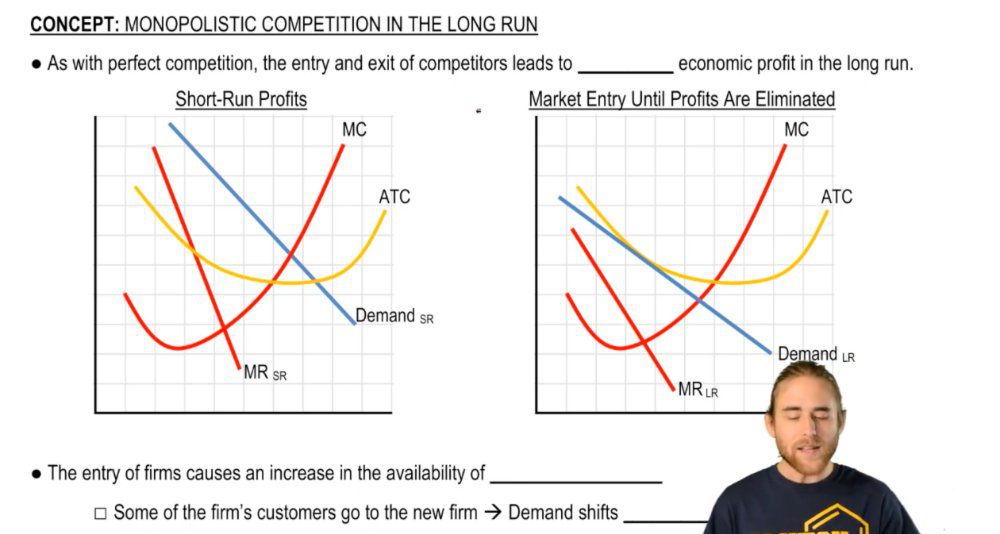
 09:47
09:47