Skip to main content
Macroeconomics
My Course
Learn
Exam Prep
AI Tutor
Study Guides
Flashcards
Explore
Try the app
My Course
Learn
Exam Prep
AI Tutor
Study Guides
Flashcards
Explore
Try the app
Back
Long Run Equilibrium definitions
You can tap to flip the card.
Long Run Equilibrium
You can tap to flip the card.
👆
Long Run Equilibrium
A market state where price equals minimum average total cost and firms earn zero economic profit, even after demand or supply changes.
Track progress
Control buttons has been changed to "navigation" mode.
1/15
Related flashcards
Recommended videos
Long Run Equilibrium quiz
Long Run Equilibrium
15 Terms
Guided course
07:04
Long Run Equilibrium
Terms in this set (15)
Hide definitions
Long Run Equilibrium
A market state where price equals minimum average total cost and firms earn zero economic profit, even after demand or supply changes.
Perfect Competition
A market structure with many firms selling identical products, allowing free entry and exit, and no single firm can influence price.
Average Total Cost
A firm's total cost divided by output, showing the per-unit cost of production at various output levels.
Marginal Cost
The additional cost incurred from producing one more unit of output, crucial for determining optimal production.
Marginal Revenue
The extra revenue gained from selling one more unit, equal to price in perfectly competitive markets.
Economic Profit
The difference between total revenue and total costs, including opportunity costs; zero in long-run equilibrium.
Demand Curve
A graphical representation showing the relationship between price and quantity demanded at various prices.
Supply Curve
A graphical representation showing the relationship between price and quantity supplied at various prices.
Entry
The process by which new firms join a market, typically attracted by short-run profits, increasing market supply.
Exit
The process by which firms leave a market, usually due to losses, reducing market supply.
Aggregate Demand
The total demand for a product in the market, influencing price and quantity when it shifts.
Market Supply
The total quantity of a good that all firms in a market are willing to sell at each price.
Zero Economic Profit
A situation where total revenue equals total costs, including opportunity costs, leaving no incentive for entry or exit.
Short Run Profit
A temporary situation where firms earn above-normal returns due to a sudden increase in demand.
Minimum ATC
The lowest point on the average total cost curve, indicating the most efficient scale of production.
 BackBack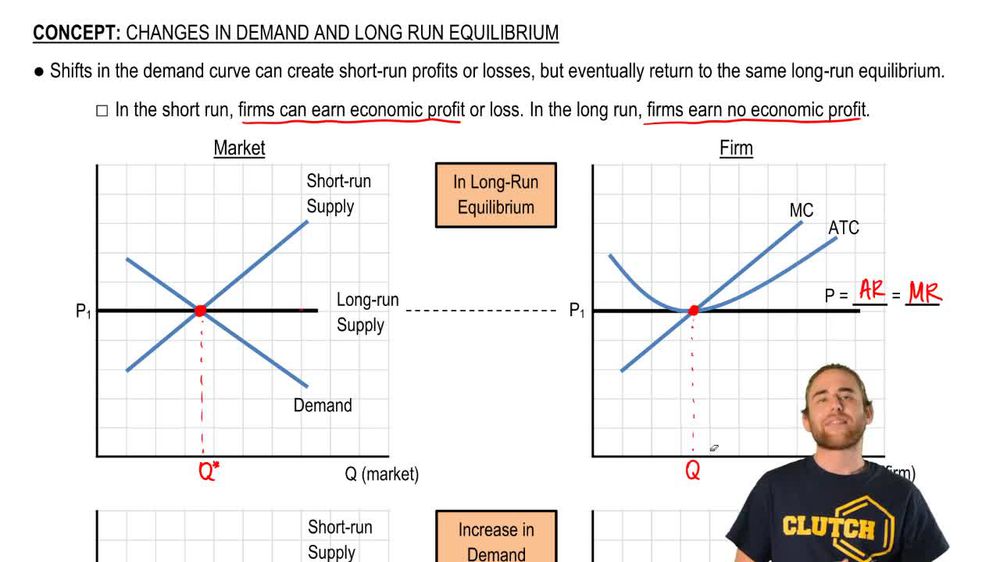
 07:04
07:04