A persistent government budget deficit occurs when tax revenues are less than government spending, requiring the government to borrow funds to cover the gap.
What is the crowding out effect in fiscal policy?
The crowding out effect happens when government borrowing competes with firms for loanable funds, driving up interest rates.
How does government borrowing affect interest rates?
Government borrowing increases the demand for loanable funds, which drives up the price of money, resulting in higher interest rates.
What is the impact of higher interest rates on investment spending?
Higher interest rates lead to decreased investment spending because investors prefer lower rates for higher profits.
How does reduced investment spending affect long-run economic growth?
Reduced investment spending stunts long-run economic growth by limiting capital investments like factories and equipment.
What are the long-term implications of a government budget deficit on GDP?
A government budget deficit can stunt the long-run growth of GDP by reducing investment and capital formation.
How does increased government debt affect future budgets?
Increased government debt leads to higher future interest payments, putting pressure on future budgets.
What fiscal actions might governments take to address high debt in the future?
Governments may need to increase taxes or cut spending to pay off debt and manage future budget pressures.
What is the recommended fiscal policy during recessions and expansions?
Governments should increase spending during recessions and run surpluses during expansions to balance the budget over time.
Does government spending typically decrease during economic expansions?
In practice, government spending often does not decrease during expansions, making it hard to balance the budget.
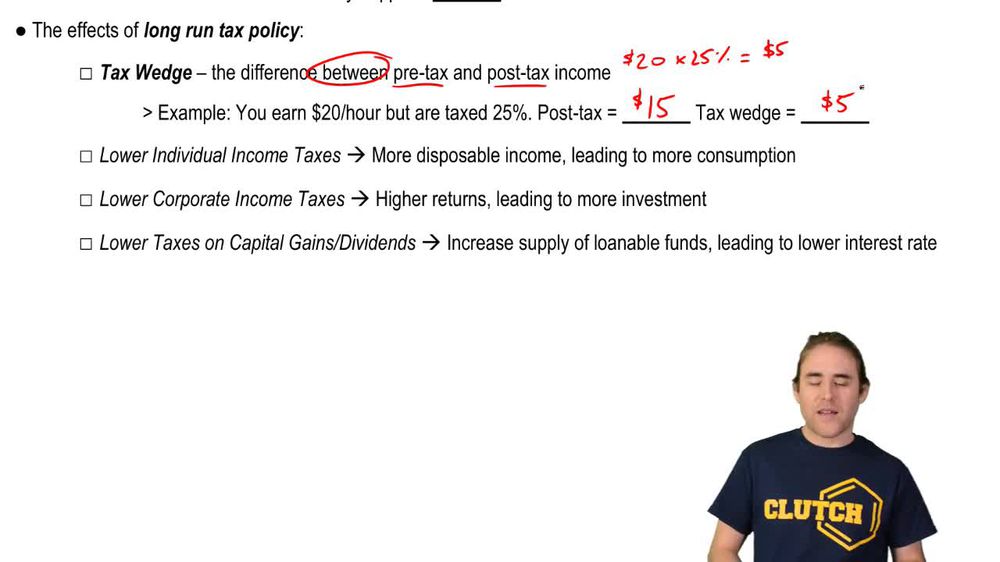
What is the tax wedge?
The tax wedge is the difference between pretax and post-tax income, representing the portion of earnings taken by taxes.
How do lower individual taxes affect disposable income and consumption?
Lower individual taxes increase disposable income, leading to higher consumption.
What is the effect of lower corporate taxes on investment?
Lower corporate taxes result in higher returns for firms, encouraging more investment.
How do lower taxes influence the supply of loanable funds?
Lower taxes increase the supply of loanable funds by incentivizing households to save more.
Why must lower taxes be balanced with government spending?
Lower taxes must be balanced with reduced government spending to maintain a balanced budget and avoid deficits.
 Back
Back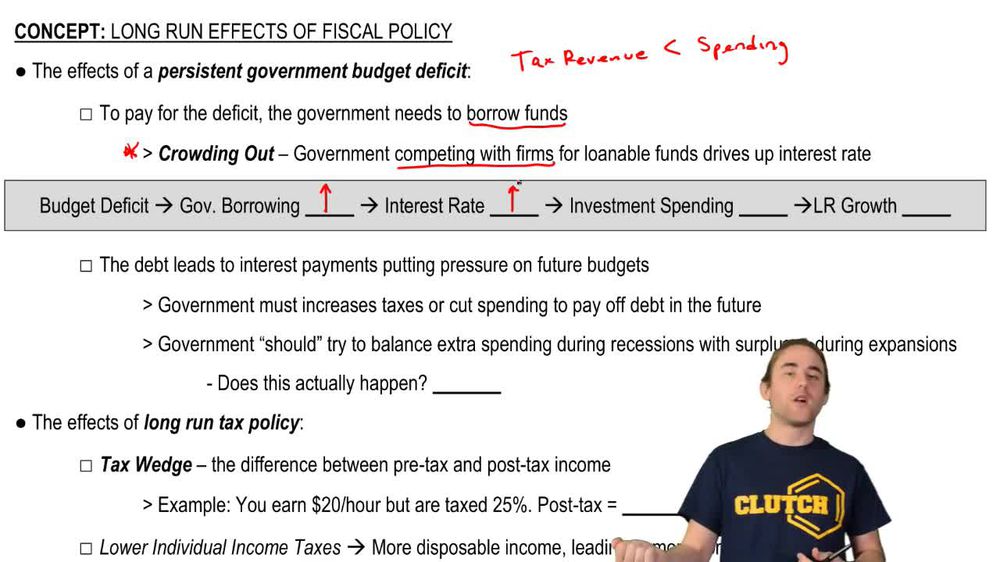
 03:39
03:39