Skip to main content
Macroeconomics
My Course
Learn
Exam Prep
AI Tutor
Study Guides
Flashcards
Explore
Try the app
My Course
Learn
Exam Prep
AI Tutor
Study Guides
Flashcards
Explore
Try the app
Back
Indifference Curves for Perfect Substitutes and Perfect Complements quiz
You can tap to flip the card.
What shape do indifference curves for perfect substitutes take?
You can tap to flip the card.
👆
What shape do indifference curves for perfect substitutes take?
Indifference curves for perfect substitutes are straight lines, reflecting a constant rate of substitution between the goods.
Track progress
Control buttons has been changed to "navigation" mode.
1/15
Related flashcards
Recommended videos
Indifference Curves for Perfect Substitutes and Perfect Complements definitions
Indifference Curves for Perfect Substitutes and Perfect Complements
12 Terms
Guided course
04:02
Indifference Curves for Perfect Substitutes and Perfect Complements
Terms in this set (15)
Hide definitions
What shape do indifference curves for perfect substitutes take?
Indifference curves for perfect substitutes are straight lines, reflecting a constant rate of substitution between the goods.
Why are \$5 bills and \$10 bills considered perfect substitutes in the example?
Because you are indifferent between two \$5 bills and one \$10 bill, as both equal \$10 in value.
What is the marginal rate of substitution (MRS) for perfect substitutes?
The MRS is constant for perfect substitutes, meaning you always trade at the same rate, such as 2 \$5 bills for 1 \$10 bill.
How do indifference curves for perfect complements differ from those for perfect substitutes?
Indifference curves for perfect complements are right-angled, while those for perfect substitutes are straight lines.
What is an example of perfect complements given in the lesson?
Left shoes and right shoes are perfect complements because you need equal amounts of each to form pairs.
Why does having more left shoes than right shoes not increase satisfaction with perfect complements?
Because you can only match pairs, extra left shoes without matching right shoes do not increase utility.
What happens to the indifference curve when you have more of one complement than the other?
The indifference curve becomes flat along the axis of the excess good, showing no increase in satisfaction.
How does the concept of perfect substitutes relate to utility maximization?
With perfect substitutes, consumers maximize utility by choosing combinations based on the constant rate of substitution.
What does the right angle in the indifference curve for perfect complements represent?
It represents the point where the quantities of both goods are equal, maximizing satisfaction.
Why are perfect substitutes and perfect complements considered 'special cases' in indifference curve analysis?
Because their indifference curves have unique shapes—straight lines or right angles—unlike typical convex curves.
What is the significance of the budget constraint in consumer choice theory?
The budget constraint limits the combinations of goods a consumer can afford, affecting their utility maximization.
How does the marginal rate of substitution (MRS) behave for perfect complements?
For perfect complements, the MRS is undefined except at the right angle, since satisfaction only increases with equal increments of both goods.
What does it mean to be 'indifferent' between two bundles of goods?
It means the consumer receives the same level of satisfaction from either bundle.
How do indifference curves for perfect substitutes reflect consumer preferences?
They show that the consumer is willing to trade one good for another at a constant rate, indicating equal preference.
Why are real-world examples of perfect substitutes and complements considered 'silly' or rare?
Because most goods are not perfectly substitutable or complementary; these cases are idealized for theoretical analysis.
 BackBack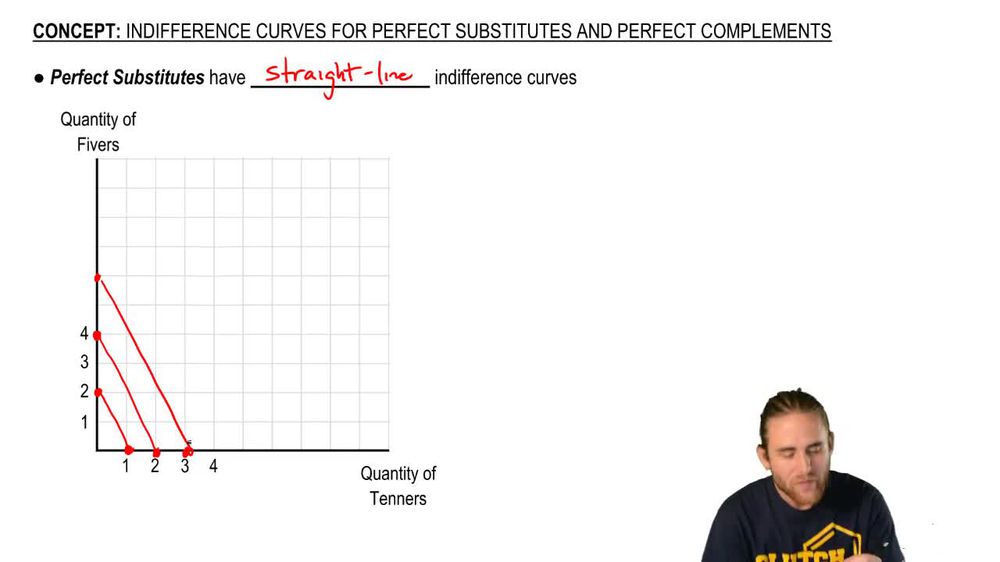
 04:02
04:02