Skip to main content
Macroeconomics
My Course
Learn
Exam Prep
AI Tutor
Study Guides
Flashcards
Explore
Try the app
My Course
Learn
Exam Prep
AI Tutor
Study Guides
Flashcards
Explore
Try the app
Back
Indifference Curves for Perfect Substitutes and Perfect Complements definitions
You can tap to flip the card.
Indifference Curve
You can tap to flip the card.
👆
Indifference Curve
A graphical representation showing combinations of two goods between which a consumer is equally satisfied.
Track progress
Control buttons has been changed to "navigation" mode.
1/12
Related flashcards
Recommended videos
Indifference Curves for Perfect Substitutes and Perfect Complements quiz
Indifference Curves for Perfect Substitutes and Perfect Complements
15 Terms
Guided course
04:02
Indifference Curves for Perfect Substitutes and Perfect Complements
Terms in this set (12)
Hide definitions
Indifference Curve
A graphical representation showing combinations of two goods between which a consumer is equally satisfied.
Perfect Substitutes
Goods that can replace each other at a constant rate, leading to straight line indifference curves.
Perfect Complements
Goods consumed together in fixed proportions, resulting in right-angled indifference curves.
Marginal Rate of Substitution
The constant rate at which one good is exchanged for another while maintaining the same satisfaction.
Straight Line Indifference Curve
A visual outcome when two goods can be swapped at a fixed rate, reflecting perfect substitutability.
Right-Angled Indifference Curve
A graphical shape formed when satisfaction depends on consuming goods in equal amounts, as with perfect complements.
Consumer Preferences
The ranking of different combinations of goods based on the satisfaction they provide.
Utility Maximization
The process of choosing combinations of goods that provide the highest possible satisfaction.
Budget Constraint
A limitation representing the combinations of goods a consumer can afford given their income and prices.
Constant Marginal Rate of Substitution
A situation where the willingness to trade one good for another does not change along the indifference curve.
Equal Quantities
A requirement for maximum satisfaction with perfect complements, such as needing the same number of left and right shoes.
Consumer Choice Theory
A framework analyzing how individuals decide between different bundles of goods to maximize satisfaction.
 BackBack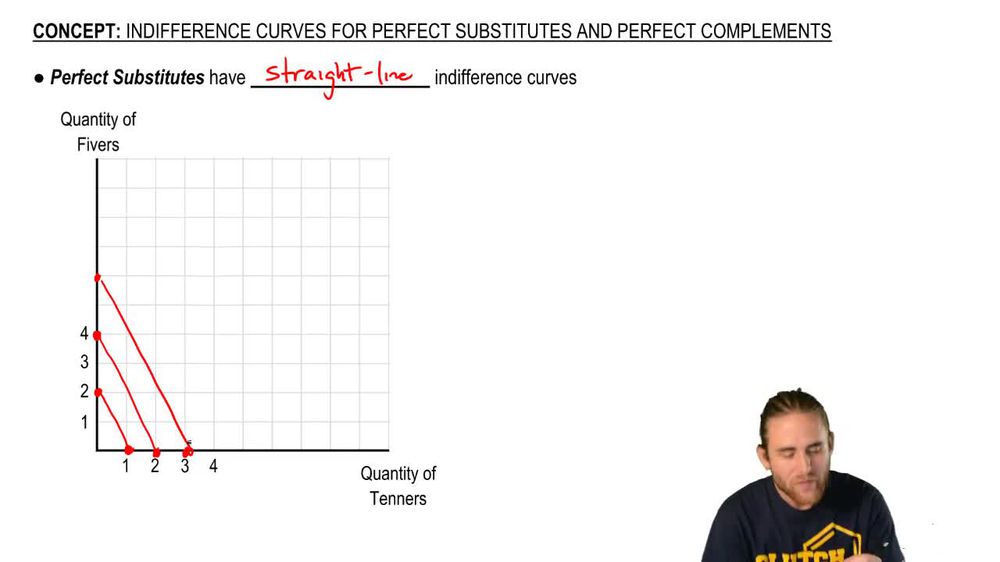
 04:02
04:02