Skip to main content
Macroeconomics
My Course
Learn
Exam Prep
AI Tutor
Study Guides
Flashcards
Explore
Try the app
My Course
Learn
Exam Prep
AI Tutor
Study Guides
Flashcards
Explore
Try the app
Back
History of the US Banking System quiz
You can tap to flip the card.
What was the main problem with U.S. banks issuing their own currency before 1864?
You can tap to flip the card.
👆
What was the main problem with U.S. banks issuing their own currency before 1864?
There was no uniform currency or significant regulation, leading to frequent bank panics and financial crises.
Track progress
Control buttons has been changed to "navigation" mode.
1/15
Related flashcards
Related practice
Recommended videos
History of the US Banking System definitions
History of the US Banking System
15 Terms
History of the US Banking System
17. The Monetary System
10 problems
Topic
The Financial Crisis of 2007-2009 (The Great Recession)
17. The Monetary System
10 problems
Topic
18. The Monetary System
7 topics
15 problems
Chapter
Guided course
09:10
History of the US Banking System
2
views
Terms in this set (15)
Hide definitions
What was the main problem with U.S. banks issuing their own currency before 1864?
There was no uniform currency or significant regulation, leading to frequent bank panics and financial crises.
What major change occurred in the U.S. banking system after 1864?
The federal government regulated national banks and introduced a uniform currency, but there was still no central bank.
Why was the money supply unresponsive to local economic conditions between 1864 and 1913?
Because there was no central bank to adjust the money supply based on local needs.
What event in 1907 highlighted the instability of the U.S. banking system?
The Panic of 1907, caused by risky investments by less-regulated trusts, led to financial instability and bank panics.
How did J.P. Morgan help stabilize the economy during the Panic of 1907?
He loaned reserves to banks, stopping the panic and stabilizing the economy.
What was the main purpose of establishing the Federal Reserve after 1907?
To centralize and control the money supply, aiming to prevent financial panics.
What role did plunging commodity prices play in the Great Depression?
They led to bank runs in the 1930s, deepening the economic downturn.
What was the Federal Reserve criticized for during the Great Depression?
Economists believe it mismanaged the crisis by not intervening effectively to stop the depression.
What did the Glass-Steagall Act of 1933 establish?
It created the FDIC to insure bank deposits and separated commercial banks from investment banks.
What is the purpose of FDIC insurance for bank deposits?
It insures deposits up to a certain amount, protecting customers if a bank fails.
How did the Glass-Steagall Act differentiate between commercial and investment banks?
Commercial banks were FDIC insured and handled deposits, while investment banks traded financial assets and were not insured.
What caused the savings and loan crisis of the 1980s?
Deregulation allowed savings and loan banks to make riskier investments, leading to failures and a government bailout.
Why did depositors withdraw funds from savings and loan banks in the 1970s?
High inflation made them seek higher interest rates in other accounts, prompting risky behavior by savings and loan banks.
What was the financial impact of the savings and loan crisis on taxpayers?
The government, and thus taxpayers, paid approximately \$124 billion to bail out the failed banks.
What recurring theme is seen in the history of U.S. banking crises?
Whenever regulation is lacking, banks tend to take excessive risks, leading to financial instability.
 BackBack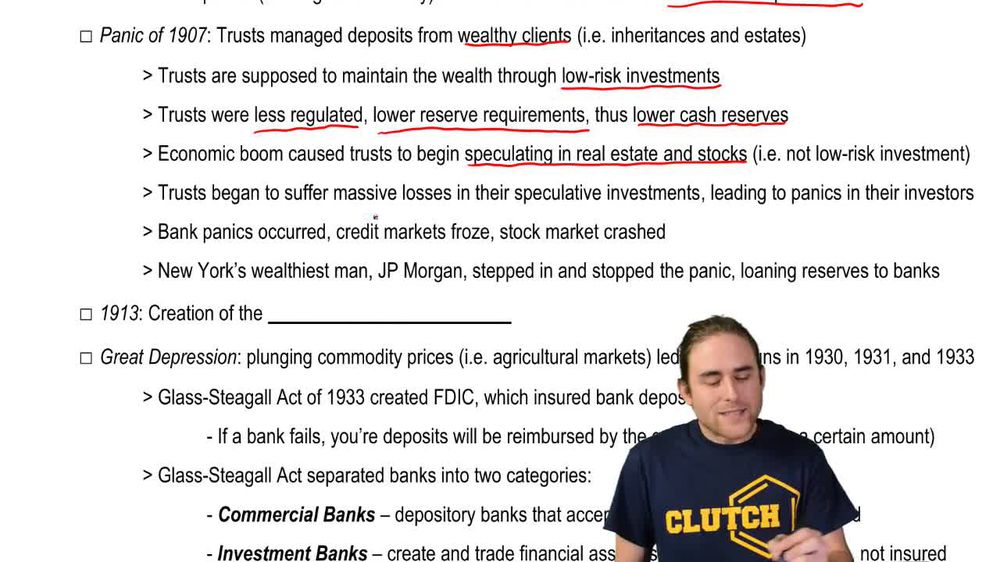
 09:10
09:10