Skip to main content
Macroeconomics
My Course
Learn
Exam Prep
AI Tutor
Study Guides
Flashcards
Explore
Try the app
My Course
Learn
Exam Prep
AI Tutor
Study Guides
Flashcards
Explore
Try the app
Back
History of the US Banking System definitions
You can tap to flip the card.
Uniform Currency
You can tap to flip the card.
👆
Uniform Currency
A standardized form of money issued nationwide, replacing individual bank notes and simplifying transactions across regions.
Track progress
Control buttons has been changed to "navigation" mode.
1/15
Related flashcards
Related practice
Recommended videos
History of the US Banking System quiz
History of the US Banking System
15 Terms
History of the US Banking System
17. The Monetary System
10 problems
Topic
The Financial Crisis of 2007-2009 (The Great Recession)
17. The Monetary System
10 problems
Topic
18. The Monetary System
7 topics
15 problems
Chapter
Guided course
09:10
History of the US Banking System
2
views
Terms in this set (15)
Hide definitions
Uniform Currency
A standardized form of money issued nationwide, replacing individual bank notes and simplifying transactions across regions.
Central Bank
An institution responsible for managing a nation's money supply and acting as a lender of last resort to stabilize the economy.
Bank Panic
A widespread rush by depositors to withdraw funds due to fears of insolvency, often leading to financial instability.
Bank Run
A situation where many customers withdraw deposits simultaneously, fearing the bank will fail and be unable to return their money.
Trust
A financial entity managing assets for wealthy clients, often with less regulation and lower reserve requirements than banks.
Speculation
The act of investing in high-risk assets with the hope of large returns, often contributing to financial crises.
Federal Reserve
The central banking system established to control the money supply and prevent financial panics in the United States.
Great Depression
A severe economic downturn in the 1930s marked by bank failures, plunging commodity prices, and widespread unemployment.
Glass-Steagall Act
A 1933 law that created deposit insurance and separated commercial banking from investment banking to reduce risk.
FDIC
A government agency insuring bank deposits up to a set limit, reassuring depositors their funds are protected even if a bank fails.
Commercial Bank
A financial institution accepting deposits and offering checking accounts, with deposits insured by the government.
Investment Bank
A financial institution focused on creating and trading financial assets, not covered by deposit insurance.
Savings and Loan Crisis
A 1980s financial disaster caused by deregulation and risky investments, resulting in massive government bailouts.
Money Market Account
A type of financial account offering higher interest rates, attracting depositors away from traditional savings institutions.
Commodity Prices
The market values of basic goods like agricultural products, whose declines can trigger economic downturns and bank runs.
 BackBack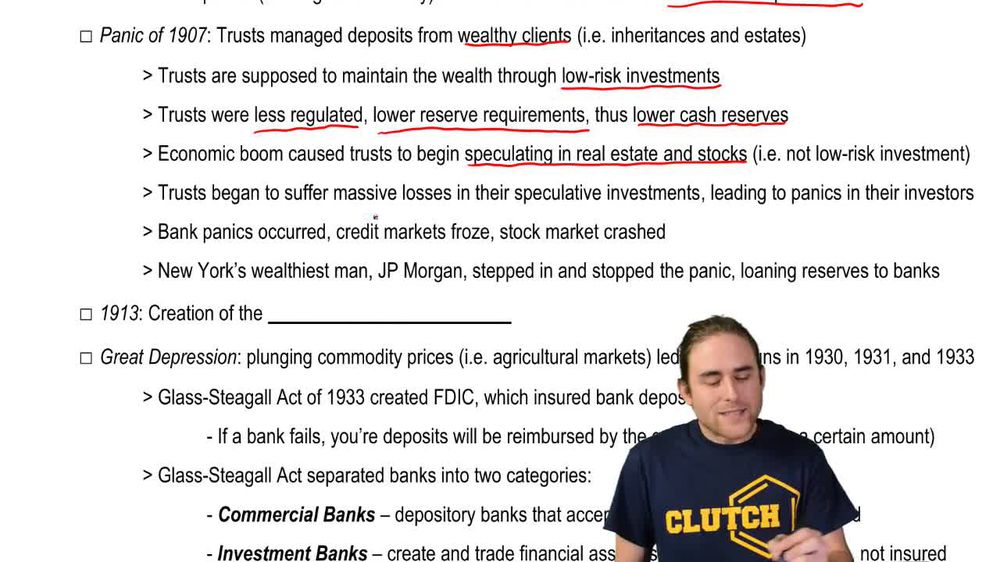
 09:10
09:10