Skip to main content
Macroeconomics
My Course
Learn
Exam Prep
AI Tutor
Study Guides
Flashcards
Explore
Try the app
My Course
Learn
Exam Prep
AI Tutor
Study Guides
Flashcards
Explore
Try the app
Back
Government Purchases and the Multiplier Effect quiz
You can tap to flip the card.
What is the multiplier effect in fiscal policy?
You can tap to flip the card.
👆
What is the multiplier effect in fiscal policy?
The multiplier effect describes how a change in government spending leads to a larger change in GDP through repeated rounds of increased consumption.
Track progress
Control buttons has been changed to "navigation" mode.
1/15
Related flashcards
Related practice
Recommended videos
Government Purchases and the Multiplier Effect definitions
Government Purchases and the Multiplier Effect
14 Terms
Government Purchases and the Multiplier Effect
19. Fiscal Policy
10 problems
Topic
Taxes, the Multiplier Effect, and Automatic Stabilizers
19. Fiscal Policy
9 problems
Topic
20. Fiscal Policy
6 topics
12 problems
Chapter
Guided course
08:02
Government Purchases GDP Multiplier
8
views
1
rank
Terms in this set (15)
Hide definitions
What is the multiplier effect in fiscal policy?
The multiplier effect describes how a change in government spending leads to a larger change in GDP through repeated rounds of increased consumption.
How does an increase in government spending initially affect households?
It increases household income by creating jobs, which leads to higher household consumption.
What role does the marginal propensity to consume (MPC) play in the multiplier effect?
MPC determines how much of additional income households spend versus save, influencing the size of the multiplier effect.
How does the multiplier effect impact aggregate demand?
It causes multiple rightward shifts in aggregate demand, each smaller than the previous, reflecting repeated increases in consumption.
What is the formula for calculating the multiplier?
The multiplier is calculated as 1/(1-MPC).
If the MPC is 0.75, what is the value of the multiplier?
The multiplier is 4, since 1/(1-0.75) = 1/0.25 = 4.
How much will GDP increase if government spending rises by \$5 billion and the multiplier is 4?
GDP will increase by \$20 billion, since \(5 billion x 4 = \)20 billion.
What happens to the size of each round of increased consumption in the multiplier process?
Each round of increased consumption is smaller than the previous, but the cumulative effect is significant.
Can the multiplier effect work in reverse with a decrease in government spending?
Yes, a decrease in government spending can lead to a larger decrease in GDP due to the multiplier effect.
Which components of GDP can the multiplier effect influence?
The multiplier effect can influence consumption, investment, and net exports.
What happens when households receive extra income from government spending?
They spend a portion of it based on their MPC, triggering further rounds of spending.
Why does the multiplier effect result in more total spending than the initial government expenditure?
Because each round of spending generates additional income and consumption, amplifying the initial impact.
What is the relationship between MPC and the size of the multiplier?
A higher MPC leads to a larger multiplier, as more income is spent and less is saved.
How does the multiplier effect relate to fiscal policy?
It shows that small changes in government spending can cause large changes in the economy's GDP.
What equation should you remember for calculating the multiplier in exams?
You should remember the equation: multiplier = 1/(1-MPC).
 BackBack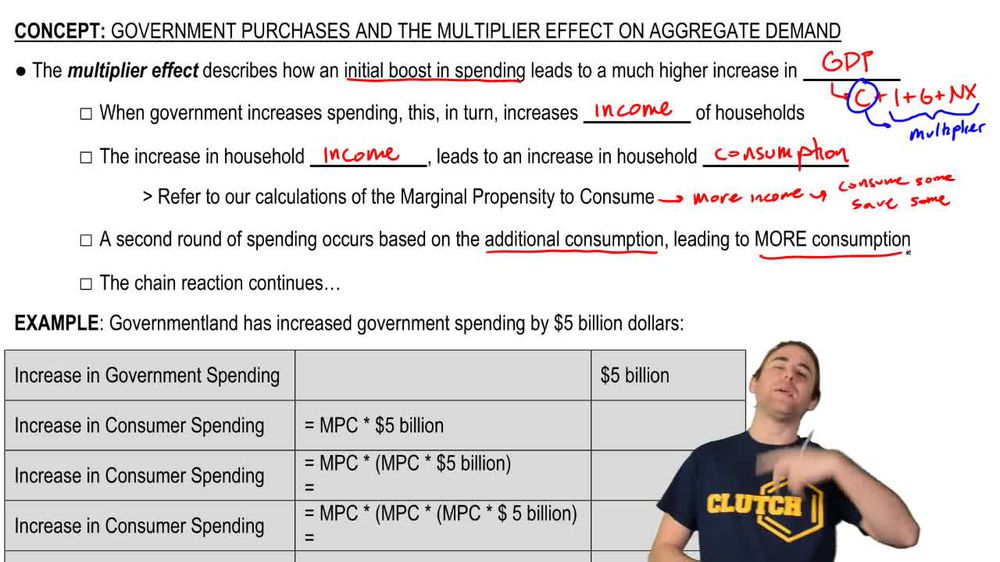
 08:02
08:02