Skip to main content
Macroeconomics
My Course
Learn
Exam Prep
AI Tutor
Study Guides
Flashcards
Explore
Try the app
My Course
Learn
Exam Prep
AI Tutor
Study Guides
Flashcards
Explore
Try the app
Back
Government Purchases and the Multiplier Effect definitions
You can tap to flip the card.
Multiplier Effect
You can tap to flip the card.
👆
Multiplier Effect
A chain reaction where an initial change in spending leads to amplified shifts in total output and income through repeated rounds of consumption.
Track progress
Control buttons has been changed to "navigation" mode.
1/14
Related flashcards
Related practice
Recommended videos
Government Purchases and the Multiplier Effect quiz
Government Purchases and the Multiplier Effect
15 Terms
Government Purchases and the Multiplier Effect
19. Fiscal Policy
10 problems
Topic
Taxes, the Multiplier Effect, and Automatic Stabilizers
19. Fiscal Policy
9 problems
Topic
20. Fiscal Policy
6 topics
12 problems
Chapter
Guided course
08:02
Government Purchases GDP Multiplier
8
views
1
rank
Terms in this set (14)
Hide definitions
Multiplier Effect
A chain reaction where an initial change in spending leads to amplified shifts in total output and income through repeated rounds of consumption.
Fiscal Policy
Government actions involving changes in spending or taxation aimed at influencing overall economic activity and aggregate demand.
Government Spending
Expenditures by the public sector on goods, services, and projects, directly injecting funds into the economy and affecting GDP.
Gross Domestic Product
The total market value of all final goods and services produced within a country, often measured as C+I+G+NX.
Household Income
Earnings received by individuals or families, which increase when government outlays create jobs or fund projects.
Household Consumption
Spending by individuals or families on goods and services, which rises with increases in disposable income.
Marginal Propensity to Consume
The fraction of additional income that households spend on consumption rather than saving, crucial for determining the multiplier.
Aggregate Demand
The total demand for goods and services in an economy at various price levels, influenced by changes in spending components.
Aggregate Demand Curve
A graphical representation showing the relationship between the price level and the quantity of output demanded.
Chain Reaction
A sequence of events where an initial economic action triggers subsequent rounds of spending and income generation.
Multiplier
A numerical value, calculated as 1/(1-MPC), indicating the total impact on GDP from an initial change in spending.
Initial Spending
The first round of expenditure, often by the government, that sets off further rounds of economic activity.
Consumption Function
A relationship showing how household spending varies with changes in disposable income.
Rounds of Spending
Successive cycles of expenditure and income generation, each smaller than the previous, resulting from the multiplier effect.
 BackBack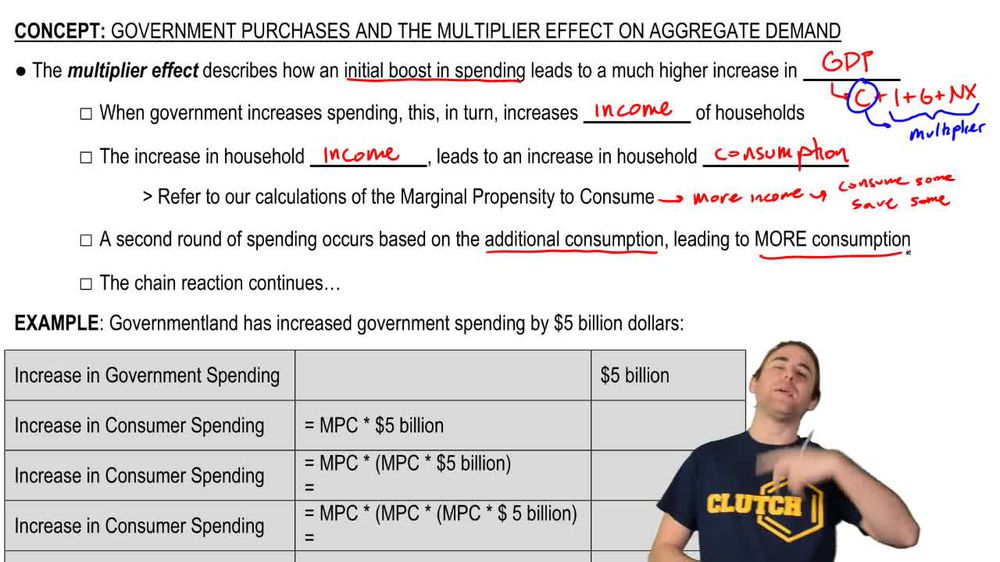
 08:02
08:02