Skip to main content
Macroeconomics
My Course
Learn
Exam Prep
AI Tutor
Study Guides
Flashcards
Explore
Try the app
My Course
Learn
Exam Prep
AI Tutor
Study Guides
Flashcards
Explore
Try the app
Back
Four Market Model Summary: Perfect Competition definitions
You can tap to flip the card.
Perfect Competition
You can tap to flip the card.
👆
Perfect Competition
A market structure with countless firms, identical products, and no single firm able to influence price.
Track progress
Control buttons has been changed to "navigation" mode.
1/14
Related flashcards
Recommended videos
Four Market Model Summary: Perfect Competition quiz
Four Market Model Summary: Perfect Competition
15 Terms
Guided course
05:02
Four Market Model Summary: Perfect Competition
Terms in this set (14)
Hide definitions
Perfect Competition
A market structure with countless firms, identical products, and no single firm able to influence price.
Price Taker
A firm that must accept the market price, unable to set its own due to intense competition.
Barriers to Entry
Obstacles preventing new firms from joining a market, absent in this structure.
Marginal Revenue
The additional income from selling one more unit, equal to price in this market.
Marginal Cost
The extra expense of producing one more unit, used to determine optimal output.
Profit Maximizing Quantity
The output level where additional revenue from selling equals the extra cost of producing.
Long-Run Equilibrium
A state where firms earn zero economic profit and price matches average total cost.
Economic Profit
Total revenue minus all costs, including opportunity costs; zero in the long run here.
Average Total Cost
Total cost divided by output, equal to price in long-run equilibrium.
Allocative Efficiency
A condition where resources are distributed so that price equals marginal cost.
Productive Efficiency
A situation where goods are produced at the lowest possible cost, at minimum average total cost.
Average Revenue
Revenue per unit sold, identical to price in this market structure.
Supply
The total amount of a good firms are willing to sell at various prices in the market.
Demand
The total amount of a good consumers are willing to buy at various prices in the market.
 BackBack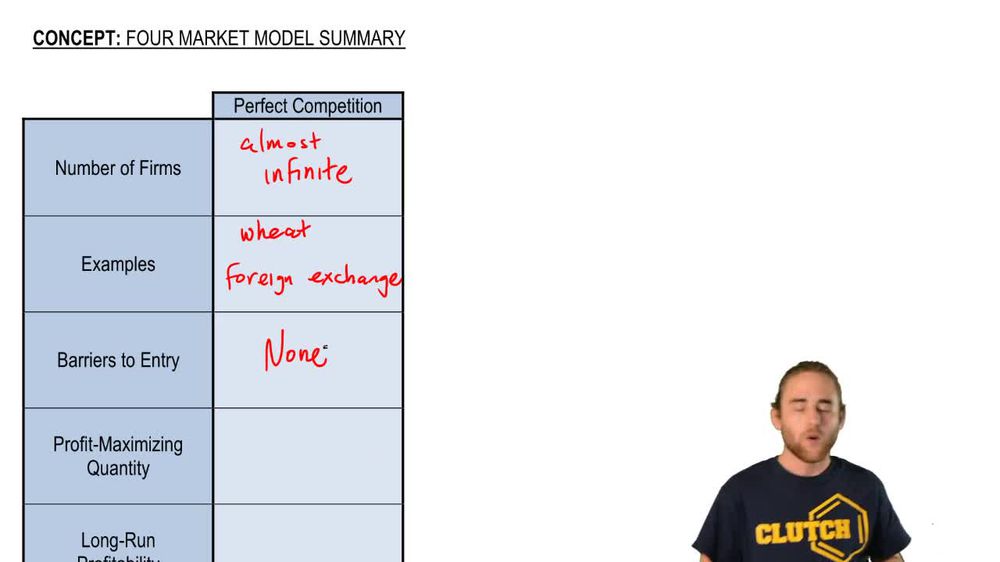
 05:02
05:02