A market structure with many firms offering differentiated products and low barriers to entry, leading to competitive but not perfectly competitive outcomes.
Barriers to Entry
Obstacles that make it difficult for new firms to enter a market, typically low in this structure, allowing easy market access.
Profit Maximizing Quantity
The output level where additional revenue from selling one more unit equals the additional cost of producing it.
Marginal Revenue
The extra income a firm receives from selling one more unit, always less than price due to the downward-sloping demand.
Marginal Cost
The increase in total cost from producing one additional unit, used to determine optimal output.
Average Total Cost
Total cost divided by the number of units produced, used to assess profitability at different output levels.
Economic Profit
The surplus remaining after all costs, including opportunity costs, are subtracted from total revenue; zero in the long run here.
Demand Curve
A graphical representation showing the relationship between price and quantity demanded, downward sloping for each firm.
Markup
The difference between price and marginal cost, reflecting the firm's pricing power over costs.
Price-Setting Behavior
The ability of firms to choose prices above marginal cost due to product differentiation and market power.
Long-Run Equilibrium
A state where firms earn zero economic profit as price equals average total cost, attracting and expelling firms until balance.
Perfect Competition
A benchmark market structure with infinite firms, identical products, and no barriers to entry, used for comparison.
Market Structure
The organizational and competitive characteristics of a market, influencing firm behavior and outcomes.
Differentiated Products
Goods or services distinguished by branding, quality, or features, allowing firms to have some control over pricing.
Fast Food Market
An example of this structure, where numerous firms compete with similar but not identical offerings and easy entry.
 Back
Back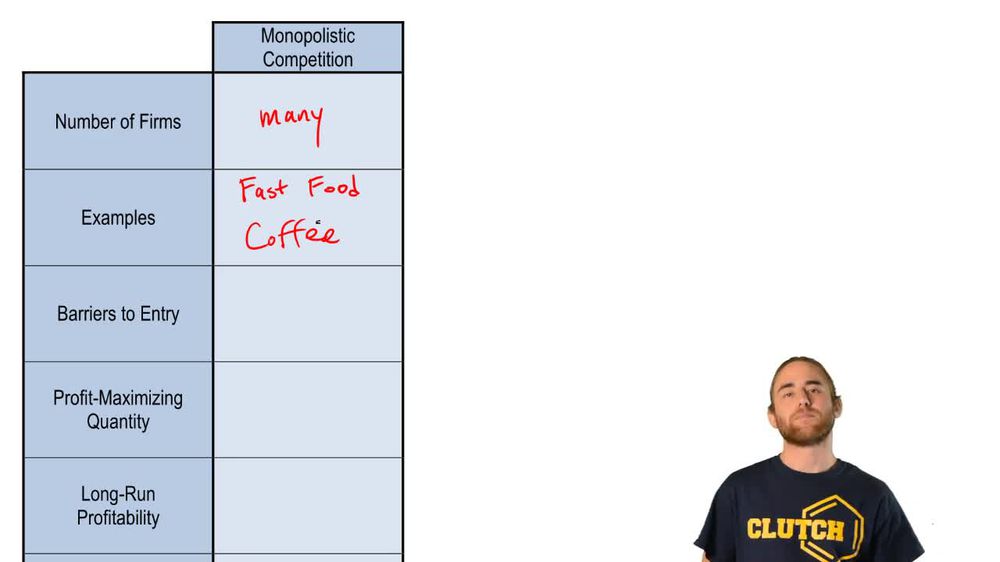
 03:30
03:30