An externality is a cost or benefit that affects bystanders who are not involved in the economic transaction.
What is a negative externality? Give an example.
A negative externality imposes a cost on innocent bystanders, such as pollution from a paper factory affecting nearby residents.
How does a positive externality differ from a negative externality?
A positive externality creates a benefit for bystanders, while a negative externality imposes a cost on them.
What does the marginal social cost (MSC) curve represent?
The MSC curve represents the total cost to society, including both private and external costs.
How is the supply curve affected by a negative externality?
With a negative externality, the supply curve shifts to reflect higher social costs, showing the true cost to society.
What is the marginal social benefit (MSB) curve?
The MSB curve represents the total benefit to society, including both private and external benefits.
How does the demand curve change with a positive externality?
With a positive externality, the demand curve shifts to the right to reflect higher social benefits.
Why do negative externalities lead to overproduction in the market?
Negative externalities lead to overproduction because the market does not account for all costs, resulting in more being produced than is socially optimal.
Why do positive externalities result in underproduction?
Positive externalities result in underproduction because the market does not account for all benefits, so less is produced than is socially optimal.
What is deadweight loss in the context of externalities?
Deadweight loss is the loss of economic efficiency that occurs when the market outcome differs from the socially optimal quantity due to externalities.
How do property rights relate to externalities?
Clearly defined and enforceable property rights can help internalize externalities and lead to more efficient market outcomes.
What happens if nobody owns the resource affected by an externality, like a lake?
If nobody owns the resource, externalities are more likely to occur because no one can prevent or charge for the external cost or benefit.
Give an example of a positive externality and explain the external benefit.
Vaccinations are a positive externality because they not only protect the individual but also reduce disease spread, benefiting others.
What is meant by 'internalizing an externality'?
Internalizing an externality means adjusting incentives so that people take into account the external costs or benefits of their actions.
Why are externalities considered a type of market failure?
Externalities are a market failure because they cause the market to allocate resources inefficiently, leading to overproduction or underproduction.
 Back
Back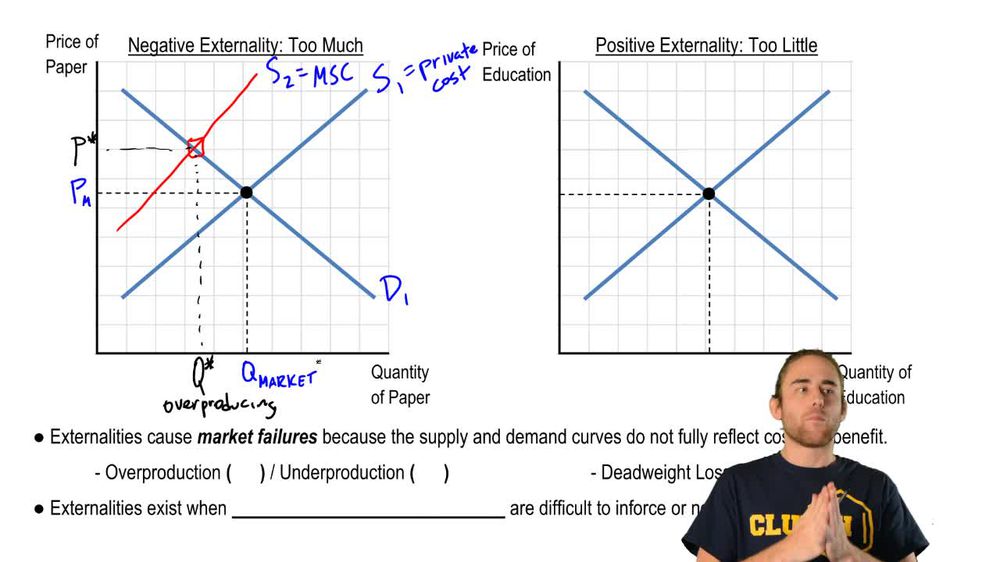
 14:23
14:23
