Skip to main content
Macroeconomics
My Course
Learn
Exam Prep
AI Tutor
Study Guides
Flashcards
Explore
Try the app
My Course
Learn
Exam Prep
AI Tutor
Study Guides
Flashcards
Explore
Try the app
Back
Externalities: Social Benefits and Social Costs definitions
You can tap to flip the card.
Externality
You can tap to flip the card.
👆
Externality
A cost or benefit impacting those not directly involved in a transaction, extending effects beyond buyers and sellers.
Track progress
Control buttons has been changed to "navigation" mode.
1/15
Related flashcards
Related practice
Recommended videos
Externalities: Social Benefits and Social Costs quiz
Externalities: Social Benefits and Social Costs
15 Terms
Externalities: Social Benefits and Social Costs
7. Externalities
10 problems
Topic
Public Solutions to Externalities
7. Externalities
10 problems
Topic
7. Externalities
2 topics
10 problems
Chapter
Guided course
14:23
Externalities on the Graph
8
views
Guided course
10:54
Negative Externality and Positive Externality
11
views
1
rank
Terms in this set (15)
Hide definitions
Externality
A cost or benefit impacting those not directly involved in a transaction, extending effects beyond buyers and sellers.
Negative Externality
A situation where outsiders bear additional costs due to a market activity, often leading to overproduction.
Positive Externality
A situation where outsiders receive additional benefits from a market activity, often resulting in underproduction.
Private Cost
The expense directly incurred by producers, typically reflected in the supply curve, excluding effects on bystanders.
Social Cost
The total expense to society, combining private and external costs, representing the true cost of production.
External Cost
A burden imposed on outsiders by a market activity, not considered by those making the transaction.
Private Benefit
The gain received directly by consumers, typically shown by the demand curve, excluding effects on others.
Social Benefit
The total gain to society, combining private and external benefits, reflecting the full value of consumption.
External Benefit
A positive effect received by outsiders from a market activity, not considered by those making the transaction.
Marginal Social Cost
The additional expense to society for producing one more unit, including both private and external costs.
Marginal Social Benefit
The additional gain to society from consuming one more unit, including both private and external benefits.
Market Failure
A situation where market outcomes are inefficient, often due to unaccounted externalities.
Deadweight Loss
A loss of total surplus resulting from inefficient production or consumption, often visualized as a 'bow tie' on a graph.
Property Rights
Legal ownership and control over resources, crucial for determining who bears costs or receives benefits from externalities.
Equilibrium Quantity
The amount traded where supply and demand intersect, which may differ from the socially optimal level when externalities exist.
 BackBack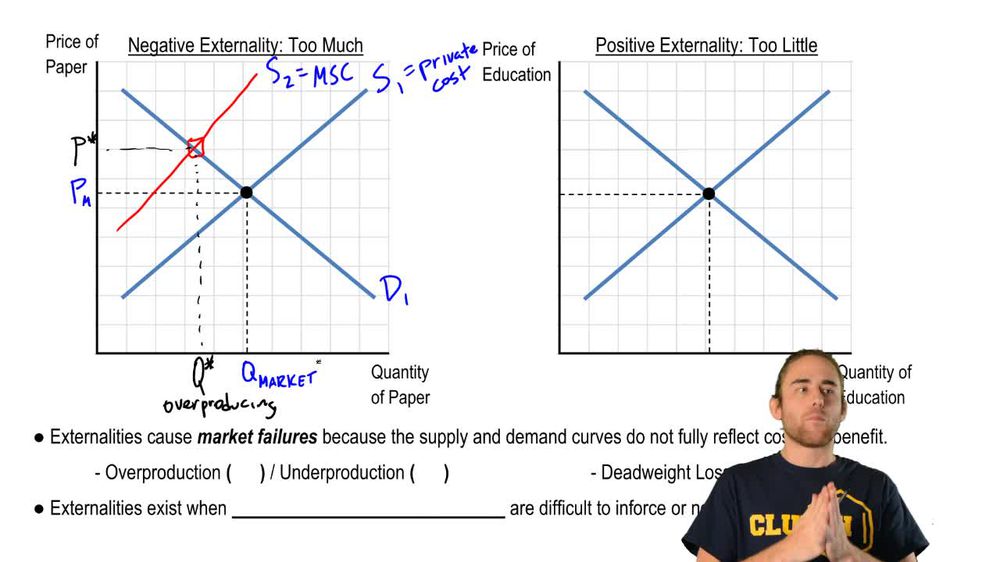
 14:23
14:23
