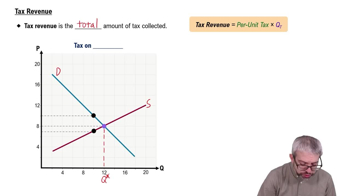
How is tax revenue calculated when a per unit tax is imposed on a market?
Tax revenue is calculated by multiplying the per unit tax rate by the quantity exchanged at the tax rate.
What graphical shape represents tax revenue on a supply and demand diagram?
Tax revenue is represented as a rectangle formed by the per unit tax and the quantity exchanged.
What happens to the supply curve when a tax is imposed on sellers?
The supply curve shifts to the left, indicating a higher cost for sellers due to the tax.
How do you determine the price buyers pay and sellers receive after a tax is imposed?
The price buyers pay is found where the new quantity after tax crosses the demand curve, and the price sellers receive is where it crosses the supply curve.
What is the per unit tax rate in a market with buyers paying \$10 and sellers receiving \$7?
The per unit tax rate is \$3, calculated as \$10 minus \$7.
What effect does a tax have on market equilibrium?
A tax moves the market away from equilibrium, causing a difference between the price buyers pay and sellers receive.
What is economic surplus in a market without a tax?
Economic surplus is the sum of consumer surplus and producer surplus, maximized at equilibrium.
How is consumer surplus defined in a supply and demand diagram?
Consumer surplus is the area above the price and below the demand curve.
What happens to consumer surplus when a tax is imposed?
Consumer surplus decreases, losing areas B and C, and is reduced to area A.
How is producer surplus defined in a supply and demand diagram?
Producer surplus is the area below the price and above the supply curve.
What happens to producer surplus when a tax is imposed?
Producer surplus decreases, losing areas D and E, and is reduced to area F.
Which areas represent tax revenue after a tax is imposed?
Tax revenue is represented by the rectangle covering areas B and D.
What is deadweight loss in the context of a tax on a market?
Deadweight loss is the surplus lost due to reduced trades, represented by areas C and E.
How does economic surplus change after a tax is imposed?
Economic surplus includes consumer surplus, producer surplus, and tax revenue, but loses areas C and E, indicating a net reduction.
Why does deadweight loss occur when a tax is imposed?
Deadweight loss occurs because the market is no longer at the efficient quantity, resulting in lost trades and reduced total surplus.
 Back
Back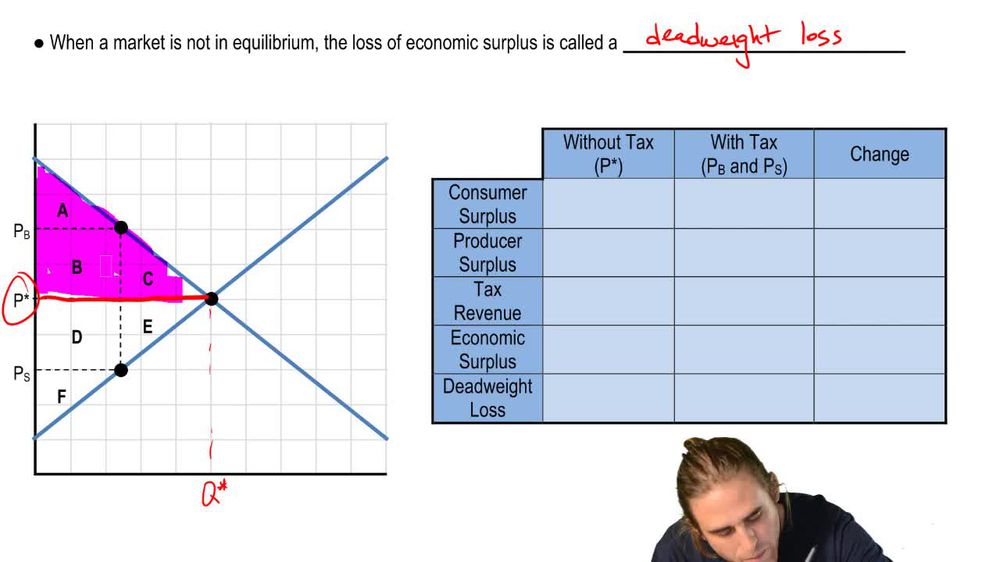
 09:45
09:45