Back

WIllingness to Pay and Consumer Surplus quiz

Control buttons has been changed to "navigation" mode.
1/15
  • What is consumer surplus?

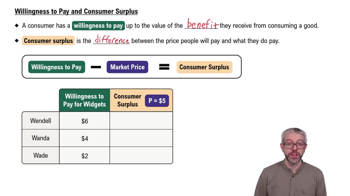
    Consumer surplus is the difference between a consumer's willingness to pay and the market price for a good.
  • How do you calculate consumer surplus for an individual?

    Subtract the market price from the individual's willingness to pay; the result is their consumer surplus.
  • What happens to consumer surplus when the market price decreases?

    Consumer surplus increases as the market price decreases, since the gap between willingness to pay and price widens.
  • Why will a rational consumer not buy a product if the price is above their willingness to pay?

    A rational consumer will not buy if the price exceeds their willingness to pay because it would make them worse off.
  • How is consumer surplus visually represented on a supply and demand graph?

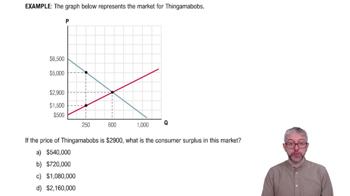
    Consumer surplus is the area below the demand curve and above the market price.
  • What does the demand curve represent in terms of willingness to pay?

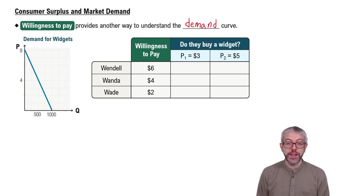
    The demand curve represents the marginal benefit to society and consumers, reflecting their willingness to pay.
  • How can you determine who will buy a product using the demand curve?

    Anyone whose point on the demand curve is above the market price will buy the product.
  • What is the formula for the area of consumer surplus on a graph?

    The area is calculated as one half times the base times the height of the triangle formed between the demand curve and the price.
  • What does the height of the consumer surplus triangle represent?

    The height is the difference between the highest willingness to pay and the market price.
  • What does the base of the consumer surplus triangle represent?

    The base is the quantity of goods sold, from zero up to the number of buyers at the market price.
  • Why is consumer surplus always positive or zero?

    Consumer surplus is never negative because consumers only buy when their willingness to pay is at least equal to the price.
  • What happens to consumer surplus when new buyers enter the market due to a price drop?

    New buyers gain consumer surplus equal to their willingness to pay minus the new lower price.
  • How does expressing willingness to pay in dollars help in calculating consumer surplus?

    It allows for straightforward calculations of consumer surplus using simple subtraction.
  • What is total consumer surplus in a market?

    Total consumer surplus is the sum of all individual consumer surpluses for everyone who buys the product.
  • How does consumer surplus measure the benefits consumers receive?

    Consumer surplus quantifies the extra benefit consumers get from paying less than their maximum willingness to pay.