What is consumer optimum consumption in the context of budget constraints and indifference curves?
Consumer optimum consumption is where the budget constraint is tangent to the highest attainable indifference curve, maximizing utility within the consumer's budget.
Why does the optimum consumption point occur where the budget constraint and indifference curve are tangent?
Because this is the only point where the consumer can achieve the highest possible utility given their budget.
What happens to the budget constraint when a consumer's income increases?
The budget constraint shifts outward, allowing the consumer to reach higher indifference curves and higher utility.
How does a decrease in the price of one good affect the budget constraint?
It pivots the budget constraint outward along the axis of the good whose price decreased, increasing the quantity of that good the consumer can afford.
If a consumer's income decreases, what happens to their optimum consumption point?
The optimum consumption point moves to a lower indifference curve, reflecting reduced utility due to the lower income.
Why can't a consumer choose a point on a higher indifference curve than where their budget constraint is tangent?
Because those points are not affordable given the consumer's budget.
What does it mean for two curves to be tangent in this context?
It means the budget constraint and the indifference curve touch at exactly one point, indicating the optimum consumption.
What is the effect of a price decrease in vodka on the budget constraint in the example?
The budget constraint pivots outward on the vodka axis, allowing the consumer to buy more vodka for the same income.
How does the consumer decide which indifference curve to be on?
The consumer chooses the highest indifference curve that is still tangent to their budget constraint.
What happens to the optimum consumption if the price of beer remains constant but vodka becomes cheaper?
The consumer can afford more vodka, so the optimum point shifts to a new tangency on a higher indifference curve.
Why would a consumer not choose a point on a lower indifference curve if a higher one is affordable?
Because a higher indifference curve represents greater utility, so the consumer always prefers it if it's within their budget.
What does the tangency condition between the budget constraint and indifference curve represent?
It represents the point where the consumer maximizes utility given their budget.
How do changes in income or prices affect the consumer's optimum consumption?
They shift or pivot the budget constraint, leading to a new tangency point with a different indifference curve.
What is the role of indifference curves in determining consumer choice?
Indifference curves show combinations of goods that provide the same utility, helping identify the highest utility attainable within the budget.
What must you find to determine the consumer's optimum consumption after a change in income or price?
You must find the new point where the budget constraint is tangent to an indifference curve.
 Back
Back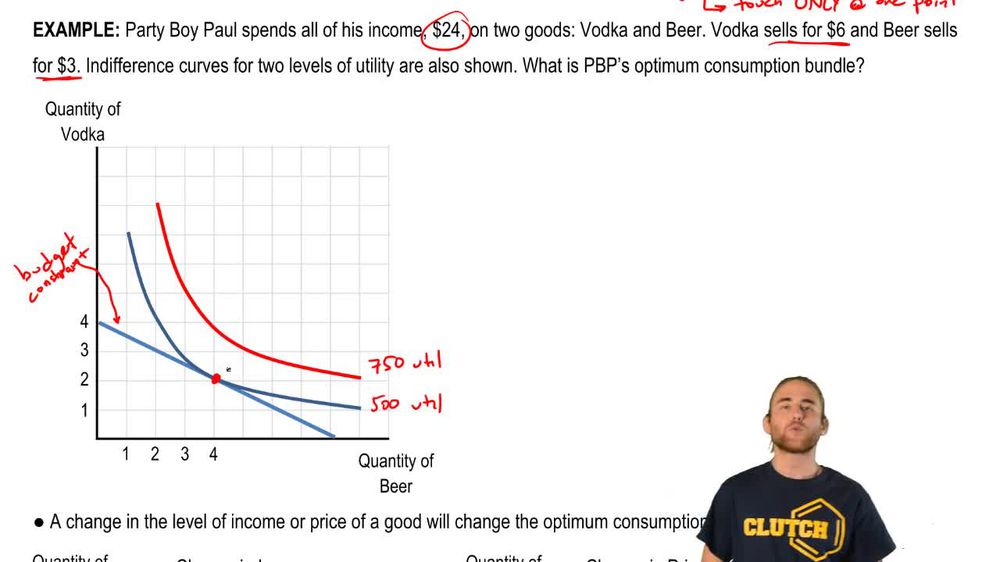
 07:07
07:07