Skip to main content
Macroeconomics
My Course
Learn
Exam Prep
AI Tutor
Study Guides
Flashcards
Explore
Try the app
My Course
Learn
Exam Prep
AI Tutor
Study Guides
Flashcards
Explore
Try the app
Back
Characteristics of Perfect Competition quiz
You can tap to flip the card.
What is the defining characteristic of goods sold in a perfectly competitive market?
You can tap to flip the card.
👆
What is the defining characteristic of goods sold in a perfectly competitive market?
Goods are identical, meaning buyers cannot distinguish one seller's product from another's.
Track progress
Control buttons has been changed to "navigation" mode.
1/15
Related flashcards
Recommended videos
Characteristics of Perfect Competition definitions
Characteristics of Perfect Competition
14 Terms
Guided course
02:29
Characteristics of Perfect Competition
Guided course
03:57
Market Demand and Individual Firm Demand
Terms in this set (15)
Hide definitions
What is the defining characteristic of goods sold in a perfectly competitive market?
Goods are identical, meaning buyers cannot distinguish one seller's product from another's.
Who determines the price in a perfectly competitive market?
The market determines the price, and individual buyers and sellers are price takers.
What does it mean for firms to be 'price takers' in perfect competition?
Firms must accept the market price and cannot influence it by their own actions.
How many buyers and sellers are typically present in a perfectly competitive market?
There are many buyers and many sellers, often considered almost infinite.
What is the significance of free entry and exit in perfect competition?
Firms can freely enter or leave the market without significant barriers.
Give an example of a perfectly competitive market.
Agricultural products like wheat or foreign exchange markets are examples.
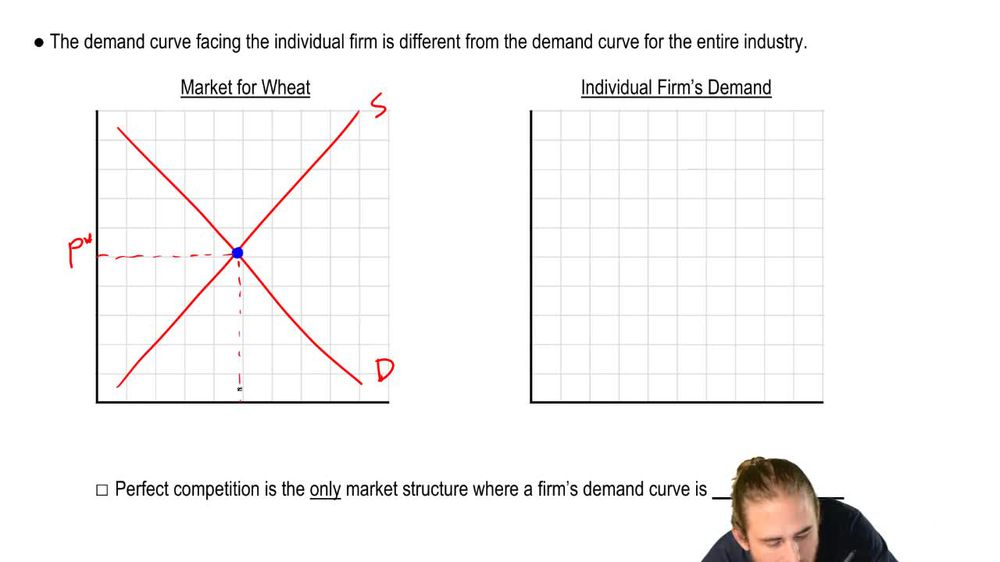
What does the demand curve look like for an individual firm in perfect competition?
It is perfectly elastic, represented by a horizontal line at the market price.
Why is the individual firm's demand curve horizontal in perfect competition?
Because the firm can sell any quantity at the market price but cannot sell at a higher price.
What happens if a firm in perfect competition tries to charge a price above the market price?
It will sell nothing, as buyers will purchase from other sellers at the market price.
What is the equilibrium price (P*) in a perfectly competitive market?
It is the price where market demand equals market supply.
How does the market demand curve differ from the individual firm's demand curve in perfect competition?
The market demand curve slopes downward, while the individual firm's demand curve is horizontal.
Why can't a single firm influence the market price in perfect competition?
Because each firm is a small part of the market and their output is insignificant relative to total market supply.
What role does identical goods play in perfect competition?
Identical goods ensure that buyers have no preference for one seller over another, reinforcing price taking.
How does perfect competition affect a firm's production and profit decisions?
Firms base their decisions on the market price, as they cannot influence it and must accept it.
What market structures do not have a perfectly elastic (horizontal) demand curve for individual firms?
Monopolistic competition, oligopoly, and monopoly do not have a horizontal demand curve for individual firms.
 BackBack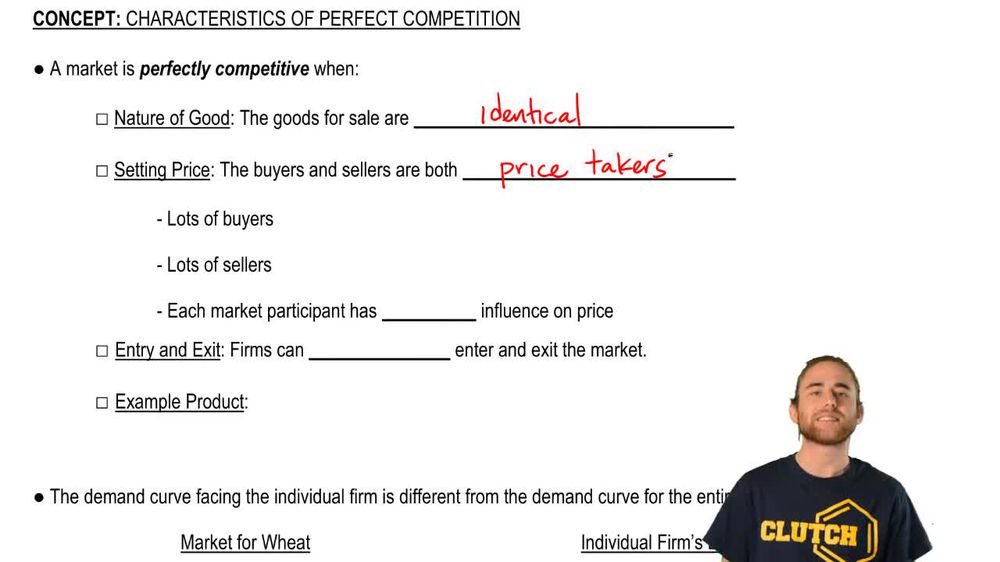
 02:29
02:29