Skip to main content
Macroeconomics
My Course
Learn
Exam Prep
AI Tutor
Study Guides
Flashcards
Explore
Try the app
My Course
Learn
Exam Prep
AI Tutor
Study Guides
Flashcards
Explore
Try the app
Back
Characteristics of Perfect Competition definitions
You can tap to flip the card.
Perfect Competition
You can tap to flip the card.
👆
Perfect Competition
A market structure with identical goods, many buyers and sellers, and no individual influence over price.
Track progress
Control buttons has been changed to "navigation" mode.
1/14
Related flashcards
Recommended videos
Characteristics of Perfect Competition quiz
Characteristics of Perfect Competition
15 Terms
Guided course
02:29
Characteristics of Perfect Competition
Guided course
03:57
Market Demand and Individual Firm Demand
Terms in this set (14)
Hide definitions
Perfect Competition
A market structure with identical goods, many buyers and sellers, and no individual influence over price.
Identical Goods
Products that are indistinguishable from one another, making brand or producer irrelevant to buyers.
Price Taker
A participant who must accept the prevailing market price and cannot influence it through their own actions.
Equilibrium Price
The market-set value where the quantity supplied equals the quantity demanded, often denoted as P*.
Equilibrium Quantity
The amount of a good bought and sold at the market-clearing price, balancing supply and demand.
Free Entry
The ability for new firms to join a market without significant barriers or restrictions.
Free Exit
The ability for firms to leave a market easily when they no longer wish to produce.
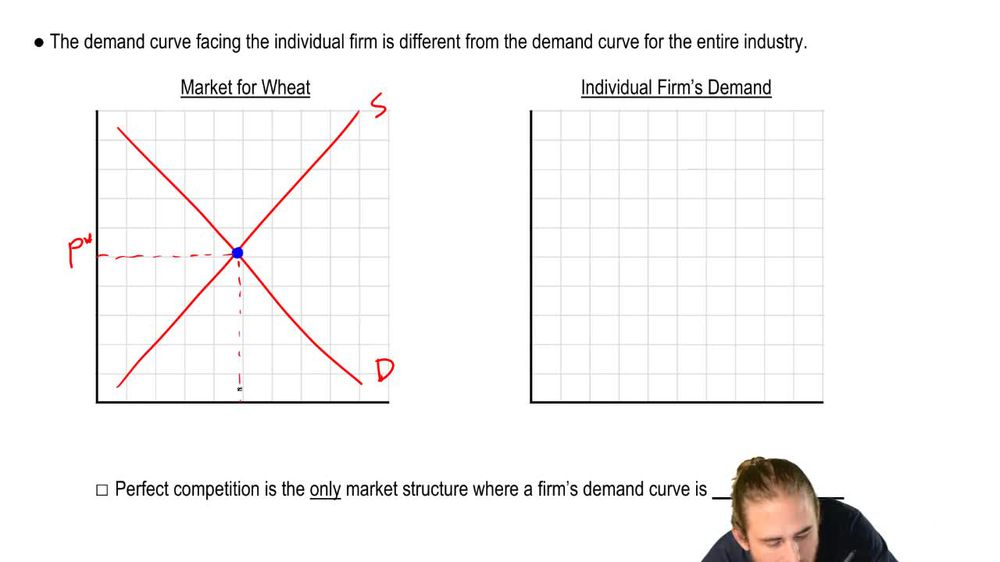
Horizontal Demand Curve
A graphical representation showing that a firm can sell any quantity at the market price, but none above it.
Perfectly Elastic Demand
A situation where even a tiny price increase causes quantity demanded to drop to zero for an individual firm.
Market Structure
The organizational and competitive characteristics defining how firms and buyers interact in a market.
Aggregate Demand
The total quantity of a good all buyers in the market are willing and able to purchase at various prices.
Aggregate Supply
The total quantity of a good all sellers in the market are willing and able to offer at various prices.
Foreign Exchange Market
A real-world example where currencies are traded in a perfectly competitive environment with indistinguishable units.
Agricultural Product
A classic example of a good in perfect competition, such as wheat, where output from different producers is identical.
 BackBack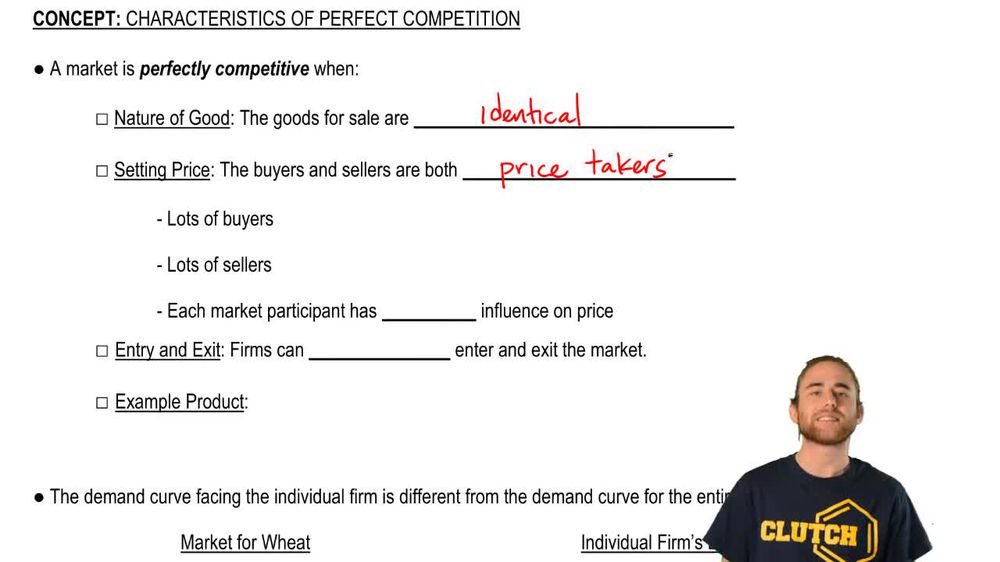
 02:29
02:29