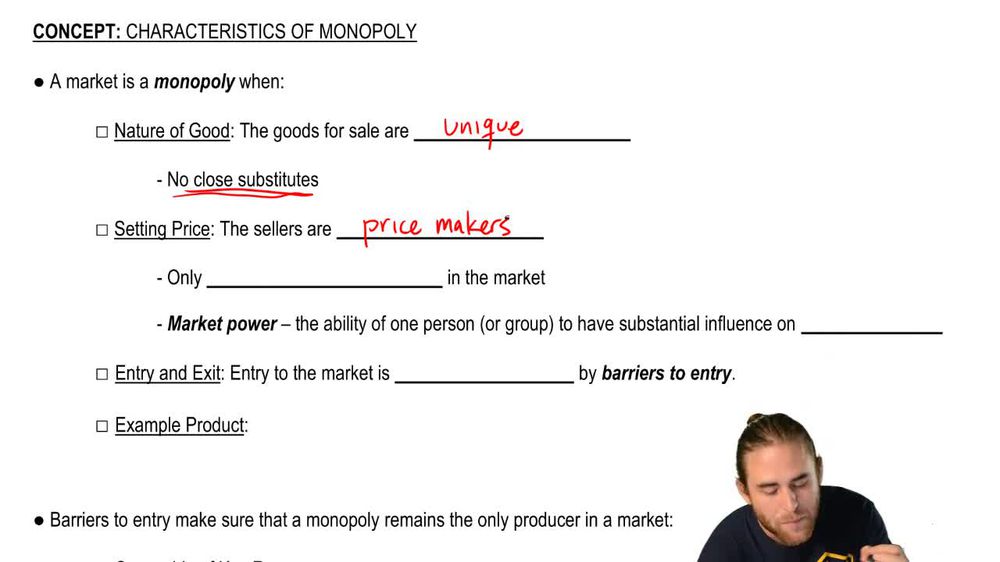
What is the main characteristic of the good supplied in a monopoly?
The good is unique and has no close substitutes, distinguishing it from goods in perfectly competitive markets.
How many producers are there in a monopoly market?
There is only one producer in a monopoly market, giving the firm complete control over supply.
What does it mean for a monopoly to be a price maker?
A monopoly can set the price of its product because it has market power, unlike firms in perfect competition that are price takers.
What is market power in the context of a monopoly?
Market power is the ability of a monopoly to influence or set the price of its product due to its control over supply.
What are barriers to entry in a monopoly?
Barriers to entry are obstacles that prevent other firms from entering the market, such as ownership of key resources, government regulation, and economies of scale.
How does ownership of key resources act as a barrier to entry?
If a monopoly controls all sources of a key resource, other firms cannot access it and are prevented from entering the market.
How do government patents create monopolies?
Patents grant exclusive rights to produce a good, preventing others from making or selling the product and creating a monopoly for the patent holder.
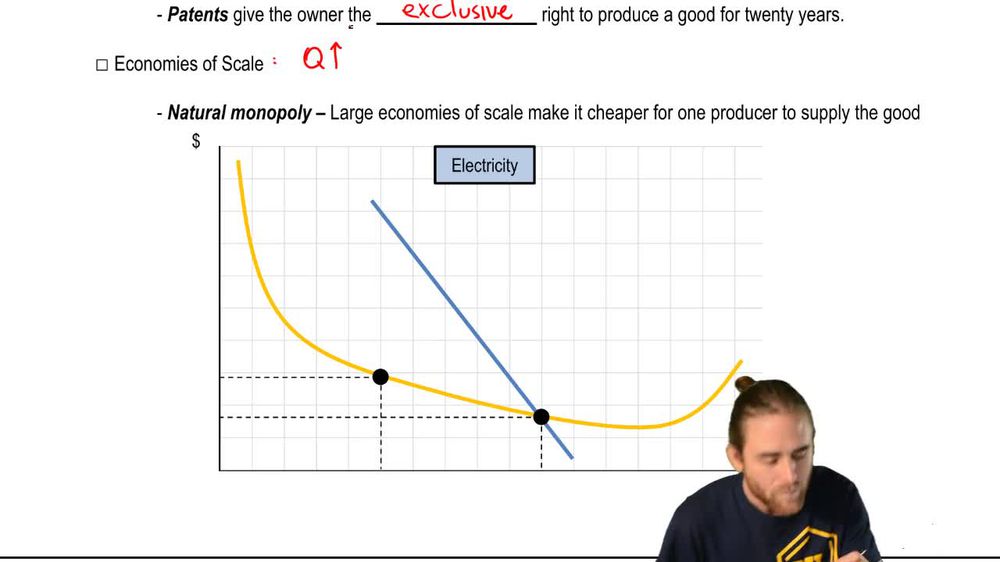
What is a natural monopoly?
A natural monopoly occurs when high fixed costs and economies of scale make it most efficient for a single firm to supply the entire market.
Why are economies of scale a barrier to entry in some markets?
Economies of scale allow a single firm to lower its average costs by increasing output, making it difficult for new firms to compete.
What happens to average total cost when a monopoly increases its output?
The average total cost decreases as output increases, due to economies of scale, especially in natural monopolies.
How does the demand curve faced by a monopoly differ from that in perfect competition?
A monopoly faces a downward-sloping demand curve, while firms in perfect competition face a perfectly elastic (horizontal) demand curve.
What must a monopoly do to increase its output?
A monopoly must lower its price to sell more units, because it faces a downward-sloping demand curve.
How does marginal revenue in a monopoly compare to price?
In a monopoly, marginal revenue is less than price because increasing output requires lowering the price for all units sold.
Why is it more efficient for one firm to supply a natural monopoly market?
One firm can achieve lower average costs by serving the entire market, whereas multiple firms would have higher costs and less efficiency.
What is the relationship between the monopoly firm's demand curve and the market demand curve?
The monopoly firm's demand curve is the same as the market demand curve, since it is the sole supplier.
 Back
Back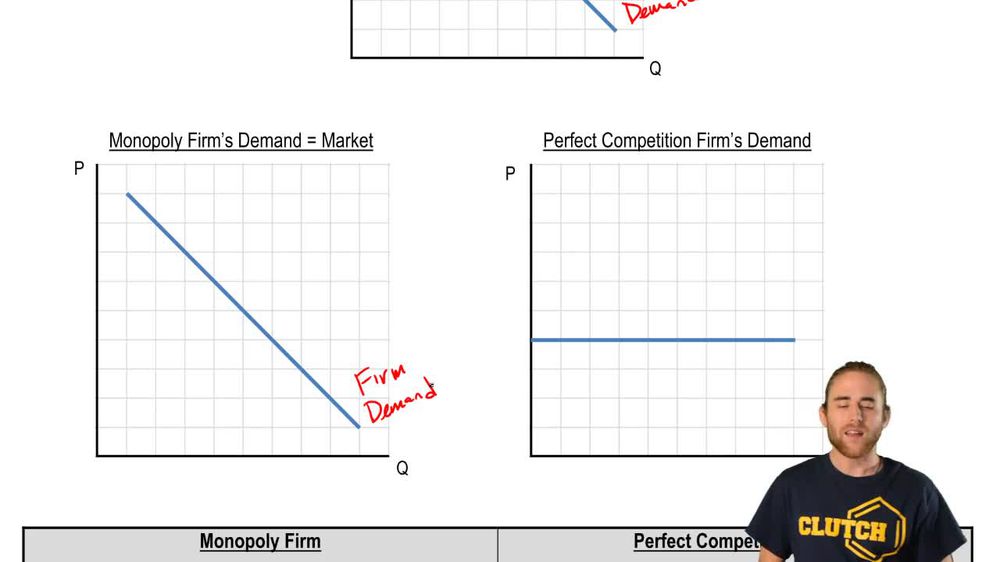
 04:17
04:17