Skip to main content
Macroeconomics
My Course
Learn
Exam Prep
AI Tutor
Study Guides
Flashcards
Explore
Try the app
My Course
Learn
Exam Prep
AI Tutor
Study Guides
Flashcards
Explore
Try the app
Back
Characteristics of Monopolistic Competition quiz
You can tap to flip the card.
What does product differentiation mean in monopolistic competition?
You can tap to flip the card.
👆
What does product differentiation mean in monopolistic competition?
Product differentiation means that goods are similar but not identical, allowing each firm to offer a unique version of a product.
Track progress
Control buttons has been changed to "navigation" mode.
1/15
Related flashcards
Recommended videos
Characteristics of Monopolistic Competition definitions
Characteristics of Monopolistic Competition
13 Terms
Guided course
05:53
Characteristics of Monopolistic Competition
1
views
Guided course
04:25
Monopolistic Competition Demand Curve
1
views
Terms in this set (15)
Hide definitions
What does product differentiation mean in monopolistic competition?
Product differentiation means that goods are similar but not identical, allowing each firm to offer a unique version of a product.
How does monopolistic competition differ from perfect competition in terms of pricing power?
Firms in monopolistic competition have some influence over price due to differentiated products, while firms in perfect competition are price takers.
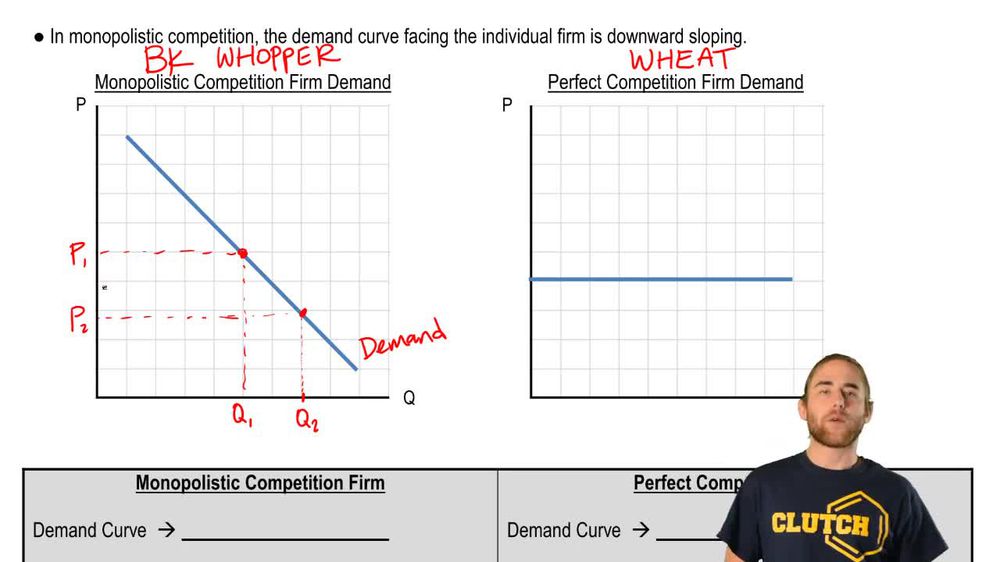
Why do firms in monopolistic competition face a downward sloping demand curve?
Because their products are differentiated, increasing output requires lowering the price to sell more units.
What is market power in the context of monopolistic competition?
Market power is the ability of a firm to influence the price of its own differentiated product.
Can firms freely enter and exit monopolistically competitive markets?
Yes, there are no significant barriers to entry or exit in monopolistic competition.
Give an example of a market that fits monopolistic competition.
The fast food industry, with brands like McDonald's and Burger King, is an example of monopolistic competition.
How does the demand curve for a firm in perfect competition differ from that in monopolistic competition?
In perfect competition, the demand curve is horizontal (perfectly elastic), while in monopolistic competition, it is downward sloping.
What happens to the price if a monopolistically competitive firm wants to increase its output?
The firm must lower its price to sell more units due to the downward sloping demand curve.
Why do firms in monopolistic competition have some control over their prices?
Because each firm offers a differentiated product that some consumers may prefer over others.
What is a barrier to entry, and does it exist in monopolistic competition?
A barrier to entry is something that prevents new firms from entering a market; in monopolistic competition, such barriers are minimal or nonexistent.
How does marginal revenue behave in monopolistic competition compared to perfect competition?
In monopolistic competition, marginal revenue decreases as output increases, unlike perfect competition where marginal revenue equals price.
What is the relationship between price, average revenue, and marginal revenue in perfect competition?
In perfect competition, price equals both average revenue and marginal revenue.
Why might a consumer choose one differentiated product over another in monopolistic competition?
Consumers may have preferences for specific features, branding, or quality that make one product more appealing than another.
What role do substitute goods play in monopolistic competition?
Substitute goods increase competition, as consumers can switch to similar products if prices rise or preferences change.
How does the ability to freely enter and exit the market affect monopolistically competitive firms in the long run?
It ensures that firms can respond to profits or losses by entering or leaving the market, which affects long-term profitability and market dynamics.
 BackBack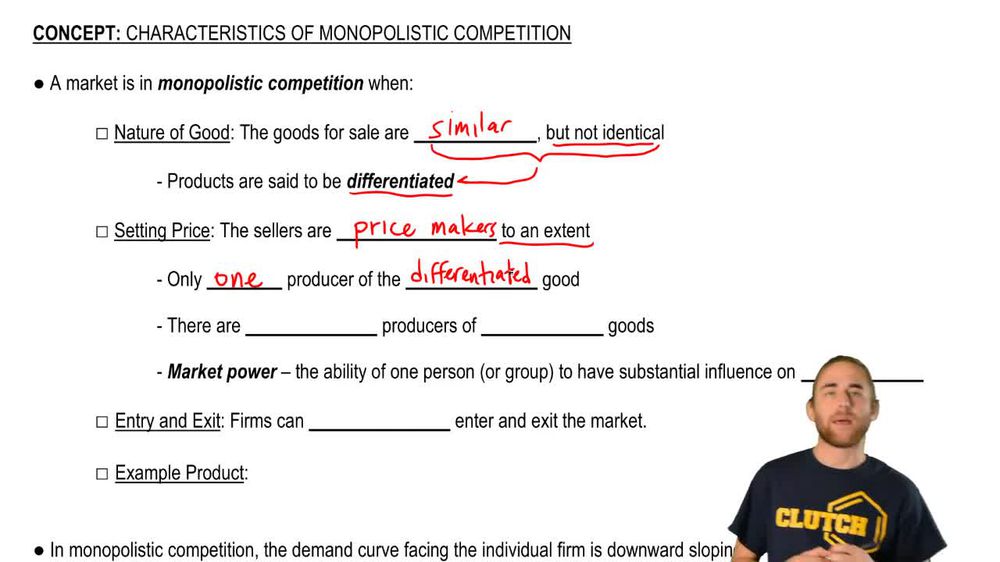
 05:53
05:53