Skip to main content
Macroeconomics
My Course
Learn
Exam Prep
AI Tutor
Study Guides
Flashcards
Explore
Try the app
My Course
Learn
Exam Prep
AI Tutor
Study Guides
Flashcards
Explore
Try the app
Back
Characteristics of Monopolistic Competition definitions
You can tap to flip the card.
Monopolistic Competition
You can tap to flip the card.
👆
Monopolistic Competition
A market structure with many firms selling similar but not identical products, each having some control over its own price.
Track progress
Control buttons has been changed to "navigation" mode.
1/13
Related flashcards
Recommended videos
Characteristics of Monopolistic Competition quiz
Characteristics of Monopolistic Competition
15 Terms
Guided course
05:53
Characteristics of Monopolistic Competition
1
views
Guided course
04:25
Monopolistic Competition Demand Curve
1
views
Terms in this set (13)
Hide definitions
Monopolistic Competition
A market structure with many firms selling similar but not identical products, each having some control over its own price.
Differentiated Products
Goods that are similar in function but have unique features or branding, making them distinct in consumers' eyes.
Market Power
The ability of a firm to influence the price of its product due to its unique characteristics or branding.
Price Maker
A firm that can set or influence the price of its product, rather than accepting a market-determined price.
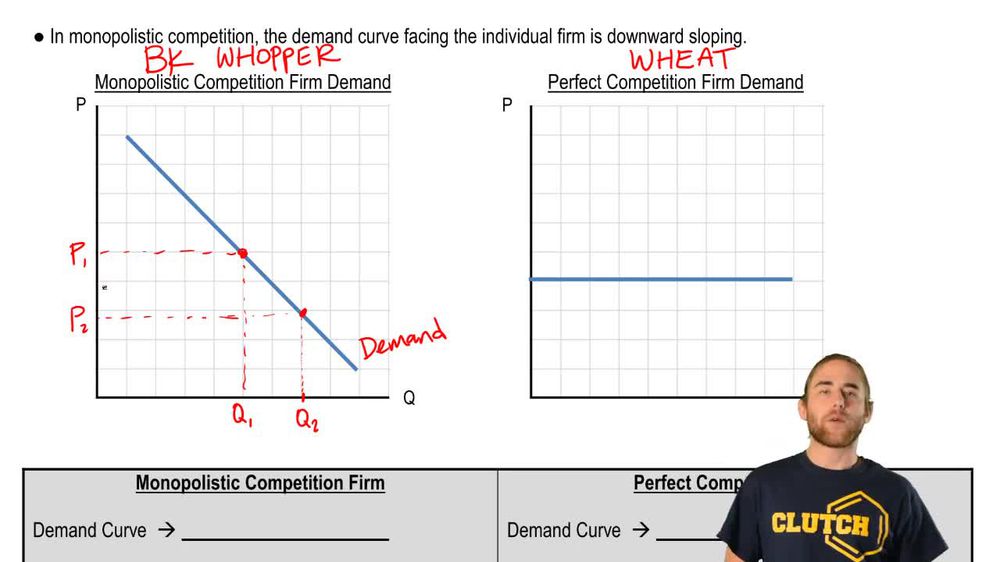
Downward Sloping Demand Curve
A graphical representation showing that increasing sales requires lowering the price, reflecting consumer sensitivity.
Perfect Competition
A market structure where many firms sell identical products and have no control over the market price.
Horizontal Demand Curve
A perfectly elastic demand situation where a firm can sell any quantity at the market price without affecting it.
Barriers to Entry
Obstacles that prevent new firms from easily entering or exiting a market, such as high startup costs or regulations.
Marginal Revenue
The additional income a firm receives from selling one more unit, which decreases as output increases in this market.
Substitute Goods
Products that can replace each other in consumption, influencing a firm's pricing power and competition.
Aggregate Demand
The total demand for goods and services in an economy, influenced by the behaviors of firms in various market structures.
Free Entry and Exit
A condition where firms can join or leave the market without facing significant obstacles, promoting competition.
Average Revenue
The revenue a firm earns per unit sold, always equal to the price in both competitive and monopolistically competitive markets.
 BackBack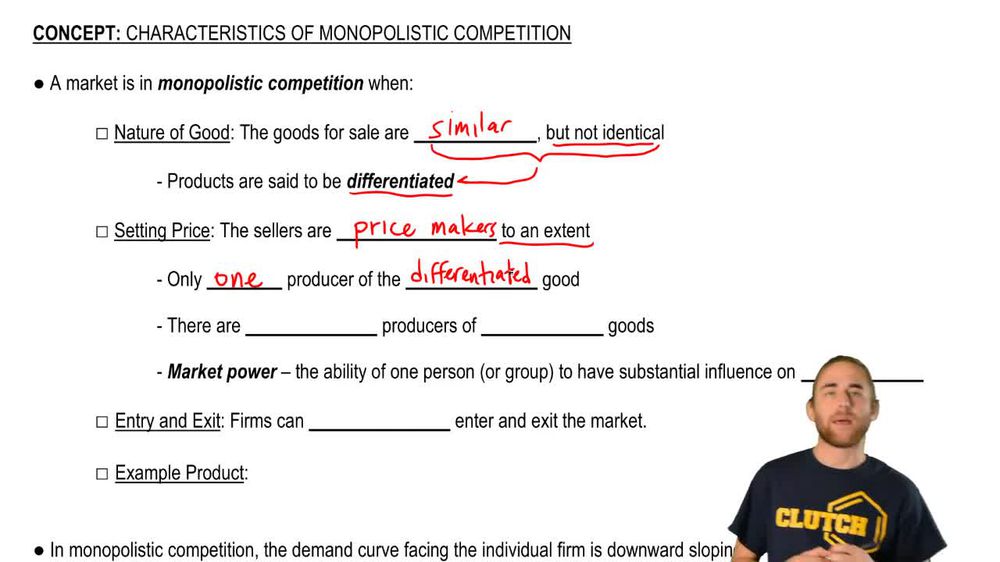
 05:53
05:53