Skip to main content
Macroeconomics
My Course
Learn
Exam Prep
AI Tutor
Study Guides
Flashcards
Explore
Try the app
My Course
Learn
Exam Prep
AI Tutor
Study Guides
Flashcards
Explore
Try the app
Back
Bilateral Monopoly quiz
You can tap to flip the card.
What is a bilateral monopoly?
You can tap to flip the card.
👆
What is a bilateral monopoly?
A bilateral monopoly is a market with a single buyer (monopsony) and a single seller (labor union) negotiating over wages or prices.
Track progress
Control buttons has been changed to "navigation" mode.
1/15
Related flashcards
Recommended videos
Bilateral Monopoly definitions
Bilateral Monopoly
15 Terms
Guided course
05:32
Bilateral Monopoly
Terms in this set (15)
Hide definitions
What is a bilateral monopoly?
A bilateral monopoly is a market with a single buyer (monopsony) and a single seller (labor union) negotiating over wages or prices.
Who are the typical parties involved in a bilateral monopoly in the labor market?
The typical parties are a labor union representing workers and an employer alliance acting as the sole buyer of labor.
What real-world example was given for a bilateral monopoly?
The Writers Guild of America (labor union) negotiating with an alliance of TV employers is an example.
How often do the Writers Guild of America and employer alliances renegotiate pay deals?
They renegotiate pay deals every three years.
What determines the outcome of wage negotiations in a bilateral monopoly?
The outcome depends on the relative bargaining power of the union and the employer alliance.
What are the goals of the employer alliance in a bilateral monopoly?
The employer alliance aims to pay the lowest possible wage, similar to a monopsony.
What are the goals of the labor union in a bilateral monopoly?
The labor union seeks to secure higher, above-average wages for its members.
Where does the negotiated wage in a bilateral monopoly typically fall?
It usually falls between the low wage desired by the monopsony and the high wage demanded by the union.
Why is the exact outcome of a bilateral monopoly negotiation uncertain?
Because it depends on the negotiation process and the relative power of each side, making the wage and quantity unknown.
How does a bilateral monopoly compare to a pure monopsony or pure union in terms of market outcomes?
A bilateral monopoly produces more competitive and desirable outcomes than either a monopsony or a union acting alone.
What happens if both sides in a bilateral monopoly have equal negotiating power?
They may agree on a wage close to the competitive equilibrium wage.
What is the main feature of the negotiation process in a bilateral monopoly?
All negotiating power is consolidated into the two groups, leading to intense bargaining.
How do the monopoly powers of each side affect the market in a bilateral monopoly?
Their monopoly powers offset each other, reducing the leverage either side would have alone.
What is the minimum benefit of a bilateral monopoly compared to one-sided market power?
It results in more competitive outcomes than if only one side (monopsony or union) had all the power.
Why are bilateral monopolies considered rare?
Because it is uncommon for there to be only one buyer and one seller in a market.
 BackBack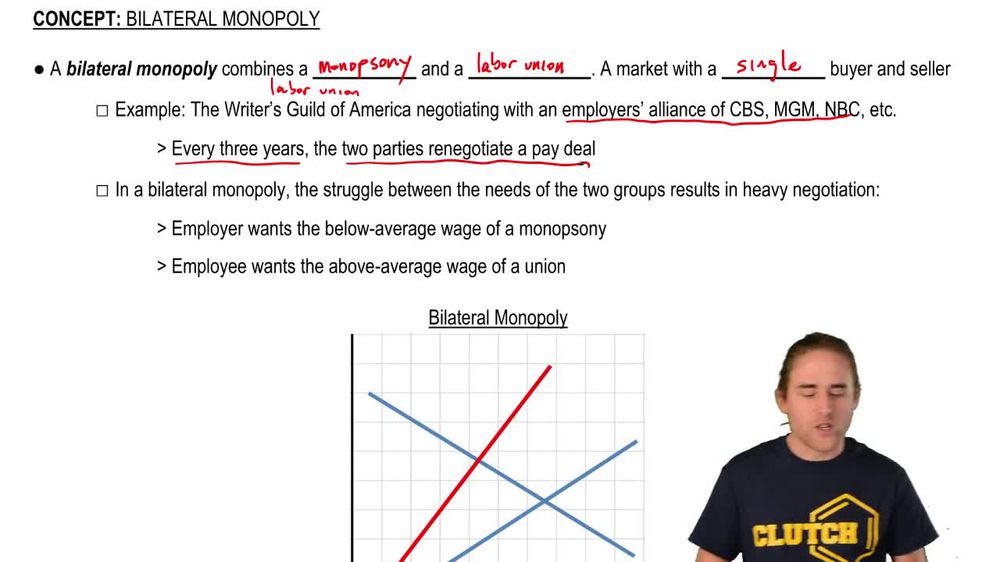
 05:32
05:32