Skip to main content
Macroeconomics
My Course
Learn
Exam Prep
AI Tutor
Study Guides
Flashcards
Explore
Try the app
My Course
Learn
Exam Prep
AI Tutor
Study Guides
Flashcards
Explore
Try the app
Back
Bilateral Monopoly definitions
You can tap to flip the card.
Bilateral Monopoly
You can tap to flip the card.
👆
Bilateral Monopoly
A market structure featuring a single buyer and a single seller, each with significant negotiating power over wages and employment terms.
Track progress
Control buttons has been changed to "navigation" mode.
1/15
Related flashcards
Recommended videos
Bilateral Monopoly quiz
Bilateral Monopoly
15 Terms
Guided course
05:32
Bilateral Monopoly
Terms in this set (15)
Hide definitions
Bilateral Monopoly
A market structure featuring a single buyer and a single seller, each with significant negotiating power over wages and employment terms.
Monopsony
A market condition where only one buyer exists, often seeking to minimize costs by pushing wages below competitive levels.
Labor Union
An organized group representing workers, consolidating labor supply to negotiate collectively for higher wages and better conditions.
Employer Alliance
A coalition of firms acting as a unified buyer, increasing bargaining power against a labor union in wage negotiations.
Negotiation Power
The relative ability of each party in a market to influence wage outcomes and employment terms during bargaining.
Competitive Equilibrium
A wage and employment level where supply and demand balance, often approached when both sides have equal bargaining strength.
High Wage
The upper wage level targeted by a labor union during negotiations, reflecting the union’s goal for above-average compensation.
Low Wage
The lower wage level sought by a monopsony, representing the minimum compensation the buyer aims to pay.
Negotiation Process
The series of discussions and compromises between a single buyer and seller to determine wages and employment terms.
Equilibrium Quantity
The amount of labor exchanged when both parties reach agreement, influenced by their relative bargaining strengths.
Monopoly Power
The leverage held by a single market participant, which can be neutralized when both sides possess similar influence.
Unionized Labor
The collective workforce represented by a labor union, sold as a single entity in negotiations with employers.
Wage Spectrum
The range between the lowest wage desired by the buyer and the highest wage demanded by the seller in negotiations.
Writers Guild of America
An example of a labor union that negotiates collectively with employer alliances for TV writers’ wages and conditions.
Market Outcome
The final wage and employment level resulting from the interplay of bargaining power in a bilateral monopoly.
 BackBack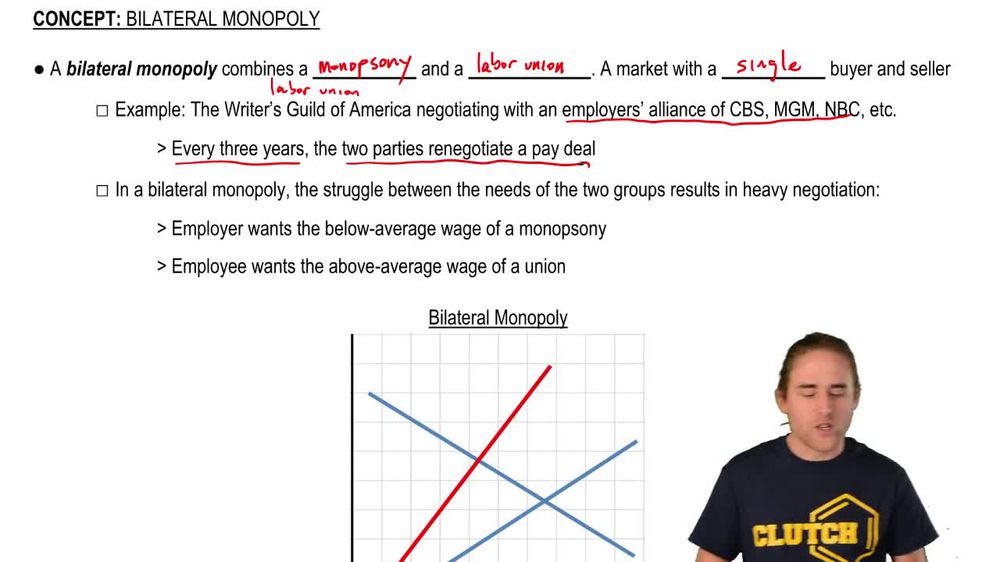
 05:32
05:32